


How I Passed the MRCGP SCA Exam in my first attempt – Dr Melissa Morton
If you are a GP trainee preparing for your MRCGP SCA exam, this blog is a must to help you pass. We are lucky to have Dr Melissa Morton – a GP who recently passed her SCA exam – share her own experience of how she prepared and passed first time.
– Join National SCA WhatsApp Teaching Group here
– Get SCA Updates and Teaching Emails here
– Register for next Free SCA Webinar here
– Pass with SCA Ultimate Package here
Introduction
Preparing for the SCA seemed like a very daunting task in the beginning. Although I was confident seeing patients in my surgery, I was aware that sitting an exam such as this for the first time could be risky. Not many GP registrars had taken the exam and therefore it was not possible to learn much from the previous experience of others. However, due to my CCT date being imminent, I had no option but to go for an early sitting.
I decided to approach the exam by using it as an opportunity to improve my consultation skills and clinical knowledge and focused on the positive aspects of participating in the exam. Unlike previous assessments such as RCA, the SCA seems a more appropriate assessment that could reflect real-life clinical practice.
Having now passed the exam at my first attempt I feel fortunate to be in a position to reflect on how I prepared for the exam – to hopefully help other trainees sitting the SCA in the future. At the outset it does feel like you have a real challenge ahead when you are preparing for the exam – however it is in my view a very fair assessment of a trainee’s ability to consult. For me at least the whole process of preparing for the SCA – through to taking the exam itself – was a positive experience.
To find out more about what the SCA exam is (and how to prepare in general), read our dedicated blog here.
My SCA Preparation
It is important to remember that any GP trainee in primary care – regardless of level of training – has started to prepare for the SCA already, simply by seeing patients. It sounds obvious but a great way to prepare for the exam is to see as many patients as possible in your own clinic. Not only does this expose you to a plethora of scenarios but it helps to build stamina when seeing lots of different cases.
The SCA is a long assessment, comprising 12 scenarios back-to-back with a short 10-minute break in the middle. It can feel like a real challenge at times, and it is so important that you are comfortable seeing lots of patients in your surgery. You need to have the mental endurance to be comfortable going from one scenario to another without being easily fatigued by challenging patients or difficult conversations. Before my exam, I would see a minimum of twenty patients per day (10 in the morning and 10 in the afternoon) and I felt that this prepared me well. In the months leading up to your SCA, it is worth discussing clinic capacity with your educational supervisor and increasing this if appropriate. I would recommend monitoring how long it takes to see each patient as you will only get 12 minutes in the SCA per scenario, and it is vital that you use your time well. As the RCGP have already stated, the exam is marked in three separate domains: data gathering and diagnosis, clinical management and medical complexity and relating to others. When I was practicing for the exam, I noticed that I spent too much time data gathering. It was therefore important for me to work on taking a more focused history and increasing time devoted to clinical management to improve my performance. I assessed this by reflecting on scenarios in my clinics and receiving feedback from colleagues regarding my management of clinical cases.
Ensure that you are familiar with the format of the exam and the curriculum coverage. The RCGP has a lot of useful information on their website regarding the exam and there are some scenarios that you can watch with GP supervisors or other trainees, to ultimately discuss the cases and reflect upon how candidates performed and areas for improvement.
Use your GP colleagues and educational supervisors when possible and ask them to help with your preparation. This can be done in several different ways. I am very fortunate to have an extremely supportive practice and my colleagues would encourage exam practice through joint clinics, workplace-based assessments (COTs/CBDs) and mock consultations. Record yourself interacting with patients and watch the recordings back with a supervisor as part of a tutorial to gain feedback. I was advised to offer video appointments to some of my patients to gain experience in consulting remotely, which reflects the format of the exam. If you work in a practice like mine where long term conditions are primarily managed by the nursing team, ask if you can sit in with the nurses in their clinics.
If you are not already doing on-call days as the duty doctor at your practice, ask if you can have the opportunity to do this. You will often find that the more challenging and unusual cases come through when you are on call. By doing more of these shifts you can become more competent at managing urgent and unscheduled situations which will stand you in good stead for the exam. I have found that some of the most interesting cases that I have seen occur at the end of a long shift as duty doctor. I also found that during my time as duty doctor, I received a variety of calls from other healthcare professionals (such as district nurses, paramedics, social workers, etc.). Through dealing with these requests, you can develop your ability to work with other members of the wider healthcare team to provide efficient patient care. A discussion with a fellow healthcare professional can come up in my exam and it is much easier to work through this kind of scenario if you have experience doing this in your surgery.
If your practice is willing to organise a mock exam take the opportunity to participate in this. My practice organised a mock exam using patients from the PPG as simulated patients. It was a great opportunity to practise in a familiar setting and it was invaluable to get the feedback of the GP partners which made me feel much more confident for the real exam.
The VTS scheme in my area ran SCA preparation afternoons where trainees could opt to do a mock scenario online with feedback from TPDs and communication experts. It is well worth giving this a go if it is an option in your area as you can get specific feedback on your performance which can be hugely helpful and provide tips for self-development. Through these sessions, you also have the opportunity to observe other trainees in their mock scenarios and this can be an educational and supportive experience.
I would advise any trainee preparing for this exam to speak with other trainees in your cluster/VTS group and see who else is preparing for the exam. Establish a small study group if you can and practise scenarios (preferably remotely) to enhance your skills in consulting remotely and to get feedback from one another. Remember that your colleagues in training are the only ones who know exactly how you feel and are facing the same challenges as you. If another trainee in your VTS group has already done the exam ask them if they can give you any advice and perhaps discuss more challenging cases that they encountered.
Arora’s SCA package
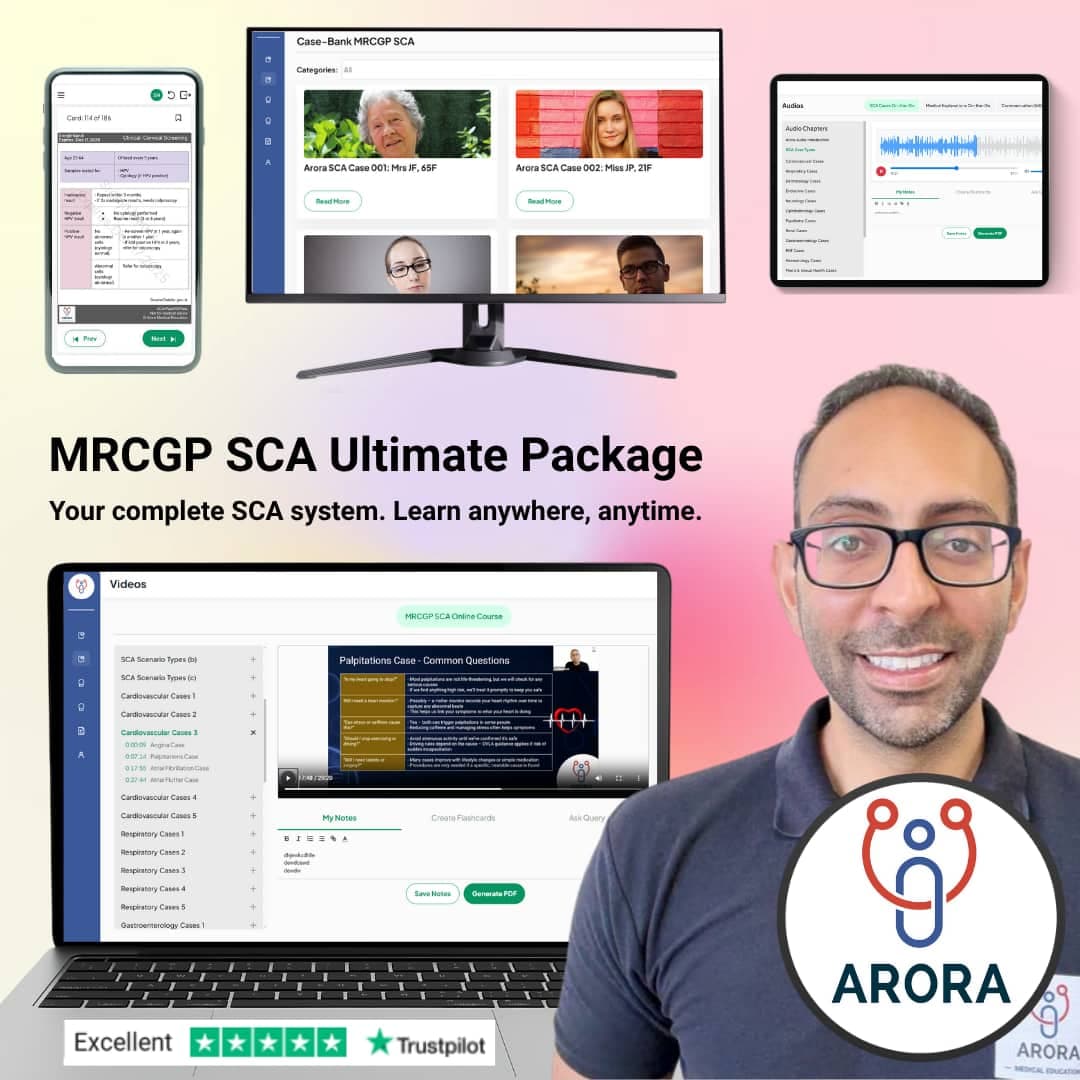
In the latter months leading up to the exam, I decided to look at revision packages that could support me in my SCA preparation. I found the Arora Medical Education website and had a look through the packages available. The reviews of Arora Medical Education were outstanding and I found Dr Arora extremely professional and friendly from the outset. I decided to purchase the SCA Ultimate Package and also took a 1:1 mock exam.
Given that the SCA itself costs well over £1000 to sit, I wanted to give myself the best chance of passing the exam at first sitting and I felt that the revision package would be helpful. It certainly made a difference to my preparation and some of the tips that I picked up from the consultation videos (such as the ‘3 Arora bubbles’ and how to enhance your ability to discuss ideas, concerns and expectations) have influenced my day-to-day practice and improved my communication style.
The SCA mock exam was another fantastic opportunity to practice several different scenarios and receive personal feedback from a GP educator. I found that the explanation of common conditions advice was excellent and highlighted to me the importance of avoiding jargon when possible.
I can’t thank Dr Arora and his team enough for the brilliant revision package and I am certain it helped me in my preparation and in passing the exam. I also know that the tips I picked up from the package have had a positive impact on my consultation style in real practice.
The day of the exam
It is vitally important to perform a walk-through of the SCA online platform before the day of the SCA. Familiarising yourself with the system can reduce unnecessary stress on the day of the exam. It was nice to take the SCA in my room at my surgery and I would therefore recommend doing the same if your practice can facilitate that for you.
Arrive for the exam in plenty of time in case of IT issues and to ensure that you can complete your ID check. It is important that you aren’t disturbed during the exam so disconnecting your landline is necessary and inform your colleagues that you are taking an exam. I made sure my door was locked and that I had a ‘do not disturb’ sign on the door (I was even advised to place a chair outside my door, just in case someone did not see the sign!).
Try to keep calm if there are IT issues and have the number for the IT support team to hand, just in case. I found it helpful to have a whiteboard and pen in the exam to make written notes, plus a large bottle of water. There is an online option using the platform to make notes but I preferred to do it by hand using the whiteboard.
Take your time when reading the patient notes in the 3 minutes of reading time and always remember that you must scroll down to the bottom of the notes provided until it states ‘End of Notes’ (I almost missed some blood test results at the bottom of the page in one of my scenarios). Try to keep calm and view each consultation with a fresh pair of eyes, as if it is the only consultation that you are doing that day. It is easier said than done but it is important not to dwell on a consultation that hasn’t gone as well as you’d hoped.
Remember that the assessors are looking at your performance as a whole, so don’t let one bad consultation throw you off. It is difficult but attempt to focus on the exam as an opportunity to show how far you have come throughout your training and to demonstrate all that you have learned over the last few years.
Some final words
The SCA can seem like an overwhelming challenge when you are in the midst of preparing for it. I would be reassured by the fact that there are many things that you can do to build upon your consultation skills in the months leading up to the exam and you should ask for help from colleagues and other trainees where possible. Try to think of the SCA as a routine clinic and something that you deal with in day to day practice.
In my opinion the SCA scenarios on the whole were fair and felt like consultations that I would deal with in an average day. If your educational supervisor thinks that you are ready to take the exam, be encouraged by that and use your real life consultations as opportunities for learning, reflection and professional development.
I hope that I have been able to pass on at least some advice that may help you in your own preparation for the assessment. Remember to believe in yourself and be confident in your own ability – use the exam to show off all of those excellent skills that you have spent years working on!
How Arora Medical Education Can Support You
Clear Teaching Built for Busy Trainees.
If you want a guided path, our SCA resources help you build confidence at each step. Everything is created by senior UK doctors with experience in the exam and in teaching.
You can choose:
– SCA Ultimate – a full SCA preparation system with case banks, videos, audios, regular live teaching sessions, and flashcards.
– A focused 1-to-1 SCA Mock or Feedback session to work with a senior Arora GP tutor.
– Individual resources such as audios, videos, case banks or mocks.
Each option follows a clear plan that helps you stay organised and focused. Explore these more here.
Also:
– Join National SCA WhatsApp Teaching Group here
– Get SCA Updates and Teaching Emails here.
– Register for next Free SCA Webinar here
Other blogs that may be helpful

SCA Tutor - Dr Aman Arora
Hi! I’m Dr. Aman Arora, a Portfolio GP with over a decade of clinical and teaching experience, dedicated to helping doctors achieve their goals with confidence. Having had the privilege of supporting more than 50,000 doctors worldwide across exams such as MRCGP AKT, SCA, MSRA, PLAB 2 and PLAB 1, I understand the challenges you face and the strategies needed to overcome them. Through personalised face-to-face sessions, engaging online courses, mocks, audio and a vibrant social media community, we’re here to guide you every step of the way.
Whether you’re looking to pass crucial exams or take the next big step in your medical career, we’re here to help you succeed. Feel free to get in touch with any thoughts, questions, or ideas — I look forward to working with you and being part of your journey.

Arora Team - Dr Pooja Arora
Dr Pooja Arora is a GP with a background in Medical Politics, where she passionately focuses on improving the opportunities and working conditions for junior doctors. She is proud to hold FRCGP (Fellow of Royal College of General Practitioners).
You can find out more about Pooja’s previous roles and qualifications here.
Other blogs that may interest you