


Failed MRCGP SCA? Here is how to make sense of it and prepare properly for your re-sit
If you have just found out you did not pass the MRCGP SCA, take a breath before you do anything else.
Most GP trainees describe the same feelings after a failed sitting: shock, frustration, a quiet embarrassment, and a worry that something is fundamentally wrong with their consulting. Almost none of that is accurate. But it feels very real in the days after results, and it is worth acknowledging before moving on to anything practical.
You have not gone backwards. You have sat a specific, technically marked assessment, and on this occasion the standard was not met. That is a different thing from not being a good doctor, or not being suited to general practice.
This blog is written for GP trainees who want to understand what the MRCGP SCA is actually measuring, why capable trainees sometimes fall short of the standard, and how to approach a re-sit with more structure and more confidence than the first time round.
– Join SCA WhatsApp Teaching Group here
– Get SCA Updates and Teaching Emails here
– Register for next Free SCA Webinar here
– Pass with SCA Ultimate Package here
What the SCA is actually assessing
It helps to be precise about this, because a lot of trainees go into the SCA with a slightly inaccurate picture of what is being tested.
The SCA is not a test of how much you know. It is a test of how reliably you can demonstrate safe, patient-centred consulting across a range of case types – under time pressure, with standardised role-players, and in the specific domains the RCGP has defined.
The marking uses Borderline Regression across the whole sitting. There is no fixed pass mark per case. A difficult case does not automatically fail you. What matters is the overall pattern across the assessment – and that is an important thing to hold onto, because it means one or two difficult cases do not define the result.
What your feedback is actually telling you
The feedback statements from the RCGP are not a verdict on your consulting ability. They are markers of what was not demonstrated clearly enough on that sitting.
The RCGP’s own advice is to read the feedback with your trainer, and to use the educational notes linked to each feedback statement to understand what the assessors were looking for and how to show it more clearly. That is the right starting point, and it matters because the most direct route to a pass is not doing more cases. It is understanding the specific gaps the feedback is pointing at and making targeted changes.
Most trainees who fail the SCA fall short in one or two areas rather than across the board. The most common themes are data gathering that is thorough but loses clarity and direction, management plans that are clinically reasonable but not specific enough to this patient’s context and concern, and a consulting style where the relationship component is present but not consistently demonstrated. Your feedback will tell you which of these applies to you.
The first 72 hours
Right after results, resist the urge to either book immediately or avoid everything for weeks. Both are understandable, but neither is the most useful response.
A simple approach is to give yourself a day or two, then do two things: read the feedback once, without trying to analyse it in full, and arrange a short debrief with your trainer or educational supervisor within the week. That combination gives you enough distance from the emotion to think clearly, while keeping enough momentum to avoid losing weeks.
Turning feedback into a preparation plan
Once you are ready to work, the most useful question to ask about each feedback statement is not “what does this mean about me” but “what would someone watching the consultation have needed to see or hear instead?”
That shift – from feedback as a reflection on you to feedback as a description of a behaviour – is where most good re-sit preparation starts. It stops you changing everything, and stops you guessing.
Pick one primary area to focus on first. You will still work on the others, but having a clear centre of gravity in your practice sessions makes improvement more measurable and more sustainable.
Deliberate practice rather than volume
After a fail, a common instinct is to do as many mock consultations as possible. Volume has some value, but if the underlying habits are not changing, high volume can just reinforce what you already do.
A more effective approach is to practise fewer cases, but more carefully. Do a case, identify the one or two minutes where the pattern went wrong, and repeat the same case immediately with a specific change in mind. That kind of deliberate repetition builds new defaults faster than moving on to a new case each time.
If time pressure was part of the problem
Many trainees who struggle with the SCA report that time ran out before they reached a clear plan. The fix is almost never to speak faster. It is to change the structure of the consultation earlier.
A useful frame for practice is to ask: by the midpoint of the case, do I know what I am dealing with and what this patient is most concerned about? If the answer is no, the issue is usually in the data-gathering phase – not in how quickly you are working, but in what you are prioritising. The SCA rewards a consultation that moves from clear data gathering to a shared, specific plan. If the emphasis is too heavily on history-taking, the management section suffers.
Re-sit timing
There is no universally right answer on when to re-sit. The RCGP advises discussing the timing with your trainer based on your feedback and how much further preparation is likely to be needed.
A rough way to think about it: if your feedback suggests the issue is mainly about clarity and demonstration – showing what you can already do more reliably – an earlier sitting may be appropriate. If the feedback suggests repeated omissions, weak management structure or difficulty under pressure, giving yourself more preparation time is usually the better decision. The aim is for your next sitting to feel genuinely different, not just sooner.
Preparing your mindset, not just your technique
One thing that is often underestimated after a failed sitting is the effect on confidence. Most trainees who re-sit do not lack ability. What they sometimes lack is trust in their own consulting under pressure.
Rebuilding that trust takes practice that is done carefully rather than anxiously. Practicing back-to-back cases builds resilience. Rehearsing a simple reset between cases – a breath, a moment of stillness, a single focus word – trains you to recover when a case goes badly. And spending time deliberately on the opening of a consultation, because the first thirty seconds tend to set the tone for everything that follows.
How Arora Medical Education can help
If you want structured support for your MRCGP SCA re-sit, our SCA packages are built around both consulting technique and knowledge, with a focus on the specific patterns the SCA rewards.
Everything is created by senior UK GPs and educators with experience in the exam and in teaching.
You can choose:
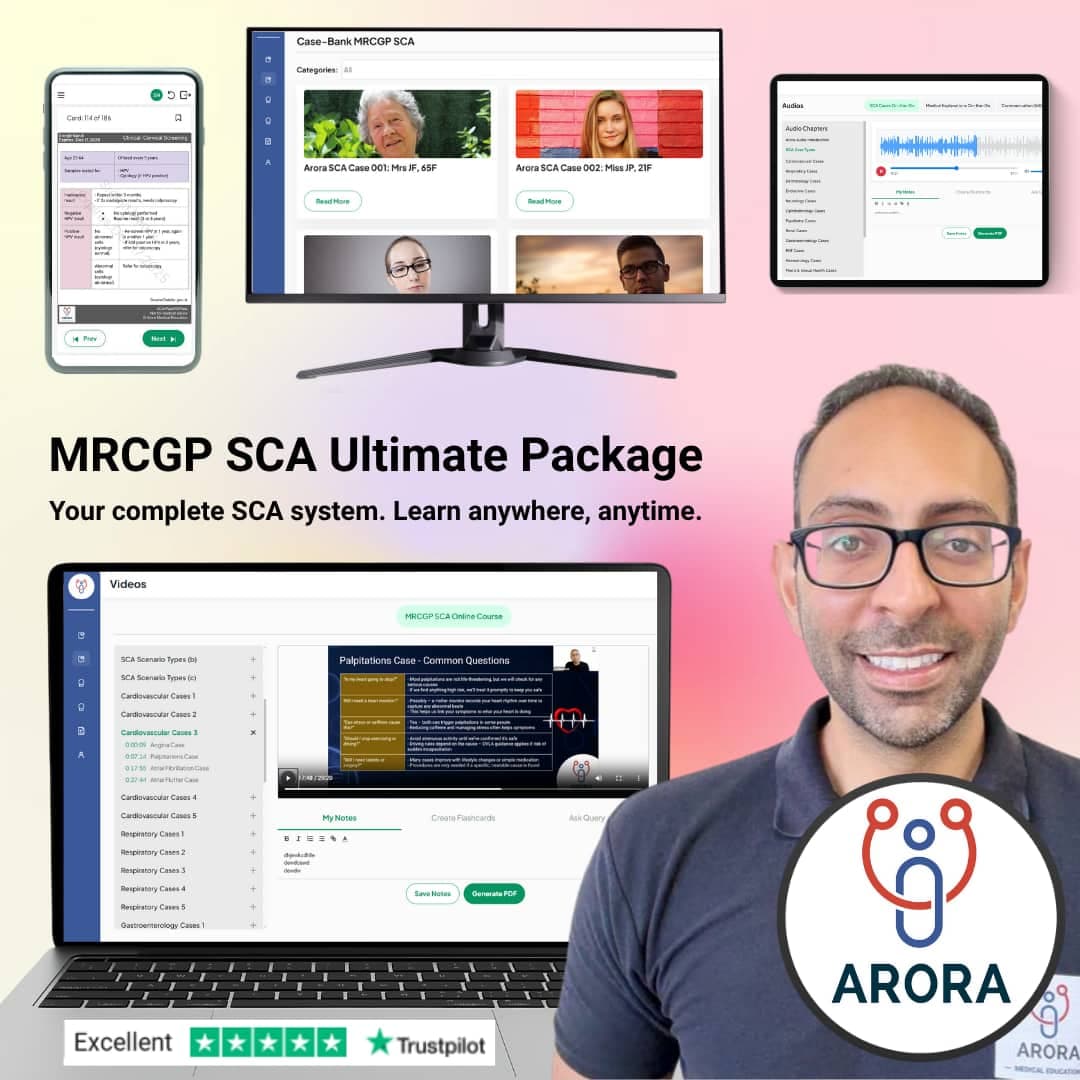
– SCA Ultimate – a full SCA preparation system with case banks, videos, audios, regular live teaching sessions, and flashcards.
– A focused 1-to-1 SCA Mock or Feedback session to work with a senior Arora GP tutor.
– Individual resources such as audios, videos, case banks or mocks.
Each option follows a clear plan that helps you stay organised and focused. Explore these more here.
Also:
– Join SCA WhatsApp Teaching Group here
– Get SCA Updates and Teaching Emails here
– Register for next Free SCA Webinar here
Final thoughts
Failing MRCGP SCA does not mean your consulting is poor. It means that on this occasion, the assessment did not see enough of what it needed to see. That is a correctable problem.
The trainees who go on to pass at re-sit are not usually those who worked the hardest in the weeks before. They are the ones who understood their feedback clearly, made specific and targeted changes, and practised with intention rather than anxiety.
You can do the same.
#CanPassWillPass

Dr Aman Arora - Lead SCA Tutor
Hi! I’m Dr. Aman Arora, a Portfolio GP with over a decade of clinical and teaching experience, dedicated to helping doctors achieve their goals with confidence. Having had the privilege of supporting more than 50,000 doctors worldwide across exams such as MRCGP AKT, SCA, MSRA, PLAB 2 and PLAB 1, I understand the challenges you face and the strategies needed to overcome them. Through personalised face-to-face sessions, engaging online courses, mocks, audio and a vibrant social media community, we’re here to guide you every step of the way.
Whether you’re looking to pass crucial exams or take the next big step in your medical career, we’re here to help you succeed. Feel free to get in touch with any thoughts, questions, or ideas — I look forward to working with you and being part of your journey.

Dr Pooja Arora - Senior SCA Tutor
Dr Pooja Arora is a GP with a background in Medical Politics, where she passionately focuses on improving the opportunities and working conditions for junior doctors. She is proud to hold FRCGP (Fellow of Royal College of General Practitioners).
You can find out more about Pooja’s previous roles and qualifications here.
Other blogs that may interest you