


10 Things That Gain Marks in MRCGP SCA
The MRCGP SCA is one of the three components of the MRCGP, alongside the AKT and workplace based assessment. For many trainees, it is also the most unfamiliar.
Because the SCA is still relatively new, it creates uncertainty. That uncertainty often shows up as nerves. I see this repeatedly in trainees who are clinically strong but underperform on the day. Not because they lack skill, but because anxiety pushes them away from their natural consultation style. Many fall into rigid scripts or forced phrases that do not reflect how they normally work with patients.
The SCA does not reward acting. It rewards clear thinking, safe decision making and structured communication under pressure. When nerves take over, those strengths can disappear.
This guide shares ten practical tips that are often missed in standard revision advice. Each one links directly to what examiners look for, how real candidates lose marks and what you can do differently in your preparation and on the day. These principles form the backbone of how we train doctors in our SCA courses and mock exams.
Before we get started...
To find out more about what the SCA exam is (and how to prepare in general), read our dedicated blog here.
– Join National SCA WhatsApp Teaching Group here
– Get SCA Updates and Teaching Emails here
– Register for next Free SCA Webinar here
– Pass with SCA Ultimate Package here
1) Trust the doctor that you already are
One of the most common reasons trainees struggle in the SCA is trying to become someone else. This shows up clearly in role play. Over rehearsed lines. Forced empathy. Responses shaped by rumours rather than real clinical thinking.
When asked why this happens, most trainees give the same answer. They believe this is what examiners want to hear.
You did not reach the SCA by accident. You reached it because you are already a safe and capable doctor. You have managed hundreds of real consultations. You have dealt with uncertainty, emotion and risk in everyday practice. That experience still matters.
The SCA is not about starting from zero. It is about refining what you already do. You may need to be clearer in your structure, explain your reasoning more openly or strengthen your safety netting. But your core consultation style should remain your own.
What you can do in practice:
– Record practice consultations and notice how you naturally open, listen and close
– Identify two or three habits that already work well and keep them
– Avoid memorised scripts that feel unnatural when spoken
– Ask for feedback on clarity and safety rather than performance
Most trainees already have the majority of what they need. Trust your foundation and build on it.
2) Don’t become ‘robotic’
Relying on memorised question lists often leads to stiff and unnatural consultations. In the worst cases, it stops you from noticing key issues as they emerge. I see this often in practice sessions. The trainee knows what they plan to say, but they stop listening to what the patient is actually telling them.
The SCA tests your ability to manage a full twelve minute consultation. You cannot memorise that. Trying to do so usually increases anxiety and makes adaptation harder. When something unexpected comes up, panic follows because the script no longer fits.
It is useful to revise common presentations and think through likely approaches. That part matters. But these should act as loose frameworks rather than fixed pathways. You need room to respond to what unfolds in front of you.
What you can do in practice:
– Learn structures, not sentences
– Practice identifying the main problem early and adjusting your focus as new information appears
– In role play, pause and respond to what the patient just said rather than moving to the next planned question
– Practice cases where the agenda changes part way through the consultation
There is no single correct consultation model in General Practice. Real consultations are unpredictable and layered. The SCA reflects this. Staying flexible and engaged helps you score higher than sticking rigidly to a script.
For an ideal approach to data gathering, watch this short video.
3) Always show RELEVANCE
Data gathering in the SCA is not about asking as many questions as possible. It is about showing why each question matters. Examiners are not only listening to what you ask. They are listening to how and why you ask it.
Most doctors will ask similar core questions by the end of a consultation. What separates stronger candidates is relevance. Two doctors can ask about smoking, alcohol or stress. One sounds forced. The other sounds natural. The difference is whether the question is clearly linked to the patient’s problem.
When questions feel disconnected, consultations start to sound like checklists. When questions are linked back to the symptom, the consultation feels focused and clinically grounded.
For example, saying:
“Slightly odd question Mrs X. Sometimes indigestion can be made worse by habits like smoking. Can I check if you smoke at all?”
lands very differently from:
“Can I ask if you smoke?”
The first shows purpose. The second sounds routine.
What you can do in practice:
– Before asking a question, link it to the symptom or concern
– Use brief signposting to explain why you are asking
– Keep bringing the problem back into the conversation during data gathering
– In role play, ask your observer whether your questions sounded connected or generic
Showing relevance helps examiners follow your thinking. It also reassures patients and keeps consultations flowing. In the SCA, relevance turns ordinary questions into high scoring ones.
Relevance is one of the 3 ‘Arora R’s of Interpersonal’ – for more details watch this short video.
4) Don’t forget the medicine
The SCA is a communication exam, but it is not only a communication exam. At its core, it tests whether you can apply clinical knowledge safely in General Practice. Many trainees focus so hard on how they sound that they lose sight of what they are actually doing clinically.
Good structure and empathy matter, but they do not replace sound medical judgement. Examiners want to see that you can recognise risk, make safe decisions and manage uncertainty in real time.
The RCGP is clear about what the SCA assesses. You must show that:
– Patients are kept safe
– You can adapt to different patients and presentations
– You can manage risk, complexity and uncertainty
– Your attitudes and decisions reflect professional GP behaviour
This means your medicine has to be right. You need to know red flags. You need to know when to reassure and when not to. You need to know first line treatments, safety netting and when to escalate.
What you can do in practice:
– Revise common GP guidelines alongside case practice
– For each case, ask yourself what would make this unsafe if missed
– Practice saying your clinical reasoning out loud
– Build a habit of summarising risk and next steps clearly at the end
After this exam, you will work as an independent GP. The SCA reflects that responsibility. Strong communication supports good medicine, but it cannot replace it.
5) Reflect and acknowledge
Reflection and acknowledgement sit at the heart of good GP consultations. In the SCA, they are also easy marks to miss. Picking up cues is not enough. You must show that you have noticed them.
Simple reflections such as “I can see this is worrying you” or “You look uncomfortable talking about this” do two things. They confirm that you have understood the patient’s emotional state. They also build rapport and trust, which helps the consultation move forward.
Problems arise when something important is said and not acknowledged. A patient may mention fear of cancer, pressure at work or embarrassment about symptoms. If this passes without reflection, the consultation can feel doctor centred and disconnected. Examiners notice this gap.
Reflection does not need to be long or dramatic. A brief, timely response is usually enough to show awareness and empathy.
What you can do in practice:
– Listen for emotional words and changes in tone
– Reflect concerns as soon as they appear, not at the end
– Keep reflections short and genuine
– After reflecting, pause and allow the patient to continue
When you build reflection into your habit, consultations feel smoother and more natural. Patients open up more easily and your clinical work becomes clearer. In the SCA, this often separates average consultations from strong ones.
6) Organise EARLY in management
The first minute of management matters more than most trainees realise. It signals the shift from listening to leading. Examiners use this moment to judge whether you truly understand the case.
That first minute sets the direction for everything that follows. Use it to show that you have understood not just the condition, but the situation. The patient’s concerns, risks, context and priorities should all come together here.
Strong candidates summarise the problem clearly before jumping into solutions. They show that their data gathering had purpose. Weak candidates rush into advice without organising their thoughts or explaining their reasoning.
Early organisation helps examiners follow your thinking. It also reassures the patient that you are in control of the consultation.
What you can do in practice:
– Start management with a brief summary of the key issues
– Name the main problem, risks and patient concerns together
– Explain what you think is going on before offering options
– Use phrases that show structure, such as “There are a few things we need to think about”
Putting the issues on the table early creates a clear framework for the rest of management. This is a core skill we focus on in our SCA teaching and mock exams. When done well, it lifts the whole consultation and makes your decisions easier to justify.
This video covers the ‘Arora Golden 1st Minute of Management’ in more detail.
7) Don’t put everything on finishing the case
One of the biggest traps in the SCA is trying to solve every problem fully within twelve minutes. That is not what the exam expects. Real GP consultations often involve ongoing management, follow up and shared plans over time.
Some SCA cases are deliberately complex. They include multiple medical, psychosocial and ethical issues. Examiners are not looking for you to tie every thread neatly. They are looking for whether you understand what matters and whether you can move the situation forward safely.
By the end of the consultation, you should be able to show two things. First, that you have identified the key issues. This includes medical risk, patient concerns, social context and uncertainty. Second, that you have a safe and sensible plan to take things forward in line with current guidance.
Trying to finish everything often leads to rushed explanations, missed safety netting or unclear priorities. These cost more marks than leaving some elements for follow up.
What you can do in practice:
– Identify the main problem and any immediate risks early
– Be clear about what needs action now and what can wait
– Use follow up plans to manage complexity safely
– Say out loud when an issue needs review rather than full resolution today
The SCA rewards safe progression, not perfection. Showing that you can manage complexity over time is a core GP skill and a strong signal to examiners.
8) Let the role-player help if they can
In the SCA, it is easy to treat the role player as a barrier between you and the examiner. You speak to the patient, but your words are aimed elsewhere. When this happens, listening often drops.
Role players know the case well. They understand the key issues, the cues that matter and the areas the case is designed to test. When you respond to those cues, they often guide you naturally toward what needs further exploration. When something is less relevant, they may subtly move you away from it.
Problems arise when trainees become fixed on their own plan. They decide early what the case is about and stop adapting. Important hints are missed. Emotional cues go unacknowledged. Opportunities to score marks pass quietly.
Strong candidates stay responsive. They allow the consultation to unfold rather than forcing it down a preset path.
What you can do in practice:
– Treat every role play as a real consultation, not a performance
– Listen for changes in tone, emphasis or emotion
– Follow cues that are repeated or emotionally charged
– Be willing to change direction if new information appears
The role player is not there to catch you out. They are there to bring the case to life. When you listen properly, they often help you show your strengths more clearly.
9) Challenge each other
Practice sessions with friends often feel comfortable. That can be helpful at first, but it can quickly limit progress. Friendly role players give information too easily. Emotional cues feel softened. Feedback becomes overly reassuring. None of this reflects the exam.
The SCA is demanding. Your practice needs to be harder than the exam, not easier. If role play feels relaxed and predictable, you are not stretching the skills that matter under pressure.
Good practice includes realism. Role players should stay in character. Emotion should feel believable. Information should not be handed over without being earned. Feedback should be honest and specific.
What you can do in practice:
– Ask role players to commit fully to the case and emotion
– Avoid breaking character, even when it feels awkward
– Give feedback on clarity, safety and structure, not just reassurance
– Rotate who plays examiner and focus on missed opportunities
– Set time limits and stick to them
Treat practice time as valuable. When sessions feel challenging, the exam often feels more manageable. Aim for the SCA to feel like a step down from practice, not a step up.
Read this blog for more tips for practicing with friends and colleagues.
10) Know you’re going to pass
Nerves are normal before the SCA. What holds trainees back is not anxiety itself, but the story they tell themselves alongside it. Many say things like “I will never pass” or “I cannot cover all of this”. Repeating these thoughts quietly undermines preparation.
Confidence does not mean ignoring gaps or hoping for the best. It means trusting that your preparation has value and that you are capable of performing under pressure. You would not be at this stage if you did not already have the core skills needed to pass.
The SCA reflects work you have been doing for years. Every clinic, on call and difficult consultation has been part of that preparation. When trainees believe they belong in the exam, it shows in their decision making, communication and calmness.
What you can do in practice:
– Replace negative self talk with neutral or factual statements
– Remind yourself regularly of what you already manage safely in real clinics
– Keep a short list of strengths you see in your practice sessions
– Visualise finishing cases calmly rather than perfectly
– Treat nerves as a sign that the exam matters, not that you are failing
This is a demanding exam, but it is one you are ready for. When belief matches preparation, performance improves. Go into the SCA expecting to pass and allow your training to show.
How Arora Medical Education Can Support You
Clear Teaching Built for Busy Trainees.
If you want a guided path, our SCA resources help you build confidence at each step. Everything is created by senior UK doctors with experience in the exam and in teaching.
You can choose:
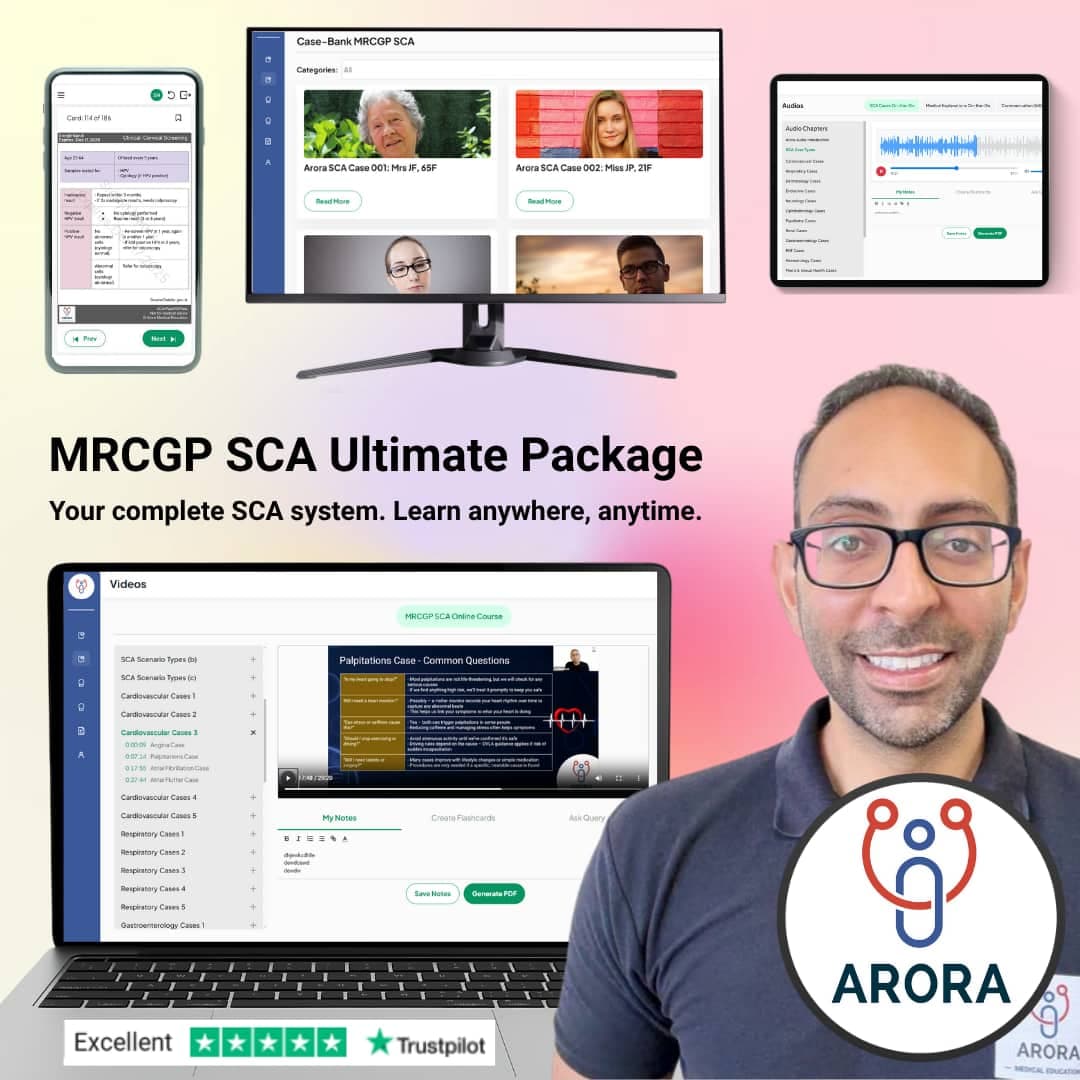
– SCA Ultimate – a full SCA preparation system with case banks, videos, audios, regular live teaching sessions, and flashcards.
– A focused 1-to-1 SCA Mock or Feedback session to work with a senior Arora GP tutor.
– Individual resources such as audios, videos, case banks or mocks.
Each option follows a clear plan that helps you stay organised and focused. Explore these more here.
Also:
– Join National SCA WhatsApp Teaching Group here
– Get SCA Updates and Teaching Emails here.
– Register for next Free SCA Webinar here
And on a Final Note…
SCA preparation is important. It is not just about reviewing day-to-day patients, doing multiple practice role-plays and reading multiple notes for months on end.
Figuring out your strengths and weaknesses early, understanding what is being assessed and tackling your preparation in an organised way are keys to success.
I look forward to meeting you soon and good luck with preparation!
#CanPassWillPass
Other blogs that may be helpful

Author Bio - Dr Aman Arora
Hi! I’m Dr. Aman Arora, a Portfolio GP with over a decade of clinical and teaching experience, dedicated to helping doctors achieve their goals with confidence. Having had the privilege of supporting more than 50,000 doctors worldwide across exams such as MRCGP AKT, SCA, MSRA, PLAB 2 and PLAB 1, I understand the challenges you face and the strategies needed to overcome them. Through personalised face-to-face sessions, engaging online courses, mocks, audio and a vibrant social media community, we’re here to guide you every step of the way.
Whether you’re looking to pass crucial exams or take the next big step in your medical career, we’re here to help you succeed. Feel free to get in touch with any thoughts, questions, or ideas — I look forward to working with you and being part of your journey.

Senior SCA Tutor - Dr Pooja Arora
Dr Pooja Arora is a GP with a background in Medical Politics, where she passionately focuses on improving the opportunities and working conditions for junior doctors. She is proud to hold FRCGP (Fellow of Royal College of General Practitioners).
You can find out more about Pooja’s previous roles and qualifications here.
Other blogs that may interest you