


5 Ways to Make Your MRCGP SCA Study Group Practice Work
The SCA, or Simulated Consultation Assessment, is one of the three components of the MRCGP, alongside the AKT and WBPA. For many GP trainees, it is also the exam that generates the most uncertainty.
If you are reading this, you have likely already started preparing for the SCA and practicing with study partners. Increasingly, this practice takes place online rather than face to face, reflecting busy rotas, geography and limited time. Study group practice can be extremely effective when done well. It can build confidence, improve structure and sharpen decision making. When done poorly, it can reinforce bad habits, create false reassurance and waste valuable preparation time.
The difference is not how often you practice, but how you practice.
This blog focuses on five practical ways to maximise your SCA practice sessions with friends and colleagues. The aim is to help you make each session purposeful, whether you practice online or in person, so your preparation leads to real improvement rather than just activity.
– Join National SCA WhatsApp Teaching Group here
– Get SCA Updates and Teaching Emails here
– Register for next Free SCA Webinar here
– Pass with SCA Ultimate Package here
Record Your Practice Cases
Recording your practice consultations and watching them back is one of the most effective ways to improve for the SCA. Many trainees are surprised by what they notice when they see themselves on screen.
You may think you explain things clearly, but do you actually do so under pressure? Do you interrupt more than you realise? Do you miss cues, rush management or rely on filler phrases? These are hard to spot in the moment but obvious on playback.
Whether you practise online or face to face, record your cases whenever possible, with consent from your study partner. After the session, watch the consultation back in full. Pay attention to how you open the consultation, how clearly you structure management and how you respond to emotion.
Your SCA performance mode is often different from how you consult in real clinics. The exam environment changes pacing, tone and clarity. Watching yourself in this context highlights habits you may not otherwise notice.
What you can do in practice:
– Record full cases rather than short clips
– Watch without multitasking and take brief notes
– Identify two strengths and two areas to improve per case
– Focus on clarity, structure and missed cues rather than perfection
Feedback from others is helpful, but it is never complete. Recording and reviewing your own consultations consistently leads to faster and more reliable improvement, and makes every study group session more productive.
Critically Self Reflect
Many trainees judge the success of a study group session by how many cases they complete. Case numbers matter, but they are not what drives improvement. The biggest gains usually happen after the session, once the pressure to move straight onto the next case is gone.
Do not switch off as soon as the role play ends. Take time later to revisit the cases you did yourself. A consultation can feel smooth in the moment, yet still contain missed red flags, unexplored impact on work or rushed management.
This is where honest self critique becomes valuable. Ask yourself what actually happened, not what you meant to do. Did I include all 3 Arora Bubbles of Data Gathering? Have I actually asked all the red flags that I could have? Did I know what the guy did at work or find out if his symptoms affected it? Did I actually come back to the alcohol like I said I was going to? Could I have involved him in the second half, or did I completely take over the consultation for 4 minutes? Did I use the Arora 3 Steps of Management properly?
This kind of reflection works best when you are on your own and not under pressure to perform. It allows you to spot your personal patterns rather than generic mistakes.
What you can do in practice:
– After each session, review your own cases before switching off
– Choose one or two cases and analyse them in detail
– Ask yourself what you missed, what you rushed and what you avoided
– Link feedback to your usual structure for data gathering and management
This is where practice turns into progress and where real improvement for the SCA begins.
Practice Back to Back
Practicing single cases in isolation does not prepare you for the emotional reality of the SCA. In the exam, cases come one after another, with no pause to reset. How you handle one case directly affects the next.
A very common pattern after the exam is this. “The first case went badly and it affected everything that followed.” This usually happens because trainees have not practiced recovering from a difficult case.
Moving on is not automatic. It is a skill that needs rehearsal. Simply telling yourself to forget the last case does not work if you have never practiced doing it under pressure.
Back to back practice exposes this early. It helps you notice how long you carry frustration, self doubt or disappointment into the next consultation, and it gives you the chance to work on resetting quickly.
What you can do in practice:
– Practice at least two cases in a row before stopping to discuss
– Avoid immediate feedback between back to back cases
– Notice how the first case affects your opening and focus in the second
– Develop a simple reset routine between cases, such as a pause or breath
The ability to move on is a quiet but critical exam skill. Practising cases back to back is how you train it rather than hoping it appears on the day.
You get to practice back to back cases in exam condition in our Mock SCA sessions.
Be Challenging When Acting
Many study group sessions feel comfortable. Role players are friendly, information is given easily and feedback focuses mainly on clinical decisions. This can feel reassuring, but it does not reflect the reality of the SCA.
In the exam, challenges are rarely limited to medicine alone. Candidates are tested on emotion, communication difficulty, uncertainty and complexity. If you only practice straightforward or cooperative scenarios, these elements can feel unfamiliar on the day.
Another common gap is feedback. Groups often focus on whether the right drug was prescribed or the correct referral made. These matter, but they are not the whole exam. Areas such as ICE, shared decision making, practical advice and impact on work or family are just as important and are often where marks are gained or lost.
When acting as the patient, your role is not to help your friend pass the case. It is to recreate the challenge realistically.
What you can do in practice:
– Build emotion into role play, such as frustration, anxiety or embarrassment
– Avoid giving information too easily or too early
– Include communication barriers or competing concerns
– After each case, discuss non clinical areas as deliberately as clinical ones
The more challenging your practice feels, the more prepared you will be. Well designed difficulty in practice makes the exam feel manageable rather than overwhelming. You will find plenty of challenging cases to practice in our SCA Case Bank.
Repeat Sections of a Case
Feedback in study groups often falls into two traps. It becomes overly critical, and it stays theoretical. Long lists of “you should have” or “you missed” rarely change how you perform next time. They create awareness, but not improvement.
Talking about what went wrong is not the same as fixing it. Real improvement comes from doing, not discussing.
One of the most effective ways to improve is to repeat specific sections of a case straight away. This could be the opening minute, the explanation of a diagnosis, or the first part of management. Repeating a short section for twenty seconds allows you to apply feedback immediately, while it is still fresh.
This turns feedback into action and builds muscle memory, which is exactly what the SCA rewards.
What you can do in practice:
– Pause the case and repeat a specific section rather than restarting everything
– Re practise the opening minute or management summary after feedback
– Focus on clarity and structure rather than wording
– Keep repeats short and targeted
Repeating sections embeds improvement far more effectively than discussion alone. It is one of the fastest ways to turn practice time into better exam performance.
Our SCA Packages cover teaching and resources on all aspects of the GP consultation.
In Summary...
To get real value from SCA study group practice, focus on quality rather than volume.
– Record your own cases and watch them back honestly
– Critically reflect on your performance after each session
– Practice back to back cases to build recovery and resilience
– Challenge each other realistically when acting as the patient
– Repeat key sections of cases to turn feedback into improvement
When practice is structured this way, confidence grows for the right reasons and performance improves where it matters most in the exam.
How Arora Medical Education Can Support You
Clear Teaching Built for Busy Trainees.
If you want a guided path, our SCA resources help you build confidence at each step. Everything is created by senior UK doctors with experience in the exam and in teaching.
You can choose:
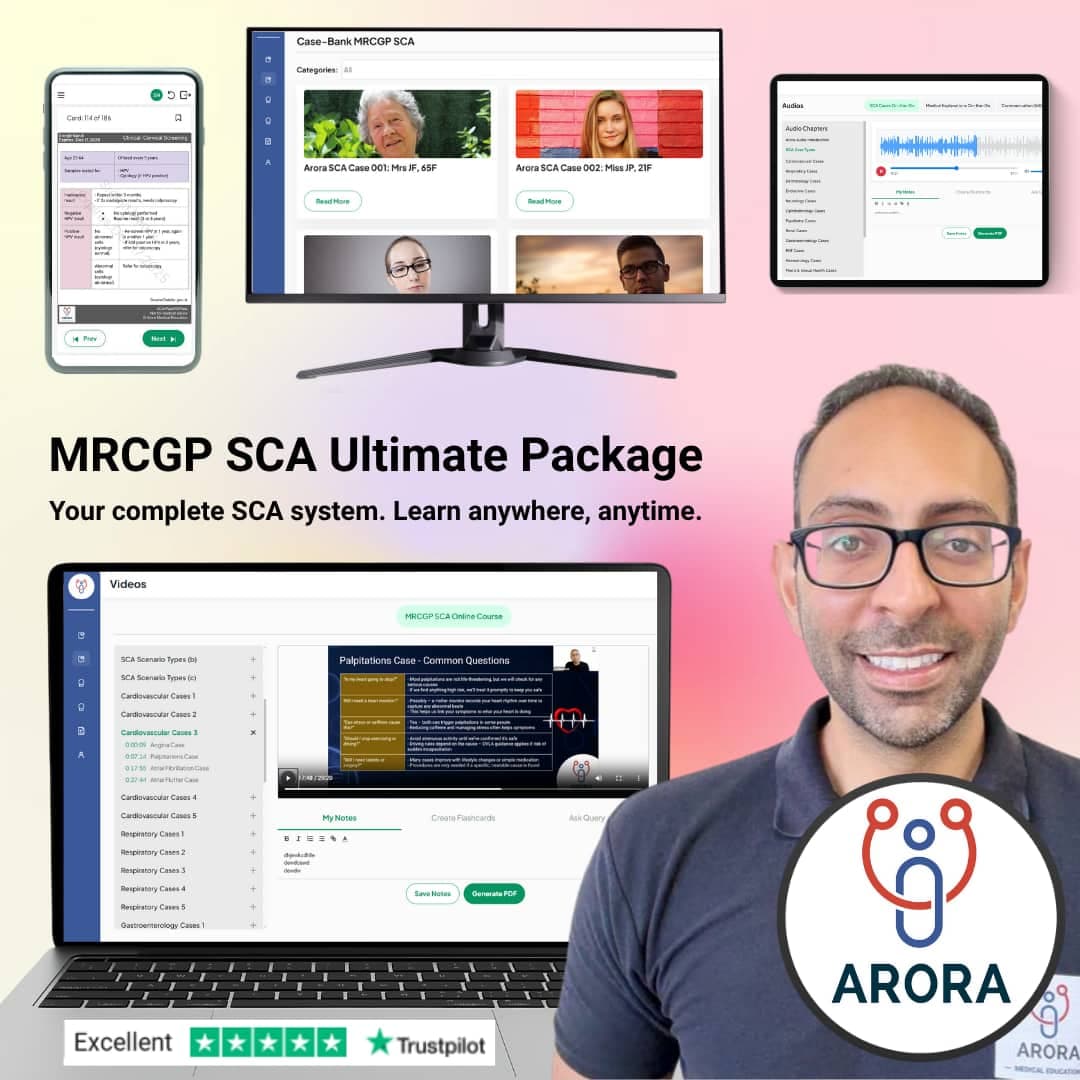
– SCA Ultimate – a full SCA preparation system with case banks, videos, audios, regular live teaching sessions, and flashcards.
– A focused 1-to-1 SCA Mock or Feedback session to work with a senior Arora GP tutor.
– Individual resources such as audios, videos, case banks or mocks.
Each option follows a clear plan that helps you stay organised and focused. Explore these more here.
Also:
– Join National SCA WhatsApp Teaching Group here
– Get SCA Updates and Teaching Emails here.
– Register for next Free SCA Webinar here
On a final positive note
You will pass the SCA if your practice is efficient and purposeful. Like any assessment, success comes from planning well, practicing deliberately and maintaining a steady, realistic mindset.
When your preparation is structured and your practice sessions are productive, confidence builds naturally. By the time you enter the exam, even in a virtual setting, the format feels familiar rather than intimidating.
Good luck with your preparation.
#CanPassWillPass

Author Bio - Dr Aman Arora
Hi! I’m Dr. Aman Arora, a Portfolio GP with over a decade of clinical and teaching experience, dedicated to helping doctors achieve their goals with confidence. Having had the privilege of supporting more than 50,000 doctors worldwide across exams such as MRCGP AKT, SCA, MSRA, PLAB 2 and PLAB 1, I understand the challenges you face and the strategies needed to overcome them. Through personalised face-to-face sessions, engaging online courses, mocks, audio and a vibrant social media community, we’re here to guide you every step of the way.
Whether you’re looking to pass crucial exams or take the next big step in your medical career, we’re here to help you succeed. Feel free to get in touch with any thoughts, questions, or ideas — I look forward to working with you and being part of your journey.

Author Bio — Dr Pooja Arora
Dr Pooja Arora is a GP with a background in Medical Politics, where she passionately focuses on improving the opportunities and working conditions for junior doctors. She is proud to hold FRCGP (Fellow of Royal College of General Practitioners).
You can find out more about Pooja’s previous roles and qualifications here.
Other blogs that may interest you