


The MRCGP SCA (Simulated Consultation Assessment): What it is and how to Prepare
If you are an ST2 or ST3 GP trainee preparing for the MRCGP SCA (Simulated Consultation Assessment), this guide is for you.
The SCA is often seen as the most unpredictable part of MRCGP. Not because the medicine is difficult, but because candidates are unsure what the exam is really assessing and how to demonstrate it consistently in a 12-minute consultation.
This blog explains what the MRCGP SCA involves, how it is assessed and how to prepare in a focused, practical way. It is written specifically for GP trainees who want clarity, structure and a reliable approach to passing first time.
– Join National SCA WhatsApp Teaching Group here
– Get SCA Updates and Teaching Emails here
– Register for next Free SCA Webinar here
– Pass with SCA Ultimate Package here
What is the MRCGP SCA?
The MRCGP SCA (Simulated Consultation Assessment) is the RCGP’s permanent clinical exam and has replaced both the CSA (Clinical Skills Assessment) and the RCA (Recorded Consultation Assessment).
For most trainees, it is the final exam required to complete GP training, alongside the AKT and WBPA.
The SCA is a live, virtual OSCE-style exam. You take part in a series of simulated GP consultations with role-players, observed and assessed by trained examiners. Each case is designed to reflect real UK general practice, not artificial exam scenarios.
The exam assesses how you work as an independent GP across broad areas such as:
– Clinical decision-making
– Communication and interpersonal skills
– Professional judgement and safety
Importantly, the SCA is not a test of scripts or rehearsed answers. It assesses whether you can consult safely, structure a case clearly and adapt to uncertainty, just as you would in day-to-day NHS general practice.
Brief Background to MRCGP SCA
Before March 2020, the Clinical Skills Assessment (CSA) was the final clinical exam for MRCGP. It was a face-to-face OSCE-style exam held at the RCGP centre in London. Trainees completed 13 ten-minute simulated consultations with trained role players, under direct examiner observation.
In March 2020, the CSA was suspended due to the COVID-19 pandemic. The Recorded Consultation Assessment (RCA) was introduced as a temporary replacement. Instead of simulated cases, trainees submitted 13 recorded real-life GP consultations from their ST3 practice. These were reviewed and marked remotely by RCGP assessors. While necessary at the time, the RCA created challenges around case selection, consistency and standardisation.
From November 2023 onwards, the RCGP introduced the Simulated Consultation Assessment (SCA) as the permanent replacement. The SCA returns to a live assessment format, using simulated consultations, but is delivered virtually rather than in person. This allows the RCGP to assess candidates in a consistent, standardised way, while reflecting modern consultation styles used in UK General Practice.
The SCA now represents the definitive clinical assessment component of MRCGP, alongside AKT and WPBA, and is designed to test whether you are safe, effective and ready to practise independently as a GP in the UK.
What is the format of the MRCGP SCA?
The MRCGP SCA is delivered virtually via an online exam platform. Candidates usually sit the exam from a local GP practice, most commonly their own training surgery, using approved equipment and a secure setup.
The exam consists of 12 simulated consultations, each conducted live with a trained role player and assessed remotely by an RCGP examiner. Role players are carefully trained, calibrated and standardised, ensuring consistency across candidates.
Each consultation lasts 12 minutes, followed by 3 minutes of reading and preparation time before the next case.
Cases may be conducted as:
– Video consultations, which form the majority of cases
– Telephone consultations, where audio only is available
You should be prepared to manage both formats confidently, as each tests slightly different consultation skills.
Most role players act as patients, but some scenarios may involve:
– Parents or carers
– Relatives
– Other professionals, such as social workers or members of the multidisciplinary team
These cases are designed to reflect the breadth and reality of modern UK General Practice, including safeguarding, capacity, communication challenges and system-based issues.
Booking for the SCA is completed through the RCGP website, once you are eligible to sit the exam.
Exam Purpose
The MRCGP SCA is designed to assess how well you integrate and apply clinical, professional and communication skills in the context of UK General Practice.
This is not a test of isolated facts or memorised consultation models. Instead, it assesses how you think, adapt and act as an independent GP, often in situations involving uncertainty, competing priorities and patient complexity.
According to the RCGP, trainees sitting the SCA should be able to demonstrate that they can:
– Keep patients safe at all times
– Adapt their approach to different patients, presentations and contexts
– Manage risk, complexity and uncertainty appropriately
– Demonstrate professional behaviour, sound judgement and genuine concern for patients
In practical terms, this means the SCA is assessing whether you can:
– Gather relevant information efficiently
– Make safe, proportionate decisions
– Communicate clearly and empathetically
– Justify your management in a way that reflects UK primary care practice
Importantly, there is no single “perfect” consultation style. Examiners are looking for safe, patient-centred decision-making that is appropriate for a GP working independently in the NHS.
This is why strong preparation for the SCA focuses on principles, judgement and adaptability, rather than scripts or rigid structures.
Which topics could come up?
In short, any scenario that reflects real-life UK general practice can appear in the MRCGP SCA.
The exam is deliberately broad. It is designed to mirror the range, uncertainty and complexity that GPs deal with every day, rather than testing narrow conditions or rare diagnoses.
To ensure fairness and consistency, the RCGP uses a published SCA Blueprint, which is aligned with the same Clinical Experience Groups used in WPBA.
RCGP SCA Clinical Experience Groups
Cases may be drawn from any of the following areas:
– Children and young people under 19
– Gender, reproductive and sexual health, including women’s health, men’s health, LGBTQ+, gynaecology and breast
– Long-term conditions, including cancer, multimorbidity and disability
– Older adults, including frailty and end-of-life care
– Mental health, including addiction, smoking, alcohol and substance misuse
– Urgent and unscheduled care
– Health disadvantage and vulnerability, including safeguarding, mental capacity, communication difficulties and veteran health
– Ethnicity, culture, diversity and inclusivity
– New presentations of undifferentiated illness
– Prescribing decisions
– Investigations and results handling
– Professional conversations and ethical or professional dilemmas
You are not expected to know everything in depth. Instead, examiners are assessing whether you can:
– Identify key issues
– Prioritise safely
– Communicate clearly
– Apply GP-appropriate management
This is why principle-based preparation matters far more than memorising case lists or scripts.
Our MRCGP SCA packages are built around this blueprint, focusing on transferable consultation skills that work across all case types, rather than rehearsing fixed scenarios.
How is the MRCGP SCA Marked?
Each SCA case is assessed across three core marking domains, all of which run throughout the entire 12-minute consultation.
There is no single “communication section” or “management section”. Examiners are judging how well you integrate all three domains in real time.
The three SCA marking domains
1. Data gathering and diagnosis
This domain assesses how effectively you identify and use relevant information to understand the problem in front of you.
This includes:
– Focused history taking
– Interpretation of results, letters or reports
– Recognition of red flags and risk
– Understanding the patient’s ideas, concerns and expectations
– Appreciating psychosocial context and impact
Data gathering is not about asking everything. It is about being relevant, efficient and purposeful, so that you leave enough time to demonstrate safe and appropriate management.
2. Clinical management and medical complexity
This domain assesses how well you use the information you have gathered to manage both the clinical problem and the wider situation.
This includes:
– Safe and proportionate clinical decision-making
– Managing uncertainty and risk
– Explaining diagnoses and plans clearly
– Involving the patient in decisions
– Health promotion and safety-netting
– Appropriate use of NHS resources
Examiners are looking at whether your management is GP-appropriate, realistic and defensible, not whether you reach a perfect endpoint.
3. Relating to others (interpersonal skills)
This domain runs throughout the consultation and assesses how you work with the patient, not just what you say.
It includes:
– Building rapport and trust
– Picking up and responding to cues
– Acknowledging emotion
– Adapting your communication style to the situation
– Demonstrating professionalism, empathy and respect
– Managing ethical issues, equality and diversity appropriately
This is not about being “nice” or scripted. It is about showing genuine, flexible, patient-centred communication that fits the context of general practice.
How each domain is graded
Each domain in every case is awarded one of four grades:
– Clear Pass (CP) Performance clearly above the level of a newly qualified, independent GP
– Pass (P) Performance at the level expected of a newly qualified, independent GP
– Fail (F) Performance below the expected standard
– Clear Fail (CF) Performance clearly below the expected standard
Your overall result is based on patterns of performance across all cases, not a single consultation.
This is why effective SCA preparation focuses on consistent, transferable consultation principles, rather than perfecting individual cases.
All three domains are addressed in depth within our SCA Ultimate Package, with structured teaching, practice and feedback focused on what examiners actually reward.
How can I stay up-to-date about the MRCGP SCA?
For the most up-to-date and official guidance, you should always refer to the RCGP SCA information page, which outlines the exam format, marking domains and expectations directly from the College here.
We also regularly update this blog as guidance evolves, alongside publishing practical SCA teaching content and explanations through our video resources, based on real trainee questions.
If you are actively preparing, it is worth revisiting both regularly, as small clarifications and updates can make a meaningful difference to how you approach the exam.
You can also:
– Join National SCA WhatsApp Teaching Group here
– Get SCA Updates and Teaching Emails here
– Register for next Free SCA Webinar here
How Arora Medical Education Can Support You
Clear Teaching Built for Busy Trainees.
If you want a guided path, our SCA resources help you build confidence at each step. Everything is created by senior UK GPs and educators with experience in the exam and in teaching.
You can choose:
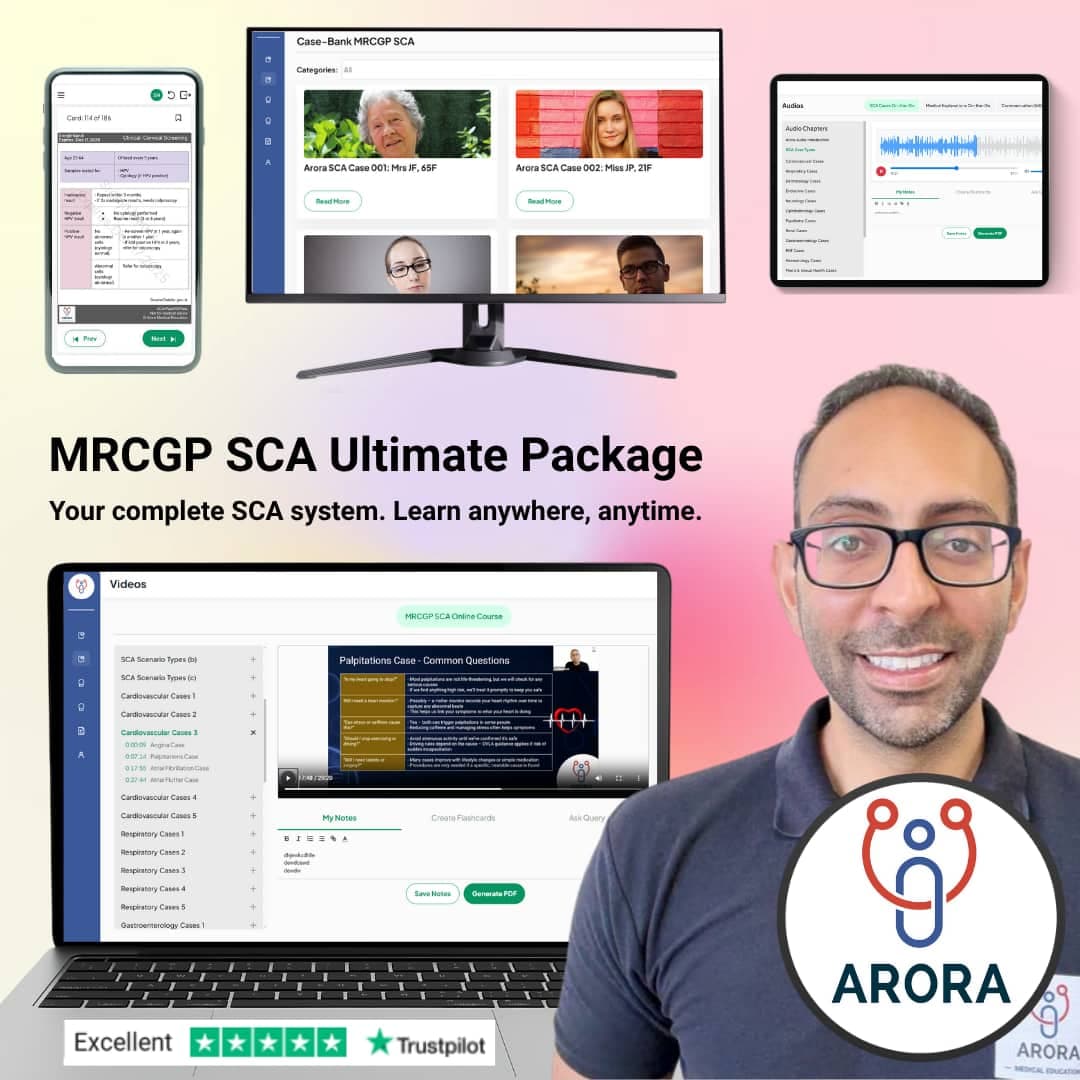
– SCA Ultimate – a full SCA preparation system with case banks, videos, audios, regular live teaching sessions, and flashcards.
– A focused 1-to-1 SCA Mock or Feedback session to work with a senior Arora GP tutor.
– Individual resources such as audios, videos, case banks or mocks.
Each option follows a clear plan that helps you stay organised and focused. Explore these more here.
On a final positive note...
Any final exit exam will naturally bring some anxiety. That is normal.
But the skills assessed in the MRCGP SCA are not new. They are the same core consultation skills you use every day in General Practice. When preparation starts early, practice is focused, and you avoid relying on a single method or rigid scripts, most trainees do very well.
Be consistent. Be reflective. Trust the doctor you already are.
Good luck with your preparation. And if you have questions along the way, feel free to get in touch.
#CanPassWillPass
Other blog that may help you

SCA Course Lead - Dr Aman Arora
Hi! I’m Dr. Aman Arora, a Portfolio GP with over a decade of clinical and teaching experience, dedicated to helping doctors achieve their goals with confidence. Having had the privilege of supporting more than 50,000 doctors worldwide across exams such as MRCGP AKT, SCA, MSRA, PLAB 2 and PLAB 1, I understand the challenges you face and the strategies needed to overcome them. Through personalised face-to-face sessions, engaging online courses, mocks, audio and a vibrant social media community, we’re here to guide you every step of the way.
Whether you’re looking to pass crucial exams or take the next big step in your medical career, we’re here to help you succeed. Feel free to get in touch with any thoughts, questions, or ideas — I look forward to working with you and being part of your journey.

Senior SCA Tutor - Dr Pooja Arora
Dr Pooja Arora is a GP with a background in Medical Politics, where she passionately focuses on improving the opportunities and working conditions for junior doctors. She is proud to hold FRCGP (Fellow of Royal College of General Practitioners).
You can find out more about Pooja’s previous roles and qualifications here.
Other blogs that may interest you