


How I passed MSRA and Got Multiple Offers – Dr Ibrahim Marwa
If you are a doctor preparing for your MSRA exam, this blog is a must to help you pass. We are lucky to have Dr Ibrahim Marwa – a doctor who recently passed his MSRA assessment and got accepted into Higher Training – share his experience of how he prepared and passed…
– Join National MSRA WhatsApp teaching group here
– Get MSRA Updates and Teaching Emails here
– Register for next Free MSRA Webinar here
– Pass with MSRA Ultimate Package here
About Me
My name is Ibrahim Marwa and I’m a public health emergency manager at the Middlesex-London Health Unit (a local public health department in Ontario, Canada). For personal and family reasons I am relocating to the UK and decided to apply to the GP training. For a full overview of how to apply for GP training click here.
I applied to GP training in August in order to potentially start in February. It was my first time applying to the training position. I studied for the Multi Speciality Recruitment assessment (MSRA) whilst also working full time and also preparing for another exam. I scored a high score and managed to secure multiple offers from all over the UK.
Before you Start MSRA Revision
MSRA is an invitation-only exam – you will not know if you will be invited to sit for the exam or not until you apply to the program and your application gets reviewed. In my case I did not start preparing (or at least seriously preparing) until I got the invitation. If I can go back in time and change one thing, I would start seriously preparing for MSRA ahead of time!
MSRA has two main components, the Clinical Decision Making (CDM) and the Situational Judgment Test (SJT). In order to pass the MSRA you need to pass both components. Because I had limited time I had to be strategic about what I needed to study (another pitfall that I would avoid if I were you). I focused more on the clinical part and spent a lot of time practicing MCQs – however if I had more time I would have spent more time understanding SJT technique. For a full overview of the MSRA exam click here.
How to Prepare for MSRA
Ideally, if you have the time, I suggest you combine knowledge and practice – meaning read the materials, get to know the basics and then put your knowledge into practice. There are plenty of materials out there, but here is the material that helped me in my studies:
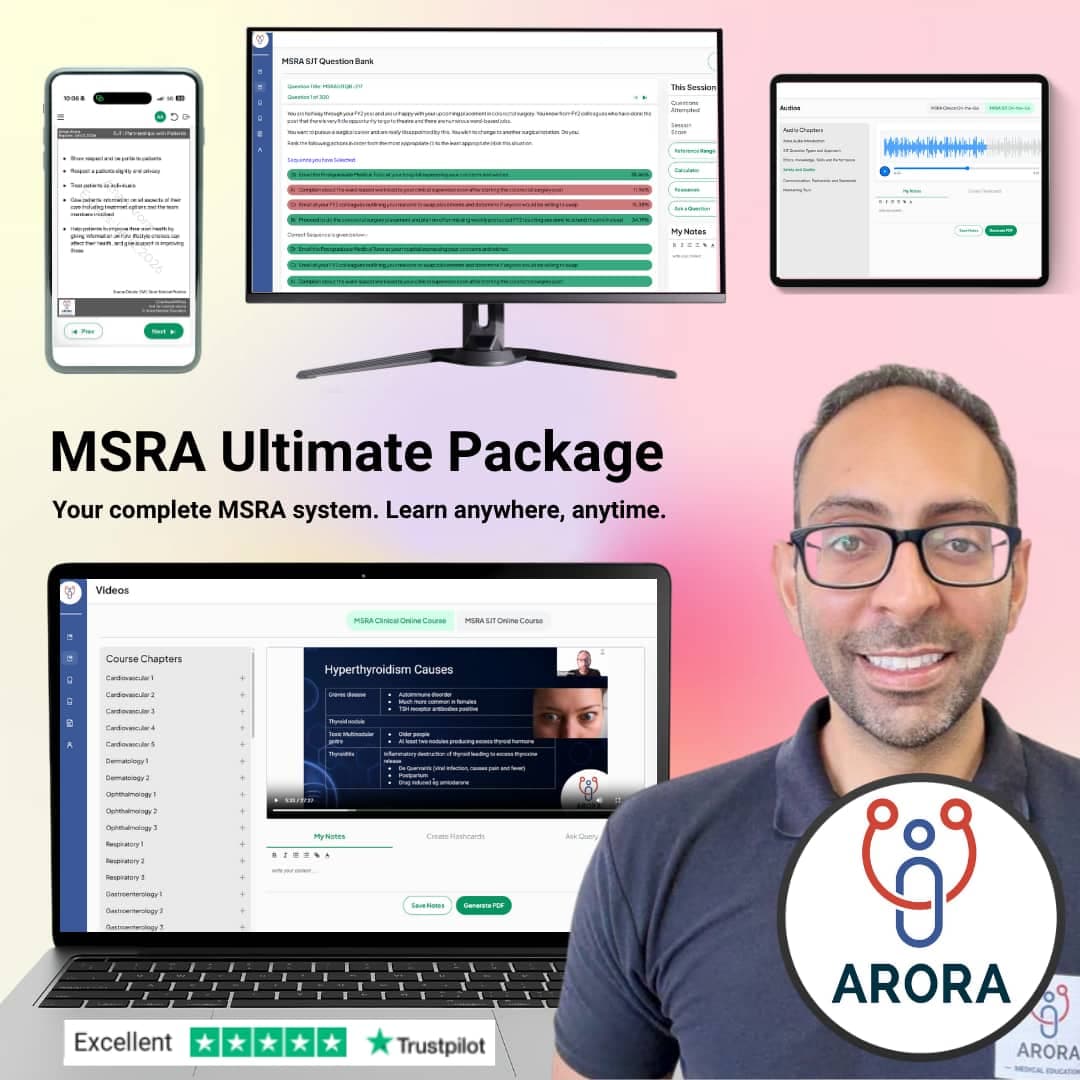
I registered in the MSRA Ultimate Package, which gave me access to multiple question banks, mocks, video lectures, audiobooks and flashcards. I will go through each one:
The lectures are an excellent resource if you want to dig deep in the relevant topics and build your knowledge base. If you have time I’d suggest going through them thoroughly, taking notes (you can do this directly on the learning platform) and perhaps summarise them.
Arora Ultimate Package will provide you with multiple different mocks (as well as two complete question banks). They are a combination of all the topics covered in the MSRA. They are all timed and predetermined. I suggest you practice the mocks when you feel ready to start answering questions. For the first few sets of mocks, I suggest you finish one full mock of each section (like one full CDM) and then spend a few hours understanding the questions and adding to the notes.
A few weeks before your exam, I suggest you take 2 mocks at a time, starting with the SJT then CDM, to put yourself in the exam situation. This will take you around 3 hours. Once you are done. Spend a few hours reviewing the materials and take notes. I did that a lot!
One thing I need to mention is that it is very important to spend some time reviewing the answers and explanations. A lot of students focus on the result of the mock and ignore reading the materials. Yes, results might give you a good indication on where you are at, but you will need to read the explanations of both your correct and incorrect answers.
The audiobooks were a delight, they are quick snapshots of the required component of the exam. I used to listen to them while commuting, at the gym, while doing chores and basically at any downtime!!
One thing you will need to understand is that every word that Dr. Arora mentioned in the audiobook counts and can be a key to a question in the exam.
MSRA Flashcards
Arora Flashcards are very important as a final review when you are done reviewing the materials. I suggest you review them one by one regularly throughout your study period.
Question Banks
One crucial component of preparing for the MSRA is to practice as many questions as possible on a regular basis. I completed all CDM questions and wanted to make sure to cover as many questions as possible. Again, for every question, I read the explanation and understood what the question was trying to ask!
The MSRA SJT Paper
The SJT component also took me a significant time of my practice. I used to solve the questions from the question bank as well as using the SJT Mocks and videos in the package, being careful to read the explanations properly. Overall, combining knowledge and practice is the key to doing well in the exam. If I would do the exam again, I would focus more on the SJT component! It is a bit tricky for me as I am not exposed to the NHS and don’t know much about the nitty gritty and the policies and procedures there. Nonetheless I scored ok, but I would definitely score more if I focused on reading, listening and practicing more SJT questions. The MSRA Ultimate Package focuses on boosting two key SJT areas: knowledge and technique.
My Preparation Tips
Below are two key tips to prepare best for your upcoming MSRA.
a) Start early. As mentioned above, don’t wait until you get invited to the exam to start preparing. Start preparing as soon as you decide to apply to a training that requires MSRA (or even sooner).
b) Focus on both sections of the exam – but do give a lot of consideration to the SJT section! If in doubt, think SJT, SJT, SJT!
A few weeks before the exam
The goal here is to develop the “muscle memory” to understand as many key points and recognize what each question is asking for.
If you are done reviewing the materials (for me, audiobooks, lectures and MCQs), I suggest reviewing flashcards and summaries that you may have created previously.
Ultimately the thing that helped me significantly was to do as many questions as possible and to simulate the exam environment! If the exam is 3 hours, just sit for the whole 3 hours solving questions before looking at the answers.
During the MSRA exam
MSRA is a 3 hour exam so it can get a little tiring. It starts with the SJT paper, followed by CDM paper. You can have a short break between the 2 sections. Try to relax in the break as much as possible – and try not to over think the questions.
My Own Challenges
I found the main challenge was starting early! I did not know if I would be invited for the exam and this impacted my study. I was working full time and was also preparing for another exam – I used to fit 4-5 hours every day (and up to 8 hours on weekends) for 3-4 weeks. It was extremely difficult, but it is all worth it!!
One last thing I want to leave you with – remember your worth. You are already a doctor, you passed the criteria to get invited for the MSRA, you have done a lot of questions and exams – and MSRA is just another one of these exams. Although the burden of the exam might be huge and significant to your training placement, please keep in mind that your worth is way more than just a score in the exam.
Good luck my friend and I wish you all the best in your career.
How Arora Medical Education Can Support You
Clear Teaching Built for Busy Doctors
If you want a guided path, our MSRA resources help you build confidence at each step. Everything is created by senior UK doctors with experience in the exam and in teaching.
You can choose:
– MSRA Ultimate – a full MSRA preparation system with question banks, videos, audios, live teaching, flashcards and mock exams.
– A live MSRA Crammer course held a few weeks before each sitting.
– Individual resources such as audios, videos, question banks or mocks.
Each option follows a clear plan that helps you stay organised and focused. Explore these more here.
Also:
– Join National MSRA WhatsApp teaching group here
– Get MSRA Updates and Teaching Emails here
– Register for next Free MSRA Webinar here

Author Bio — Dr Aman Arora
Hi! I’m Dr. Aman Arora, a Portfolio GP with over a decade of clinical and teaching experience, dedicated to helping doctors achieve their goals with confidence. Having had the privilege of supporting more than 50,000 doctors worldwide across exams such as MRCGP AKT, SCA, MSRA, PLAB 2 and PLAB 1, I understand the challenges you face and the strategies needed to overcome them. Through personalised face-to-face sessions, engaging online courses, mocks, audio and a vibrant social media community, we’re here to guide you every step of the way.
Whether you’re looking to pass crucial exams or take the next big step in your medical career, we’re here to help you succeed. Feel free to get in touch with any thoughts, questions, or ideas — I look forward to working with you and being part of your journey.

Author Bio — Dr Pooja Arora
Dr Pooja Arora is a GP with a background in Medical Politics, where she passionately focuses on improving the opportunities and working conditions for junior doctors. She is proud to hold FRCGP (Fellow of Royal College of General Practitioners).
You can find out more about Pooja’s previous roles and qualifications here.
Other blogs that may interest you