


What is the MSRA Exam and How to Prepare
Many doctors hear about the MSRA but are not always clear on what the exam actually involves or how best to prepare for it. This uncertainty often leads to late planning and unfocused revision.
This guide explains the MSRA in clear, simple terms. It outlines what the exam tests, how it is structured and what effective preparation really looks like. It also helps you build a steady, realistic plan that fits around clinical work and avoids last minute panic.
The aim is to give you clarity early, so your preparation is deliberate rather than reactive.
– Join National MSRA WhatsApp teaching group here
– Get MSRA Updates and Teaching Emails here
– Register for next Free MSRA Webinar here
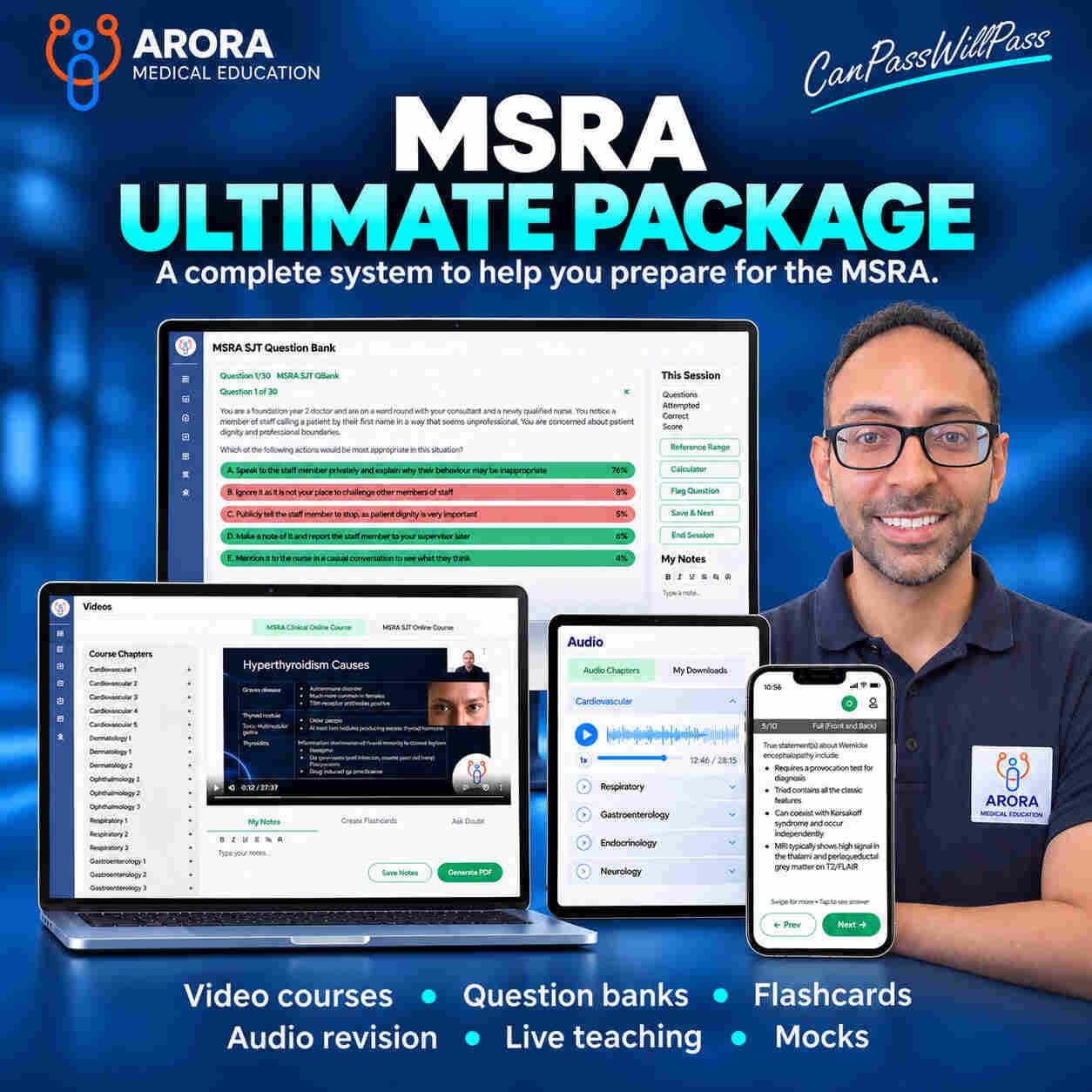
– Pass with MSRA Ultimate Package here
What is the MSRA exam?
The Multi Specialty Recruitment Assessment, or MSRA, is a computer based exam used as part of recruitment into several UK postgraduate training programmes.
It currently forms part of applications for:
– General Practice (read more here)
– Radiology (read more here)
– Psychiatry (read more here)
– Core Surgical Training (read more here)
– Ophthalmology
– Obstetrics and Gynaecology
– Neurosurgery
– Child and Adolescent Mental Health Services (CAMHS)
– Community Sexual and Reproductive Healthcare (CSRH)
– Emergency Medicine & Anaesthetics (read more here)
Each specialty uses the MSRA score differently. In some pathways it determines interview offers. In others it contributes to ranking or can lead directly to a training offer. Because of this variation, it is important to check the specific recruitment guidance for your chosen specialty. For most specialties, this information is published through NHS England’s Medical Hub and the relevant national specialty recruitment pages.
The MSRA is delivered through approved Pearson Professional Examinations test centres in the UK and internationally. Remote assessment is available only where approved under the relevant reasonable adjustment arrangements. Use of the exam can change between recruitment rounds, so always confirm current requirements with the specialty you are applying to.
MSRA 2027 Exam Dates
MSRA 2027 Exam Dates – Round 1: The MSRA exam dates for Round 1 recruitment (for training posts starting in August 2027) have been announced. There will be two sittings:
– First sitting: 5–20 January 2027 – open to applicants for all specialties.
– Second sitting: 10–18 February 2027 – reserved for applicants applying to General Practice and/or Core Psychiatry only.
How the MSRA exam is formatted
The MSRA is made up of two separate computer based papers, both sat on the same day.
The first paper tests Professional Dilemmas and lasts 95 minutes.
The second paper focuses on Clinical Problem Solving and lasts 75 minutes.
The Professional Dilemmas paper is completed first, followed by the Clinical Problem Solving paper. Candidates are offered an optional five-minute scheduled break between the two papers. A countdown timer appears on screen during this break. If a candidate takes longer than five minutes, the additional time is deducted from the Clinical Problem Solving paper.
Each paper has its own on screen timer, so you can track your time throughout the exam.
The timed MSRA assessment lasts 170 minutes in total: 95 minutes for Professional Dilemmas and 75 minutes for Clinical Problem Solving. An optional five-minute break is available between the papers. Candidates should also allow additional time for identification and test-centre administration.
Understanding the format early helps you plan pacing and manage energy on the day, both of which play a big role in overall performance.
The Professional dilemma paper (SJT) consists of 50 Situational Judgement Test questions in 95 minutes – this paper occurs first. See below for more details and example questions.
The Clinical Problem Solving paper (CPS) consists of 97 questions in 75 minutes. It follows the Professional Dilemmas paper, with an optional five-minute scheduled break between the two components. See below for more details and example questions.
Understanding the SJT Paper
To prepare effectively for the MSRA, you need a clear understanding of the Situational Judgement Test, often referred to as the SJT or Professional Dilemmas paper.
This paper assesses how you behave when faced with professional challenges at work. It looks at judgement, prioritisation and how you respond to pressure, rather than clinical knowledge. Many candidates underestimate this paper because it feels familiar, but performance often comes down to structure and consistency.
Key Points About the SJT
– The paper contains 50 questions
– Total duration is 95 minutes
– It assesses professional behaviour, not clinical knowledge
– There is no negative marking
– Questions are presented in two different formats
What the SJT Assesses
All questions are mapped to three core competencies:
– Professional Integrity – This includes honesty, accountability, patient safety and acting within your role.
– Coping With Pressure – This looks at how you prioritise tasks, manage workload, seek help appropriately and respond to stressful situations.
– Empathy and Sensitivity – This assesses communication, awareness of others’ perspectives and respectful behaviour towards patients and colleagues.
Understanding these competencies helps you answer questions with intent rather than instinct. Strong candidates consistently link their choices back to these principles, which makes their decision making clearer and more reliable under exam pressure. All of these competencies and more are covered in our MSRA SJT Resources.
SJT: The two types of question
The SJT uses two distinct question formats. Understanding how each one works helps you approach them more calmly and consistently.
1) Ranking Questions
In ranking questions, you are given four or five possible actions related to a professional scenario. You are asked to rank these actions in order of appropriateness.
– 1 represents the most appropriate action
– 4 or 5 represents the least appropriate action
These questions test prioritisation and judgement. Often more than one action seems reasonable, but you are being assessed on what should come first in that specific situation.
2) Multiple Choice Questions
In this format, you are given eight possible actions. You must select the three most appropriate responses. The correct combination usually addresses:
– Immediate safety or professionalism
– Appropriate escalation or support
– A constructive next step
Each selected action should contribute to resolving the situation. Choosing actions that overlap or avoid the core issue often leads to lost marks.
Sample SJT question
You are a FY2 Doctor on an orthopaedic ward. Your team has just seen an elderly Spanish man on the busy ward round who understands limited English. Your registrar has gained written consent from him for a hip operation scheduled for 2 days’ time. One of the nurses quietly says to you that she suspects the patient was just nodding politely and understood very little. She says she doesn’t want to undermine the registrar. You know his daughter visits daily and always translates if she is present. Do you:
Rank the following actions in order from the most appropriate (1) to the least appropriate (5) in this situation.
A) Call the patient’s daughter directly to alert her what has happened
B) Address your registrar in front of the patient about these concerns, presuming the patient does not understand
C) Speak to the registrar privately at the end of the ward round about the concerns
D) Ignore the nurse’s comment as the patient’s daughter could always relay any concerns when she visits later
E) Encourage the nurse to speak up and then carry on with your ward round tasks
Suggested Answer: CBAED
C is the best option as you are speaking directly with the registrar, and not undermining them in front of the patient or team. The question states that the ward round was busy so waiting until the end may be more appropriate, especially as the operation is still in 2 days’ time. GMC Good Medical Practice states that you should make sure ‘arrangements are made, wherever possible, to meet patient’s language and communication needs’ and be satisfied that consent is taken before providing treatment. As the nurse is reluctant to speak it is important to ensure the concerns do not go unnoticed, especially since you are aware his daughter usually translates.
B is not as good an option because although it does directly act on your concerns, it undermines the registrar in front of others and may impact your working relationship. Furthermore, it may distress the patient who has limited understanding of English. It ranks higher than A, E or D because at least the concerns are actively voiced directly to him.
A is a poor option as it potentially breaches patient confidentiality and may cause distress to the patient and relative. You are taking action to try and ensure patient understanding but going about it in a way that i) undermines the registrar, ii) may negatively impact your working relationship and iii) may negatively impact the patient and family’s trust in the medical care being provided.
E is the next worst option here as although you are encouraging her to speak up, you are not taking any responsibility in following this up – and thus checking to ensure that the consent taken is valid.
D is the worst option as it disregards a suspicion that the consent taken was invalid and fails to act on this at all. Relying on the patient’s daughter to relay any concerns that the patient may confide to her is inappropriate. This does nothing to actively voice concerns to the registrar, who is in a position to discuss the operation again and ensure consent taken is valid (in the presence of an appropriate interpreter if necessary).
Practice more SJT questions: Check out our MSRA free trial.
The MSRA Clinical Paper
The second part of the MSRA is the Clinical Problem Solving paper. This paper tests how you apply clinical knowledge to make safe and appropriate decisions. It is not a test of pure recall. Success depends on judgement, prioritisation and recognising what matters most in each scenario.
Many candidates underestimate this paper by revising facts in isolation. The exam instead asks what you would do next in real clinical situations, often under time pressure.
Key Points About the Clinical Paper
The paper contains 97 questions, comprising 86 scored questions and 11 unscored pilot questions.
– Total duration is 75 minutes
– It assesses five core competencies
– Questions are drawn from 12 clinical topic areas
– There are two different question formats
Strong performance comes from understanding clinical reasoning rather than memorising lists. Candidates who consistently ask themselves “what is the safest and most appropriate next step here?” tend to perform better than those who rely on recall alone.
Clinical paper: The five core competencies
The five core competencies that are tested:
– Investigation
– Diagnosis
– Emergency
– Prescribing
– Management
Clinical paper: The 12 clinical topic areas
12 core clinical topic areas are tested in MSRA:
– Cardiovascular
– Dermatology/ENT/Eyes
– Endocrinology/Metabolic
– Gastroenterology/Nutrition
– Infectious/Haematology/Allergy/Genetics
– Musculoskeletal
– Paediatrics
– Pharmacology and Therapeutics
– Psychiatry/Neurology
– Renal/Urology
– Reproductive
– Respiratory
All of these clinical topic areas and competencies are covered in our MSRA courses.
Clinical paper: The two types of question
1) Extended matching questions – EMQ (chose the single most appropriate answer from a choice – answers relate to several questions).
2) Single best answer – SBA (choose the single most appropriate answer from a choice – answers relate to a single question).
Sample clinical paper question
Ruby is 2 years old and is seen today with her father as she has had a one-week history of runny nose and has complained her throat hurts. This morning she has noted a rash on both cheeks but nowhere else on the body. Ruby is well in herself and eating, drinking, passing urine and opening her bowels as normal. She has no other medical history and is up to date with immunisations. She is not lethargic and on examination today is playing happily in the consulting room, has normal observations and an unremarkable respiratory and throat examination. There is a diffuse erythematous rash on both cheeks. What is her most likely diagnosis?
A) Scarlet Fever
B) Herpes virus type 6
C) Measles
D) Rubella
E) Parvovirus B19
Suggested Answer and key Learning Points: E
– Slapped Cheek Syndrome (usually school age children) is caused by the organism Parvovirus B19.
– An erythematous facial rash (one or both cheeks) is a key defining feature, but usually other prodromal features are common e.g. low-grade fever, myalgia, nausea, runny nose
– The condition is usually mild and self-limiting.
– Treatment is mainly supportive e.g. rest, fluids, analgesia.
– Complications are rare in healthy people, if a patient is pregnant then further advice should be sought.
Practice more clinical paper questions: Check out our MSRA free trial
What is the MSRA Pass Mark?
There is no single universal MSRA pass mark that applies to every specialty. Different specialties may set minimum performance thresholds for individual papers or use MSRA scores differently in recruitment. For GP recruitment, a Band 1 result in either paper is unsuccessful.
MSRA scores are standardised and equated to allow fair comparison between candidates and examination sittings. There is no single maximum standardised score. However, minimum performance thresholds and the way scores are used for selection vary by specialty.
Your result is reported using bands from 1 to 4:
– Band 1 usually indicates an unsuccessful outcome
– Band 4 represents a strong performance
How these bands are used depends on the specialty you are applying for. Some specialties use the MSRA score to shortlist for interview. Others use it to rank candidates or, in some cases, to make direct offers. Because of this variation, it is essential to check the recruitment guidance for your chosen specialty.
MSRA Scoring for GP Training
For GP training, MSRA scores are normalised. Scores are centred around a mean of 250, with a standard deviation of 40. This system allows fair comparison between candidates across different sittings.
Understanding this scoring system helps you focus on what matters. The goal is not perfection. It is to perform consistently well across both papers relative to your cohort.
How to Prepare for and Pass MSRA
A Structured Plan That Works
Build a Steady Routine
Start early. Short daily sessions help more than long irregular sessions. Aim for consistent practice so you develop familiarity with the format and pace. Click here for our FREE daily preparation planner for the upcoming MSRA exam.
Use a Range of Question Styles
Do not rely on one source. Use varied questions so you see many styles and approaches. Over time you will recognise patterns and reduce hesitation during the exam.
Improve Judgement for Professional Dilemmas
Work on structure. Think about the duties of a doctor, fairness, patient safety and teamwork. Ask yourself why an option is stronger or weaker. Understanding the reason behind each choice helps you answer new scenarios with confidence.
Strengthen Clinical Reasoning
Focus on the basics. Refresh common presentations, test results and management steps. The exam rewards clarity rather than rare knowledge. Keep things simple and rely on guidelines used in everyday practice.
Practice Under Timed Conditions
The exam is fast. Timed practice builds pacing. It also helps you make steady decisions rather than getting stuck on one question.
Learn From Your Mistakes
Review your incorrect answers. Look for patterns. Work on areas where you lose marks through hesitancy or misunderstanding. Many doctors forget this step, yet it is often where progress comes from.
Common Challenges You May Face
Not Knowing Where to Start
Break the exam into the two papers and plan for each one separately. This removes the feeling of being overwhelmed.
Running Out of Time
Timed mocks help. Aim to move on when stuck rather than losing several minutes on one question. One difficult item should not affect the rest of your paper.
Getting Distracted by Rare Topics
The MSRA rewards core knowledge. Keep your focus on common conditions and everyday judgement. Do not chase unusual details.
Feeling Unsure About Professional Dilemmas
Follow principles. Protect patients. Stay fair. Communicate clearly. Respect colleagues. These behaviours guide most questions. There is plenty of MSRA SJT support in our Ultimate Package.
How Arora Medical Education Can Support You
Clear Teaching Built for Busy Doctors
If you want a guided path, our MSRA resources help you build confidence at each step. Everything is created by senior UK doctors with experience in the exam and in teaching.
You can choose:
– MSRA Ultimate: a full MSRA preparation system with question banks, videos, audios, live teaching, flashcards and mock exams.
– A live MSRA Crammer course held a few weeks before each sitting.
– Individual resources such as audios, videos, question banks or mocks.
Each option follows a clear plan that helps you stay organised and focused. Explore these more here
Also:
– Join National MSRA WhatsApp teaching group here
– Get MSRA Updates and Teaching Emails here
– Register for next Free MSRA Webinar here
Final Pointers Before You Start
Your Next Steps
– Begin early
– Practise often
– Review your errors
– Keep things simple
– Use resources that explain why answers matter
A calm, structured plan leads to better scores. Many doctors surprise themselves when they follow a steady routine.
If you want support, you can explore the MSRA course page on our website.
I look forward to supporting you through your successful selection process, and if applying to GP training I hope to meet you on our GP training courses!
Good luck and #CanPassWillPass.

Author Bio — Dr Aman Arora
Hi! I’m Dr. Aman Arora, a Portfolio GP with over a decade of clinical and teaching experience, dedicated to helping doctors achieve their goals with confidence. Having had the privilege of supporting more than 50,000 doctors worldwide across exams such as MRCGP AKT, SCA, MSRA, PLAB 2 and PLAB 1, I understand the challenges you face and the strategies needed to overcome them. Through personalised face-to-face sessions, engaging online courses, mocks, audio and a vibrant social media community, we’re here to guide you every step of the way.
Whether you’re looking to pass crucial exams or take the next big step in your medical career, we’re here to help you succeed. Feel free to get in touch with any thoughts, questions, or ideas — I look forward to working with you and being part of your journey.

Author Bio — Dr Pooja Arora
Dr Pooja Arora is a GP with a background in Medical Politics, where she passionately focuses on improving the opportunities and working conditions for junior doctors. She is proud to hold FRCGP (Fellow of Royal College of General Practitioners).
You can find out more about Pooja’s previous roles and qualifications here.
Other blogs that may interest you