


How to Get Into UK GP Training (UK-trained or IMG doctor)
Hello! If you are considering applying for a UK GP (General Practice) training post, then this blog is for you! GP training is the most popular UK Postgraduate medical training programme and in this blog we break it down in a step-by-step guide.
– Join National MSRA WhatsApp teaching group here
– Get MSRA Updates and Teaching Emails here
– Register for next Free MSRA Webinar here
– Pass with MSRA Ultimate Package here
Basics of GP training Entry
The GP Training application process is managed nationally by the GPNRO (GP National Recruitment Office) and HEE (Health Education England).
The standard recruitment process takes place 2 times a year – once for jobs starting in August (Round 1) and once for jobs starting in February (Round 2).
It is a highly competitive process which focuses on your score in the MSRA assessment. Click here to find out more about the MSRA exam.
For some pros and cons of GP training, watch this video here.
Eligibility for application includes:
There are certain eligibility criteria that you have to meet in order to apply. For example:
– Must have a basic medical qualification eg MBBS, MBChB.
– Must be eligible to work in UK medical school.
– Must have full registration from GMC, with a licence to practice by the time your job starts.
– Must have evidence of having met UK Foundation Competencies (eg through being on the UK Foundation Year programme or through a Consultant signing a CREST 2024 (Certificate of Readiness to Enter Specialty Training) form. For details on this form click here.
– Must have at least 12 months of medical relevant experience after full GMC registration (or equivalent post-licensing experience) by the time training starts (UK or abroad).
– Hold a current and in date driver’s license or is prepared to provide alternative means of transport for domiciliary care or emergency care during the whole training programme.
The 2 GP training Application Stages & Recruitment Timeline
Stage 1: Long-listing period
✓ Occurs via application through the Oriel recruitment portal
✓ To be long-listed, you need to meet the eligibility criteria described above
Stage 2: Multi-Specialty Recruitment Assessment (MSRA)
✓ Consists of a computer-based exam with two components
a) clinical questions
b) professional dilemma questions.
✓ All questions are in multiple-choice format.
✓ Clinical problem-solving paper (CPS) – 97 clinical questions in 75 minutes.
✓ Professional dilemma paper (SJT) – 50 Situational Judgement Test questions in 95 minutes.
✓ Your MSRA Score counts for 100% of your GP Entry application score as there is currently no GP Stage 3 Assessments taking place.
– Register for our next Free MSRA Webinar here.
– Join the Arora MSRA Telegram teaching group here.
– Start our most comprehensive MSRA Ultimate Package here.
On ‘results publication day’
You will be notified of your final results and National rank through the Oriel website – communication will be through direct messaging in Oriel. An email is also sent out but do not rely on this form of communication as it may end up in your junk/spam folder. It is important to check your Oriel account regularly.
Currently your final result is based purely on your MSRA exam performance (100%) as there is no Stage 3 Assessment (used to be in the past).

Important Recuitment dates
Current Round (Round 1)
– Applications open: 23rd October – 20th November 2025
– MSRA assessment: 6th-19th January 2026 (first sitting) and 12th-25th February (second sitting)
– First Job offers: 24th March 2026
– Start date: August 2026
Next Round (Round 2)
– Applications open: Expected July 2026
– MSRA assessment: Expected September 2026
– First Job offers: Expected October 2026
– Start date: February 2027
To get started with our MSRA Ultimate Preparation package click here.
How Arora Medical Education Can Support You
Clear Teaching Built for Busy Doctors
If you want a guided path, our MSRA resources help you build confidence at each step. Everything is created by senior UK doctors with experience in the exam and in teaching.
You can choose
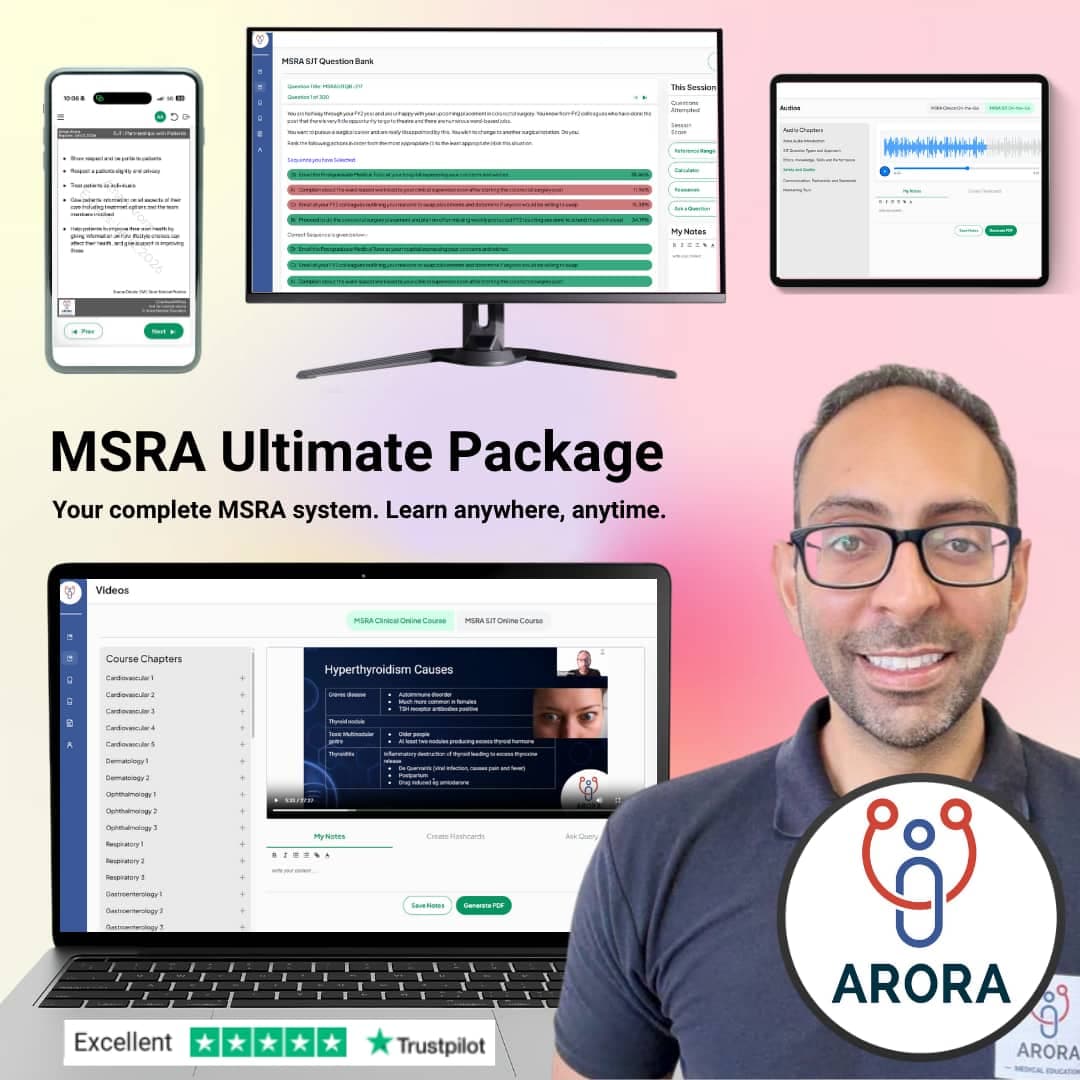
– MSRA Ultimate – a full MSRA preparation system with question banks, videos, audios, live teaching, flashcards and mock exams.
– A live MSRA Crammer course held a few weeks before each sitting.
– Individual resources such as audios, videos, question banks or mocks.
Each option follows a clear plan that helps you stay organised and focused. Explore these more here.
Also:
– Join National MSRA WhatsApp teaching group here
– Get MSRA Updates and Teaching Emails here
– Register for next Free MSRA Webinar here
Once in GP Clinical training
Completion of training is usually 3 years in total (full-time)
Usually 12-18 months in General Practice placements, 18-24 months in hospital rotations eg Paediatrics, Acute Medicine, Accident & Emergency etc
Need to complete MRCGP to exit training, which consists of 3 components:
a) AKT exam (for more details on the AKT click here)
b) SCA assessment (for more details on the SCA click here)
c) Workplace-based assessment (for more details on WBPA click here)
For some pros and cons of GP training, watch this video here.
On a final note…
If you are planning to apply for GP training I wish you good luck! General Practice is an extremely varied and rewarding career, as well as being one that allows flexibility in work-life balance.
I look forward to supporting you through your successful selection process, as well as once in GP training as well!
Good luck and #CanPassWillPass
Other blog that may help you

Author Bio — Dr Aman Arora
Hi! I’m Dr. Aman Arora, a Portfolio GP with over a decade of clinical and teaching experience, dedicated to helping doctors achieve their goals with confidence. Having had the privilege of supporting more than 50,000 doctors worldwide across exams such as MRCGP AKT, SCA, MSRA, PLAB 2 and PLAB 1, I understand the challenges you face and the strategies needed to overcome them. Through personalised face-to-face sessions, engaging online courses, mocks, audio and a vibrant social media community, we’re here to guide you every step of the way.
Whether you’re looking to pass crucial exams or take the next big step in your medical career, we’re here to help you succeed. Feel free to get in touch with any thoughts, questions, or ideas — I look forward to working with you and being part of your journey.

Author Bio — Dr Pooja Arora
Dr Pooja Arora is a GP with a background in Medical Politics, where she passionately focuses on improving the opportunities and working conditions for junior doctors. She is proud to hold FRCGP (Fellow of Royal College of General Practitioners).
You can find out more about Pooja’s previous roles and qualifications here.
Other blogs that may interest you