


10 High Power Tips to Pass Your PLAB 1 Exam
The UKMLA PLAB 1 exam is often seen as the smaller of the two PLAB exams. In reality, many doctors find it more challenging than PLAB 2. The breadth of knowledge is wide, and success depends on accuracy and correct application, not guesswork. This is not an exam to take lightly. Good planning and smart use of time make a clear difference.
– Get PLAB 1 Updates and Teaching Emails here
– Register for next Free PLAB 1 Webinar here
– Pass with PLAB 1 Ultimate Package here
Introduction
I have worked as a GMC PLAB examiner and have taught doctors preparing for both PLAB 1 and PLAB 2 for many years. During this time, one pattern is consistent. Doctors who pass do not rely on volume alone. They use a focused, structured approach and understand how to prepare for this specific exam.
For full details on what the PLAB 1 exam is and how you can prepare, click to read this this blog.
1) It is not purely knowledge.
PLAB 1 is not a test of memory alone. It assesses how well you apply core knowledge to real scenarios you may face in UK medical practice. This includes clinical decision-making, ethics and evidence-based medicine.
Knowing facts is not enough. You must decide what to do with that information in context. This is why more than one option can often appear reasonable. The exam tests judgement, not recall.
A shift in mindset is essential. Focus less on cramming and more on understanding how knowledge is used in practice. That is what separates passing candidates from those who struggle.
2) Use the free guidance provided by the GMC
Many candidates overlook resources that are available at no cost. The GMC provides two tools that should sit at the centre of your preparation.
First, the UKMLA PLAB Blueprint. This document shows exactly what the exam covers. It breaks the syllabus into clear sections and tells you where to focus your time. If something is in the blueprint, it matters. If it is not, it should not dominate your revision.
Second, the official GMC sample questions. These give a clear sense of the depth and style expected in the exam. They help you understand how knowledge is tested, not just what is tested.
Use these resources early. They come from the people who write the exam and set the standard you are aiming to meet.
3) Start where you don’t want to go.
Most candidates start with topics they enjoy or feel confident in. If cardiology feels comfortable, that is often where revision begins. This is understandable, but it is rarely the best strategy.
Do the opposite. Identify three topics you dislike or avoid and start there. This might be genetics, urology or pharmacology. These are often the areas left until the end, which leads to rushed revision and unnecessary stress.
Tackling weaker areas early builds confidence and removes fear. Once you realise you can get through them, they stop dominating your preparation later on.
I discuss this pattern in more detail in this video, where I outline three common trends seen in doctors who do not pass PLAB 1: https://youtu.be/d2mCKEnB7-s.
4) Targets lead to progress.
Unstructured revision leads to drift. Without clear targets, it is easy to jump between topics and underestimate what is still left to cover.
Set specific, time-based targets. For example, decide what you will complete in week one, then week two, and build from there. These targets matter more than daily motivation. Even if you fall behind earlier in the week, catch up later rather than changing the plan.
Progress comes from completion, not intention. Targets give you visibility of what is done and what is not.
If you need help structuring this, our free PLAB 1 daily planner programme is designed to break preparation into clear, realistic daily goals: free PLAB 1 daily planner programme.
5) Do not rely only on the usual approach
Many doctors prepare for PLAB 1 in the same way. They use the same question banks and repeat them multiple times. Question banks are important, but they should not be the only tool you use.
Different resources test knowledge in different ways. Exposure to varied formats helps you think more flexibly and improves application. This is especially useful for borderline areas where one explanation or question style has not fully clicked.
You do not need to buy everything available. Choose one or two additional resources that suit how you learn. This might be videos, audio, flashcards or structured mock exams.
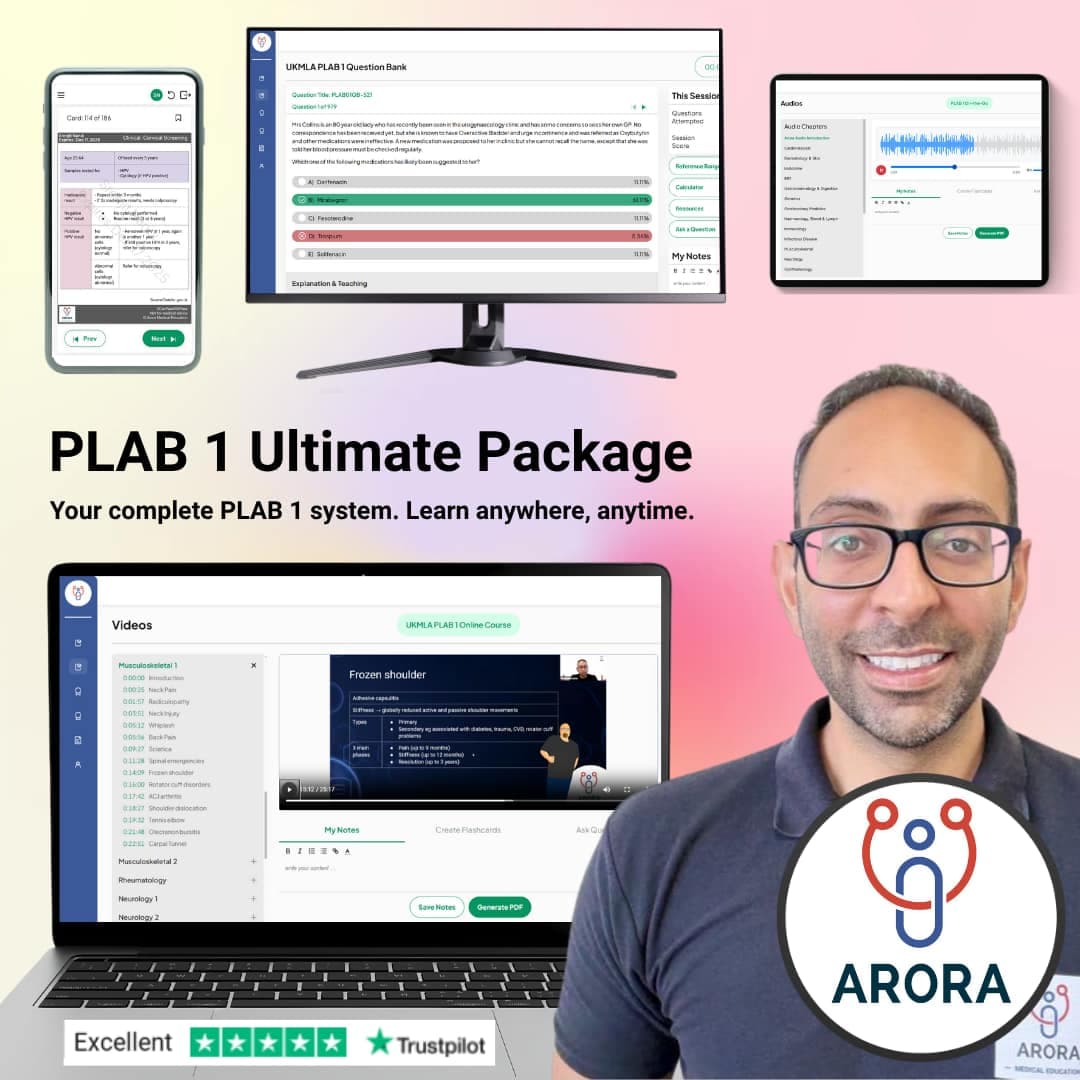
We designed the PLAB 1 Ultimate Package for this reason. It combines video teaching, audio learning, flashcards, live sessions, a question bank and mock exams so doctors can use the formats that work best for them.
The goal is not more material. It is better coverage and better understanding.
6) Make time pressure work for you.
Most preparation happens in comfortable conditions. You choose when to study, take breaks when you want and work at your own pace. The exam is very different.
PLAB 1 tests not only knowledge and application, but also how well you manage time. You need to make safe decisions under pressure.
Build this into your preparation. Set strict time limits when practising. Give yourself 30 minutes for a fixed number of questions, one hour to cover a defined set of topics, or several hours for a full mock exam. This changes how you think and how you prioritise.
Doctors make time-pressured decisions every day. PLAB 1 reflects this reality. Do not let the exam day be the first time you experience that pressure.
You can practice this properly using timed mock exams here.
7) Small words make a big difference
Many PLAB 1 errors happen because candidates answer too quickly. Pattern recognition is useful, but it can also mislead. Seeing a familiar term can push you towards an answer before you have read the question properly.
Pay close attention to qualifiers in the stem. Words such as “most likely,” “usually,” “commonly,” or “best next step” often change the correct answer. Missing these details is one of the commonest reasons for avoidable marks lost.
Slow down just enough to read the question fully before committing. Accuracy matters more than speed in borderline questions.
These exam technique areas are tested and reinforced in our PLAB 1 question bank, where question wording and time pressure closely reflect the real exam
8) Visualise the scenario as you read
Long question stems can be difficult to process in one go. By the time you reach the final line, it is easy to forget key details from the beginning.
Slow the process down and build a mental picture. As you read, visualise the patient in front of you. Add details step by step. For example, age, gender, how they walk, what you see on examination. This mirrors how you assess patients in real practice.
Creating a clear image helps you retain information and reduces missed details. It also improves clinical reasoning by keeping the scenario coherent rather than fragmented.
Use your imagination deliberately. It is a simple technique, but it prevents many avoidable errors.
9) Do not prepare in isolation
PLAB 1 preparation can feel isolating. Many doctors study alone after work, which can lead to frustration and loss of momentum.
Try to connect with others at least once a week. This could be a small study group, colleagues, or an online support group. Discuss difficult topics, test each other and plan the week ahead. Teaching someone else often exposes gaps in your own understanding.
Knowing that others are facing the same challenges helps maintain perspective and motivation. You are not the only one finding this difficult.
If you want structured peer support, you can join our PLAB 1 Telegram teaching group, where doctors share questions, clarification and guidance throughout their preparation.
10) Expect to pass, and prepare accordingly
Many candidates tell themselves they do not know enough or that the syllabus is impossible to finish. This way of thinking quietly undermines preparation.
Belief alone will not make you pass, but constant self-doubt will make preparation harder than it needs to be. Confidence affects how you revise, how you sit questions and how you recover from mistakes during the exam.
Remind yourself regularly that you already know a large amount. You have trained as a doctor and you are building on that foundation. A calm belief that passing is achievable helps you stay consistent, focused and resilient.
Telling yourself that it cannot be done or that you will never understand certain topics works against you. Prepare with the assumption that you will pass, and put your energy into making that outcome inevitable.
How Arora Medical Education Can Support You
Clear Teaching Built for Busy Doctors.
If you want a guided path, our PLAB 1 resources help you build confidence at each step. Everything is created by senior UK NHS clinicians and previous PLAB examiners with experience in the exam and in teaching.
You can choose:
– PLAB 1 Ultimate – a full PLAB 1 preparation system with question banks, videos, audios, live teaching, flashcards and mock exams.
– A live PLAB 1 Crammer course held a few weeks before each sitting.
– Individual resources such as audios, videos, question banks or mocks
Each option follows a clear plan that helps you stay organised and focused. Explore these more here.
Also:
– Get PLAB 1 Updates and Teaching Emails here.
– Register for next Free PLAB 1 Webinar here.
On a Final Note
PLAB 1 preparation does need to be taken seriously. It is not about blindly completing thousands of questions. Understanding what the exam is assessing and approaching preparation in an organised way makes revision more effective and far less draining.
Many doctors have already been through this process and are now working in the NHS. You are following a well-trodden path, and there is no reason you cannot reach the same outcome.
If you are sitting PLAB 1 soon, good luck. Prepare well and trust the process.
#CanPassWillPass

Lead PLAB 1 Tutor - Dr Aman Arora
Hi! I’m Dr. Aman Arora, a Portfolio GP with over a decade of clinical and teaching experience, dedicated to helping doctors achieve their goals with confidence. Having had the privilege of supporting more than 50,000 doctors worldwide across exams such as MRCGP AKT, SCA, MSRA, PLAB 2 and PLAB 1, I understand the challenges you face and the strategies needed to overcome them. Through personalised face-to-face sessions, engaging online courses, mocks, audio and a vibrant social media community, we’re here to guide you every step of the way.
Whether you’re looking to pass crucial exams or take the next big step in your medical career, we’re here to help you succeed. Feel free to get in touch with any thoughts, questions, or ideas — I look forward to working with you and being part of your journey.

Senior PLAB 1 Tutor - Dr Pooja Arora
Dr Pooja Arora is a GP with a background in Medical Politics, where she passionately focuses on improving the opportunities and working conditions for junior doctors. She is proud to hold FRCGP (Fellow of Royal College of General Practitioners).
You can find out more about Pooja’s previous roles and qualifications here.
Other blogs that may interest you