


The UKMLA PLAB 1 Exam: What to Expect and How to Prepare
If you are planning to sit the UKMLA PLAB 1 exam, this guide is for you.
In this blog, I explain what PLAB 1 is, what the exam actually tests, and how to prepare in a structured, realistic way. The aim is simple: to help you prepare efficiently, avoid common mistakes, and approach the exam with confidence.
I have taught thousands of doctors for PLAB 1 and PLAB 2 and have seen first-hand how a focused, well-planned approach makes a major difference to outcomes. PLAB 1 is very achievable, but it does require the right strategy.
If you want ongoing support alongside this guide, you can also:
– Get PLAB 1 Updates and Teaching Emails here
– Register for next Free PLAB 1 Webinar here
– Pass with PLAB 1 Ultimate Package here
What Is the UKMLA PLAB 1 Exam?
PLAB 1 is the written component of the Professional and Linguistic Assessments Board (PLAB) route, run by the General Medical Council (GMC). It is designed for international medical graduates who wish to gain GMC registration and work as doctors in the UK.
PLAB 1 assesses whether your medical knowledge and clinical reasoning are at the level expected of a doctor starting work in the UK healthcare system.
PLAB 1 is followed by PLAB 2, which is the practical OSCE-style assessment. Details about PLAB 2 are found here.
Key points about PLAB 1:
– It is a computer-based exam
– It consists of 180 single best answer questions
– Each question has five options, with one best answer
– The exam lasts 180 minutes
– It can be taken in multiple countries worldwide, as well as in the UK
– Exam locations are published on the GMC website
What Does PLAB 1 Actually Test?
UKMLA PLAB 1 does not test how many facts you can memorise.
Instead, it tests how well you can apply core medical knowledge to clinical scenarios, using UK best practice.
You are expected to already have undergraduate-level knowledge from your medical degree. The exam then assesses whether you can:
– Interpret symptoms and clinical findings
– Choose appropriate investigations
– Decide on safe, effective management
– Apply guidelines as used in the UK
– Interpret basic results, imaging and data
– Handle simple statistics and evidence-based questions
Broadly, questions fall into two main areas:
– Acute presentations, similar to what you might see in emergency or urgent care
– Chronic and long-term conditions, often encountered in primary care
It is important to remember that answers are based on UK guidance, which may differ from local practice in other countries. This is why preparation must be aligned to UK guidelines and standards, not local protocols.
All of our PLAB 1 teaching and resources are built around current UK guidance for this reason.
Is PLAB 1 Difficult?
PLAB 1 is challenging, but it is very passable with the right preparation.
Most difficulties arise not from lack of intelligence or effort, but from:
– Poor planning
– Over-reliance on question banks without understanding
– Studying without reference to the PLAB blueprint
– Using outdated or non-UK-focused resources
When candidates understand what the exam is really testing and prepare accordingly, outcomes improve significantly.
Watch this video for 3 key trends that I see in doctors who don’t pass PLAB 1: https://youtu.be/d2mCKEnB7-s.
How Much Does PLAB 1 Cost?
The PLAB 1 exam fee is set by the GMC and may change over time.
Up-to-date information on fees, booking, cancellation and rescheduling should always be checked directly on the GMC PLAB 1 pages, as these are the official source.
How Should I Prepare for PLAB 1?
1. Start With the GMC PLAB Blueprint
Your first step should be to download the official PLAB blueprint from the GMC website.
This document outlines:
– The systems covered
– The types of conditions tested
– The balance of topics across the exam
It is available in spreadsheet and PDF format and forms the backbone of effective preparation.
This is what we base our PLAB 1 teaching on.
2. Create a Realistic Study Plan
Once you know your exam date, work backwards.
Break your preparation into:
– Weeks
– Topics
– Question practice
– Review time
Many candidates underestimate how important planning is. Without a clear plan, preparation often becomes unfocused and large areas are missed.
We provide free PLAB 1 planners to help structure this process.
3. Use Question Banks Properly
Question banks are a key part of PLAB 1 preparation, but the number of questions completed is not what matters.
What matters is:
– Understanding why answers are right or wrong
– Identifying knowledge gaps
– Learning how questions are framed
Mock exams done under time pressure are particularly valuable, as they replicate real exam conditions and reveal weaknesses early.
Our PLAB 1 question bank and mock exams are designed specifically around these principles.
4. Combine Different Learning Formats
Different people learn in different ways. Effective preparation often includes a mix of:
– Question banks
– Video explanations
– Audio learning for passive revision
– Flashcards for reinforcement
– Live or recorded teaching
– Social media teaching eg on Instagram
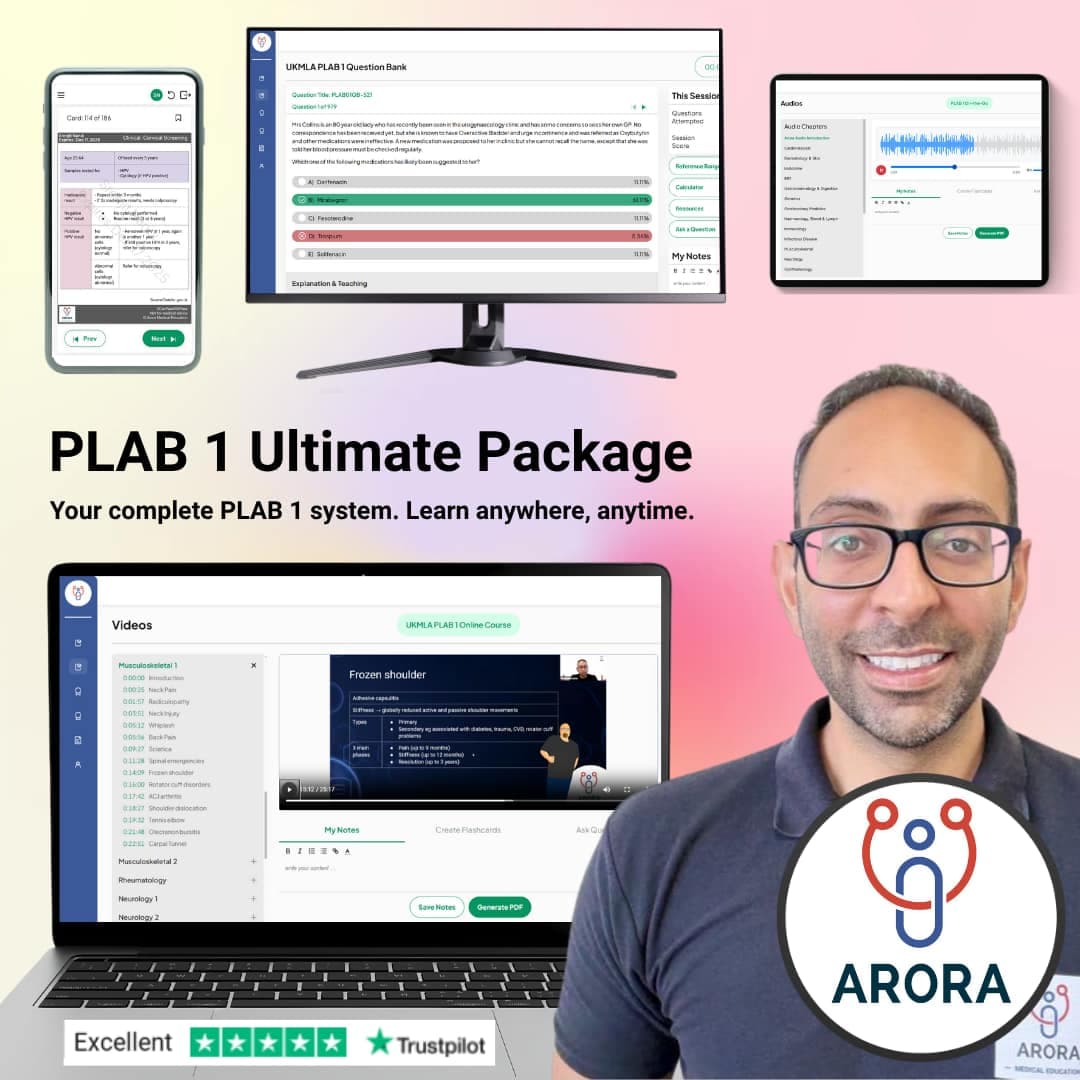
Our PLAB 1 Ultimate Package combines all of these elements to cover both knowledge and exam technique, but many candidates also mix and match resources depending on their preferences.
5. Learn With Others Where Possible
Studying alone for long periods can be tiring and demotivating.
Many candidates benefit from:
– Online discussion groups
– PLAB 1 Telegram group or WhatsApp study groups
– Regular question-based group sessions
Explaining concepts to others and discussing questions often strengthens understanding far more than passive study alone.
For 10 High Power Tips to Pass your PLAB 1 exam, read our blog here.
What Is the Pass Mark for PLAB 1?
PLAB 1 does not have a fixed pass mark.
The pass score is set for each sitting using the Angoff method, with one standard error of measurement applied. This ensures consistency and fairness across different exam sittings
What Is the PLAB 1 Pass Rate?
Based on GMC-published data, the average pass rate over recent years has been around 70%.
This means most candidates do pass, particularly those who prepare in a structured and UK-focused way.
When Are PLAB 1 Results Released?
PLAB 1 results are typically released around six weeks after the exam.
You will receive an email from the GMC directing you to the My Tests section of your GMC Online account. Results are not given by phone or in person.
How Arora Medical Education Can Support You
Clear Teaching Built for Busy Doctors.
If you want a guided path, our PLAB 1 resources help you build confidence at each step. Everything is created by senior UK NHS clinicians and previous PLAB examiners with experience in the exam and in teaching.
You can choose:
– PLAB 1 Ultimate – a full PLAB 1 preparation system with question banks, videos, audios, live teaching, flashcards and mock exams.
– A live PLAB 1 Crammer course held a few weeks before each sitting.
– Individual resources such as audios, videos, question banks or mocks
Each option follows a clear plan that helps you stay organised and focused. Explore these more here.
Also:
– Get PLAB 1 Updates and Teaching Emails here.
– Register for next Free PLAB 1 Webinar here.
Final Thoughts
There is no single “right” way to prepare for PLAB 1.
What matters most is:
– Understanding what the exam tests
– Using UK-relevant guidance
– Planning your time properly
– Reviewing mistakes honestly
– Staying consistent
PLAB 1 is a demanding exam, but it is absolutely achievable with the right approach.
If you would like further guidance, explore our PLAB 1 resources, free webinars and teaching content designed specifically for IMG doctors preparing for the UKMLA PLAB 1 exam.
#CanPassWillPass

Lead PLAB 1 Tutor - Dr Aman Arora
Hi! I’m Dr. Aman Arora, a Portfolio GP with over a decade of clinical and teaching experience, dedicated to helping doctors achieve their goals with confidence. Having had the privilege of supporting more than 50,000 doctors worldwide across exams such as MRCGP AKT, SCA, MSRA, PLAB 2 and PLAB 1, I understand the challenges you face and the strategies needed to overcome them. Through personalised face-to-face sessions, engaging online courses, mocks, audio and a vibrant social media community, we’re here to guide you every step of the way.
Whether you’re looking to pass crucial exams or take the next big step in your medical career, we’re here to help you succeed. Feel free to get in touch with any thoughts, questions, or ideas — I look forward to working with you and being part of your journey.

Senior PLAB 1 Tutor - Dr Pooja Arora
Dr Pooja Arora is a GP with a background in Medical Politics, where she passionately focuses on improving the opportunities and working conditions for junior doctors. She is proud to hold FRCGP (Fellow of Royal College of General Practitioners).
You can find out more about Pooja’s previous roles and qualifications here.
Other blogs that may interest you