


Failed UKMLA PLAB 1? 7 Practical Steps to Pass at Your Next Sitting
If you have recently received a UKMLA PLAB 1 fail result, you will know that the moment of reading it stays with you.
You may have been preparing for months. You may have left friends, family and a clinical career behind in your home country to pursue this path. And now, a number was not quite high enough, and everything feels heavier than it probably should.
Before anything else, something important needs to be said clearly: failing PLAB 1 does not mean you are not a capable doctor. It does not mean your dream of working in the UK is over. And it does not mean that the next sitting will go the same way.
PLAB 1 is a specific, demanding, time-pressured written exam. It tests applied clinical knowledge within a particular UK framework. Failing it reflects a gap between where your preparation was and where it needed to be – not a verdict on you as a clinician.
The question worth asking now is not “why did I fail?” It is: “what needs to change?”
Over 15 years, Arora Medical Education has supported thousands of international medical graduates through the PLAB pathway. This blog sets out seven practical steps to help you reset, rebuild and pass.
– Get PLAB 1 Updates and Teaching Emails here
– Register for next Free PLAB 1 Webinar here
– Pass with PLAB 1 Ultimate Package here
Step 1 - Allow yourself a pause before you restart
The immediate instinct after failing is to react. To open the question bank the following morning. To promise longer hours and more discipline.
That impulse is understandable. But it is rarely the right move in the first few days.
Failing any high-stakes exam – particularly one with so much riding on it – carries a real emotional weight. For many international medical graduates, PLAB 1 represents far more than a test. It represents years of planning, financial sacrifice and the hope of building a career in a new country. When it does not go to plan, the response is not just frustration. It can be shame, doubt, and a creeping sense that perhaps this whole journey was a mistake.
Those feelings are normal. They are also temporary.
Give yourself a few days to step back. Not to avoid the challenge, but to let the emotional noise settle. When you return to planning – and you will – you want to do so with clear thinking, not with the panic and pressure of the immediate aftermath.
The doctors who improve most between attempts do not try harder. They plan smarter. That kind of thinking requires some space first.
Step 2 - Understand what PLAB 1 is actually testing
This is where many candidates go wrong on their next attempt. They work harder, but in the same way as before. The result is the same.
PLAB 1 – aligned to the UKMLA content map – is not a test of how much you have memorised. It is a test of how well you reason through clinical scenarios using UK standards of practice.
The exam consists of 180 Single Best Answer questions answered in three hours. Each question presents a clinical vignette – a patient, a context, a problem. Your job is to select the single best answer based on how a safe, competent doctor working at FY2 level in the UK would respond.
The critical word there is UK. PLAB 1 is not testing how medicine is practised in your home country. It is testing your knowledge of UK guidelines, UK investigation pathways, UK prescribing standards and UK management priorities. Many otherwise well-prepared candidates lose marks not because they lack knowledge, but because their instinct defaults to the clinical framework they were trained in.
Understanding this distinction early is one of the most important shifts you can make. Every question you practise should be answered from the perspective of a UK clinician, using NICE guidance, BNF standards and GMC Good Medical Practice as the reference points. All of our teaching and questions are based on these core areas of UK guidance.
Step 3 - Diagnose where the marks were lost
PLAB 1 is a broad exam. It covers the full spectrum of clinical medicine expected of an FY2 doctor – medicine, surgery, paediatrics, obstetrics and gynaecology, psychiatry, ophthalmology, ENT, ethics and law – and the clinical vignette style means you must apply your knowledge, not just recall it.
When you are ready to plan your next preparation, treat your previous attempt like a clinical case. Diagnose before you prescribe.
Consider honestly:
– Were there whole clinical areas where your knowledge was thin?
– Did certain question types consistently catch you out – investigations, management steps, or ethics-based scenarios?
– Did you run out of time in the exam, or were you rushing through the final section?
– Were you answering questions through a UK lens, or was your clinical default somewhere else?
– Did you rely mostly on a question bank, without a structured knowledge foundation underneath it?
This kind of careful analysis is far more useful than simply doing more questions. The goal is to understand the shape of your gaps, not just the fact that gaps exist.
If you can identify two or three specific areas where you are consistently weaker, your next preparation becomes significantly more focused.
Step 4 - Rebuild your preparation around structure, not just effort
One of the hardest things to accept after failing is that many candidates were already working hard. Long hours, hundreds of questions, careful notes. And still a fail.
The issue is rarely lack of effort. It is usually lack of structure.
Some of the most common preparation patterns that lead to failing PLAB 1 include:
– Doing question banks without understanding the reasoning behind correct answers
– Relying on a single resource rather than a balanced approach across knowledge, application and timed practice
– Avoiding weaker clinical areas and focusing revision on what already feels comfortable
– Using old preparation materials that predate the transition to the MLA content map – older PLAB resources may no longer reflect what the exam actually tests
– Reading passively rather than practising actively under timed conditions
The next phase of preparation needs to feel different. Not necessarily more intense. More intentional.
A structured plan means deciding in advance which clinical areas you will cover and in what order. It means building in timed question practice from an early stage, not just in the final weeks. It means reviewing explanations carefully – including the questions you answered correctly, because correct answers for wrong reasons still cost you in the real exam.
Arora’s free PLAB 1 revision planner is a useful starting point if you want a day-by-day framework built around the content the exam actually covers. Download it at aroramedicaleducation.co.uk/free-planner.
Step 5 - Train for time, not just knowledge
PLAB 1 gives you three hours for 180 questions. That is one minute per question on average.
Many candidates who know their medicine still struggle on exam day because they have not trained for that pace. In practice, revision sessions tend to be slower – time to think, time to look things up, time to re-read. When exam day arrives, the time pressure creates a different kind of pressure on the brain, and performance drops.
This is not a knowledge problem. It is a training problem.
Timed practice needs to be built into your preparation from an early stage, not just in the final two weeks. It should include full-length mock exams that simulate the real experience – 180 questions, a three-hour block, no interruptions.
When you review those mocks, look beyond the score. Ask yourself where your attention dropped. Were you rushing towards the end? Were you spending too long on difficult questions and running short on time for the easier ones? Were you second-guessing answers you knew?
These patterns can all be identified and corrected. But only if you practise under conditions that bring them out.
Step 6 - Change how you review questions
Improvement in PLAB 1 happens during review, not during the act of answering.
Most candidates spend the majority of their study time answering questions. Far fewer spend enough time understanding in depth why their answers were wrong – or why the correct answer was correct.
After every question session, spend time going through every question you got wrong. For each one, ask:
– Did I misread the question or the clinical scenario?
– Was this a knowledge gap, or did I know the material but reason incorrectly?
– Was I applying UK guidelines, or instinctively defaulting to a different clinical framework?
– Was this a topic I have been avoiding?
Patterns will emerge from this process. And those patterns are where the marks are waiting.
Candidates who pass PLAB 1 on a second or third attempt do not always know dramatically more medicine than they did before. They understand the exam more deeply. They have spent time inside their mistakes rather than moving past them.
Step 7 - Know your attempt position and plan with clarity
One practical matter that deserves attention early is your attempt count.
The GMC allows a maximum of four attempts at PLAB 1. After a fourth failed attempt, a fifth and final attempt may be possible, but only after completing at least twelve months of additional learning and development, and only with formal GMC approval. After five failed attempts, candidates are no longer eligible to sit the exam.
Also worth noting: your PLAB 1 pass is valid for three years. Once you pass, you must sit and pass PLAB 2 within that window. Understanding the structure of the pathway – and where you are within it – helps you plan calmly and realistically.
If this is your first or second failed attempt, time is on your side. There is no need to rush back into the exam before you are genuinely ready. A short, well-structured preparation cycle of three to four months, done properly, is far more valuable than a hurried resit a few weeks after a fail.
If you are closer to your attempt limit, it is worth considering whether additional structured support – such as a course or a focused preparation programme – would help you make the most of the attempts you have remaining.
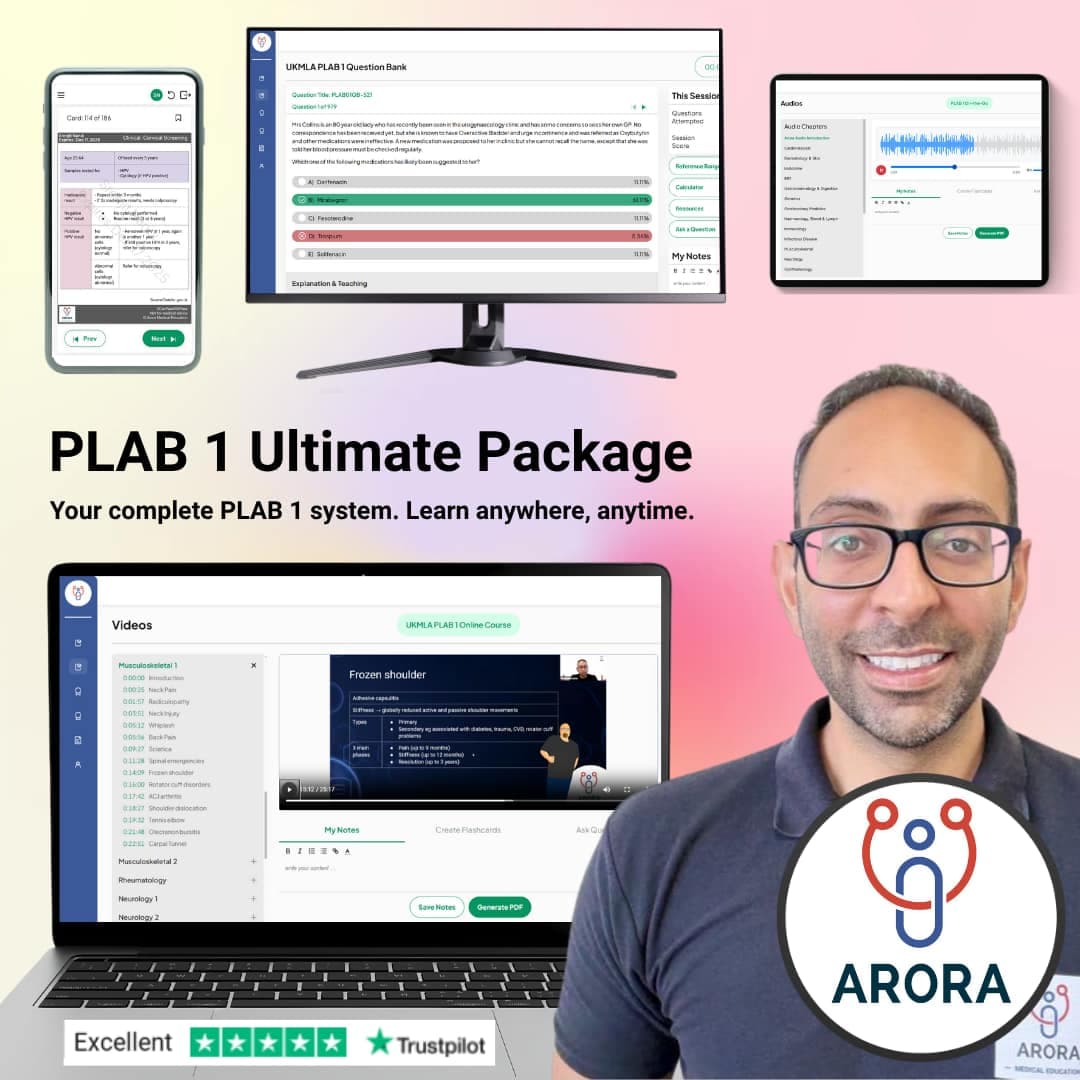
The Arora PLAB 1 Ultimate Package is built around exactly this kind of focused, structured approach – combining video courses, an AI-powered question bank, audiobook content and mock exams to give preparation the depth it needs.
The emotional side of failing, and why it matters
Before the final section, it is worth pausing here.
Failing PLAB 1 affects more than your exam timeline. For many international medical graduates, this result lands inside an already difficult experience: being far from home, managing finances carefully, watching peers in other countries progress through their careers, and facing the uncertainty of a licensing process that can feel uncontrollable.
The self-doubt that comes after a fail is real. Some doctors begin to wonder whether they made the right decision. Others feel reluctant to tell their family or friends. Some carry the result quietly for weeks.
This reaction is understandable. It is also something that tends to ease as preparation becomes structured again. When you can see progress – when mock scores begin to rise steadily, when clinical areas that once felt uncertain start to feel more familiar – confidence returns. Not through willpower, but through evidence.
You do not need to force yourself to feel confident. You need to build a process that gives confidence something to grow from.
What usually changes between fail and pass
In most cases, the shift between a fail and a pass looks like this:
Before: Preparation was effortful but uneven. Weak areas were known but not fully addressed. Time practice was limited to the final stretch. Question review was surface-level. The UK clinical framework was not fully internalised.
After: Preparation is structured from the start. Clinical areas are covered in a deliberate order. UK guidelines are the consistent reference. Full-length timed mocks are used regularly. Question review is deeper. A clear plan replaces an anxious scramble.
It is not a dramatic transformation. It is a steady, methodical shift. And that kind of shift is what changes the outcome.
How Arora Medical Education Can Support You
Clear Teaching Built for Busy Doctors.
If you want a guided path, our PLAB 1 resources help you build confidence at each step. Everything is created by senior UK NHS clinicians and previous PLAB examiners with experience in the exam and in teaching.
You can choose:
– PLAB 1 Ultimate – a full PLAB 1 preparation system with question banks, videos, audios, flashcards and mock exams.
– Individual resources such as audios, videos, question banks or mocks
Each option follows a clear plan that helps you stay organised and focused. Explore these more here.
Also:
– Get PLAB 1 Updates and Teaching Emails here.
– Register for next Free PLAB 1 Webinar here.
A final word
Failing UKMLA PLAB 1 is not the end of your journey. It is a setback on a path that many excellent international doctors have walked before you – doctors who are now working in the NHS, building careers they are proud of, and looking back at this moment as simply part of the process.
Use this period as a point of recalibration, not self-judgement.
Approach the next sitting differently. With structure. With an honest understanding of what the exam actually tests. With the UK clinical framework properly embedded. And with enough timed practice that exam day feels familiar rather than frightening.
You are capable of passing this exam.
And when you do, this moment will simply be part of your story.
#CanPassWillPass

Lead PLAB 1 Tutor - Dr Aman Arora
Hi! I’m Dr. Aman Arora, a Portfolio GP with over a decade of clinical and teaching experience, dedicated to helping doctors achieve their goals with confidence. Having had the privilege of supporting more than 50,000 doctors worldwide across exams such as MRCGP AKT, SCA, MSRA, PLAB 2 and PLAB 1, I understand the challenges you face and the strategies needed to overcome them. Through personalised face-to-face sessions, engaging online courses, mocks, audio and a vibrant social media community, we’re here to guide you every step of the way.
Whether you’re looking to pass crucial exams or take the next big step in your medical career, we’re here to help you succeed. Feel free to get in touch with any thoughts, questions, or ideas — I look forward to working with you and being part of your journey.

Senior PLAB 1 Tutor - Dr Pooja Arora
Dr Pooja Arora is a GP with a background in Medical Politics, where she passionately focuses on improving the opportunities and working conditions for junior doctors. She is proud to hold FRCGP (Fellow of Royal College of General Practitioners).
You can find out more about Pooja’s previous roles and qualifications here.