


Emergency Medicine Training In The UK: What It Is and How To Apply
If you are a junior doctor considering a career in Emergency Medicine (EM) in the UK, this guide is for you.
Emergency Medicine is a fast-paced, demanding and highly rewarding specialty. It attracts doctors who enjoy variety, acute care, decision-making under pressure and working as part of a large multidisciplinary team. It is also a specialty where early planning and understanding the recruitment process makes a significant difference.
In this blog, we explain how Emergency Medicine training works in the UK, who can apply, how the application process is structured and why MSRA performance is now central to success.
– Get MSRA Updates and Teaching Emails here
– Register for next Free MSRA Webinar here
– Pass with MSRA Ultimate Package here
What Is Emergency Medicine Training?
Emergency Medicine training in the UK prepares doctors to work as consultants in Emergency Departments, managing undifferentiated acute presentations across all age groups.
Training is designed to develop:
– Rapid clinical assessment and decision-making
– Management of acutely unwell and injured patients
– Leadership in high-pressure environments
– Safe prioritisation and risk management
– Strong communication and teamwork skills
Emergency Medicine is one of the few specialties where you will regularly manage medical, surgical, paediatric, psychiatric and trauma cases within the same shift.
Emergency Medicine Training Structure
Emergency Medicine is a run-through training programme, meaning you apply once at ST1 and progress through training without the need to reapply at higher levels, provided competencies are met.
Training is divided into:
ACCS Emergency Medicine (ST1 to ST3)
The first three years follow the Acute Care Common Stem (ACCS) structure, which includes rotations in:
– Emergency Medicine
– Acute/Internal Medicine
– Anaesthetics
– Intensive Care Medicine
This phase focuses on building a broad acute skill set that underpins safe Emergency Department practice.
Higher Specialty Training (ST4 to ST6)
From ST4 onwards, training becomes more focused on Emergency Medicine, including:
– Major trauma and resuscitation
– Paediatric emergency care
– Leadership and service management
– Teaching, governance and quality improvement
Completion of training leads to CCT in Emergency Medicine.
Eligibility and Person Specification
To apply for Emergency Medicine ST1, you must meet standard specialty training eligibility requirements. These include:
– Full GMC registration with a licence to practise by the time training starts
– Evidence of having met UK foundation competencies (either through completion of UK foundation year programme or through evidence of signed the latest CREST form – read about the CREST form here).
– No more than the permitted amount of prior Emergency Medicine experience (beyond foundation level)
– Must have 12 months medical experience (UK or abroad) after full GMC registration – by the time training is due to start.
International medical graduates can apply provided they meet the same criteria and hold GMC registration.
Eligibility details can change slightly year to year, so it is always worth checking the official NHS England guidance before applying.
How Competitive Is Emergency Medicine?
Emergency Medicine remains a popular specialty, particularly for doctors who enjoy acute work and flexible career paths.
Competition ratios vary by year and region, but it is important to understand that:
– Shortlisting is no longer portfolio-based
– MSRA score is the primary determinant of interview offers
– Interview performance then determines final ranking and job allocation
This means that exam performance matters more than ever.
Emergency Medicine Recruitment Process Overview
The recruitment process follows a standard national structure.
Stage 1: Application via Oriel
Applicants submit their application through Oriel, confirming eligibility and training history. Evidence such as CREST is uploaded at this stage where applicable.
Stage 2: MSRA Shortlisting
Shortlisting for Emergency Medicine ST1 is done using the Multi-Specialty Recruitment Assessment (MSRA).
There is no portfolio self-assessment score used for shortlisting.
Your MSRA score determines whether you are invited to interview.
The MSRA for Emergency Medicine
For Emergency Medicine applicants, MSRA is the single most important hurdle in the entire application process.
Your MSRA score is used to determine whether you are invited to interview
The MSRA is a computer based assessment which consists of two types of question papers:
a) Clinical questions (75-minute paper)
b) Professional dilemma questions (95-minute paper)
The total duration of the assessment is just under 3 hours (175 minutes, including break). A 5-minute break occurs between papers (countdown appears on screen). The Professional Dilemma Paper usually happens first and is shortly followed by the Clinical Questions paper.
The Professional dilemma paper (SJT) consists of 50 Situational Judgement Test questions in 95 minutes – this paper occurs first. It tests judgement, professionalism and decision-making in workplace scenarios.
The Clinical problem-solving paper (CPS) consists of 97 clinical questions in 75 minutes – this paper starts 2 minutes after completion of the SJT paper. It tests applied clinical knowledge across a broad range of specialties, at the level expected of a doctor entering specialty training.
Strong MSRA performance significantly increases your chances of securing an interview and ultimately a training number.
Neither paper is emergency medicine-specific. This means applicants must prepare widely and strategically, not just focus on imaging topics. This is why focused, exam-specific preparation is essential.
For full details of the MSRA exam, including example questions click here.
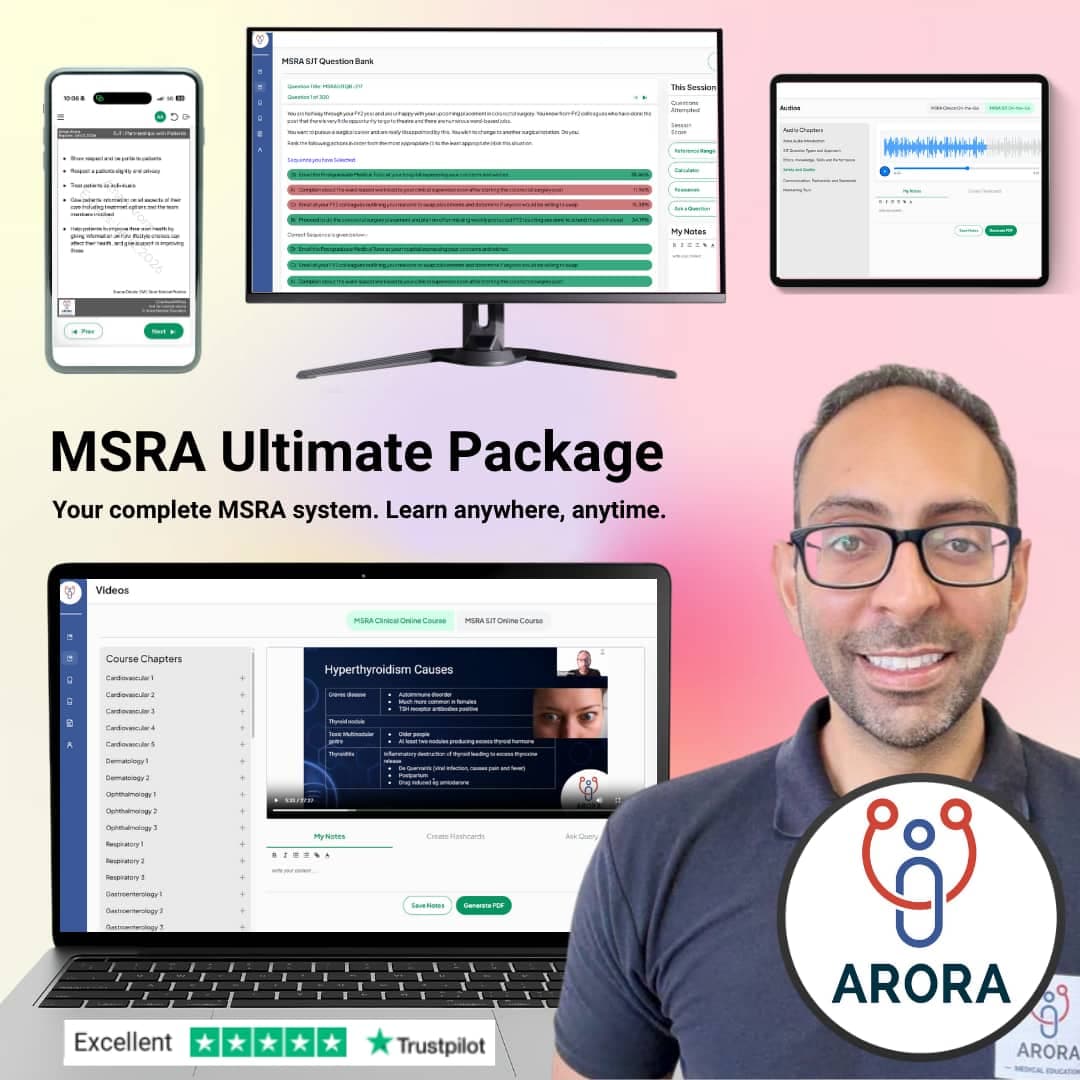
For our comprehensive All-in-one MSRA Ultimate Package click here.
Stage 3: Interview
Candidates who meet the MSRA cut-off are invited to interview.
Interviews are conducted online and usually include:
– A clinical scenario station focused on acute care
– A management or professional station assessing leadership, ethics and judgement
Interview scores are combined with MSRA scores to produce a final ranking.
Final Ranking and Job Offers
Following interviews:
– Applicants rank their preferred locations
– Final scores determine offer allocation
– Offers are made nationally
Because Emergency Medicine is run-through, securing an ST1 post sets you on a continuous pathway to CCT.
Common Questions About Emergency Medicine Applications
Do I need Emergency Medicine experience before applying?
Prior Emergency Medicine experience is helpful but not mandatory, provided you meet eligibility criteria.
Can IMGs apply for Emergency Medicine training?
Yes. Many IMGs successfully enter Emergency Medicine training each year.
Is MSRA the same for all specialties?
The same MSRA exam is used across multiple specialties, but cut-off scores and competition differ.
How Arora Medical Education Can Support You
Clear Teaching Built for Busy Doctors
If you want a guided path for the MSRA, our MSRA resources help you build confidence at each step. Everything is created by senior UK doctors with experience in the exam and in teaching.
You can choose:
– MSRA Ultimate – a full MSRA preparation system with question banks, videos, audios, live teaching, flashcards and mock exams.
– A live MSRA Crammer course held a few weeks before each sitting.
– Individual resources such as audios, videos, question banks or mocks.
Each option follows a clear plan that helps you stay organised and focused. Explore these more here.
Also:
– Get MSRA Updates and Teaching Emails here.
– Register for next Free MSRA Webinar here.
Final thoughts
Emergency Medicine is a challenging but deeply fulfilling specialty. Success in the application process depends less on background and more on understanding the system and preparing strategically.
If you are considering Emergency Medicine, start early, focus on MSRA performance and build a preparation plan that fits around real clinical work.
We wish you every success in your application.
#CanPassWillPass
Other blogs that may be helpful

Lead MSRA Tutor - Dr Aman Arora
Hi! I’m Dr. Aman Arora, a Portfolio GP with over a decade of clinical and teaching experience, dedicated to helping doctors achieve their goals with confidence. Having had the privilege of supporting more than 50,000 doctors worldwide across exams such as MRCGP AKT, SCA, MSRA, PLAB 2 and PLAB 1, I understand the challenges you face and the strategies needed to overcome them. Through personalised face-to-face sessions, engaging online courses, mocks, audio and a vibrant social media community, we’re here to guide you every step of the way.
Whether you’re looking to pass crucial exams or take the next big step in your medical career, we’re here to help you succeed. Feel free to get in touch with any thoughts, questions, or ideas — I look forward to working with you and being part of your journey.

Senior MSRA Tutor - Dr Pooja Arora
Dr Pooja Arora is a GP with a background in Medical Politics, where she passionately focuses on improving the opportunities and working conditions for junior doctors. She is proud to hold FRCGP (Fellow of Royal College of General Practitioners).
You can find out more about Pooja’s previous roles and qualifications here.