What is the GMC PLAB Exam?
If you are an international medical graduate planning to work as a doctor in the UK, this blog is for you.
Here we explain what the GMC PLAB exam is, who needs to take it, how the process works and answer the most common questions we hear from IMG doctors. The aim is to give you a clear, accurate overview so you can plan your route to UK practice with confidence.
– Get PLAB Updates and Teaching Emails here
– Register for next Free PLAB 1 or 2 Webinar here
– Pass PLAB 1 with Ultimate Package here
– Pass PLAB 2 with Academy SMART here
What is the GMC PLAB exam?
The Professional and Linguistic Assessments Board (PLAB) exam is the route used by international medical graduates (IMGs) to demonstrate that they meet the standard required to practise medicine in the UK.
PLAB is set and run by the General Medical Council (GMC) and sits under the UK Medical Licensing Assessment (UKMLA) framework. For IMG doctors, the UKMLA is delivered through PLAB 1 and PLAB 2.
The purpose of the PLAB exam is to show that an overseas-qualified doctor has the knowledge, clinical skills and professional judgement equivalent to a UK doctor entering Foundation Year 2 (FY2).
Passing both parts of the PLAB exam allows IMG doctors to apply for GMC registration, which is required before starting work in the NHS.
The two parts of the PLAB exam
The PLAB exam has two components:
– PLAB 1 – a written, single best answer exam that assesses applied medical knowledge based on UK best practice.
– PLAB 2 – an OSCE-style clinical exam that assesses practical, communication and professional skills in simulated clinical scenarios.
Each part tests different skills, and both must be passed to complete the PLAB pathway.
For detailed guidance on each exam:
– Read our full guide to PLAB 1 here.
– Read our full guide to PLAB 2 here.
PLAB exam dates and availability
PLAB 1 and PLAB 2 are held multiple times throughout the year.
– PLAB 1 is offered at exam centres worldwide, as well as in the UK.
– PLAB 2 is currently held in the UK only, at the GMC’s clinical assessment centres in Manchester.
Available dates, locations and booking windows are published on the GMC website, and candidates are advised to plan well in advance due to high demand, particularly for PLAB 2.
Who needs to take the PLAB exam?
You will usually need to take the PLAB exam if you are a doctor who qualified outside the UK and wish to work in the UK as a licensed doctor.
In general, PLAB is required if:
– You graduated from a medical school outside the UK, European Economic Area (EEA) or Switzerland, and
– Your primary medical qualification is not automatically recognised by the GMC.
For most international medical graduates, PLAB is the standard route to demonstrate that their knowledge and clinical skills meet the UK standard required for GMC registration.
Some doctors may be exempt from PLAB, for example if they hold an approved postgraduate qualification recognised by the GMC. These exemptions are specific and updated regularly, so it is important to check the GMC’s official guidance to confirm whether PLAB is required in your individual case.
If you are unsure whether you need to sit PLAB, the safest approach is to assume that you do and then verify your eligibility directly through the GMC before making any long-term plans.
Who can take the PLAB exam?
You can apply to sit the PLAB exam if you meet the following criteria set by the General Medical Council (GMC):
a) You hold a primary medical qualification (PMQ) that is acceptable to the GMC and listed in the World Directory of Medical Schools.
b) You have demonstrated English language proficiency, either by:
– Achieving an IELTS Academic score of at least 7.5 overall with a minimum of 7.0 in each section, or
– Achieving OET grade B in all four components.
You do not need to have completed your internship or foundation-level training to sit PLAB 1.
However, you must have completed an acceptable period of internship or equivalent postgraduate clinical experience before:
– Sitting PLAB 2, and
– Applying for GMC registration.
Because eligibility rules and exemptions can change, it is always advisable to confirm your individual eligibility using the GMC’s official PLAB guidance before booking your exam.
How many parts are there to the PLAB exam?
The PLAB exam has two parts: PLAB 1 and PLAB 2. You must pass both exams before you can apply for GMC registration and work as a doctor in the UK.
PLAB 1
PLAB 1 is a written exam that assesses applied medical knowledge based on UK best practice.
– It consists of 180 single best answer (SBA) questions.
– You are given 3 hours to complete the exam.
– The exam is delivered at approved test centres worldwide, including the UK and many international locations.
PLAB 1 focuses on how well you can apply clinical knowledge, rather than simply recall facts.
For full details, preparation guidance and resources, see our UKMLA PLAB 1 guide here.
PLAB 2
PLAB 2 is a practical, OSCE-style clinical exam that assesses real-world clinical skills.
– It takes place only in the UK.
– The exam is currently held at GMC clinical assessment centres in Manchester.
– You can only book PLAB 2 after successfully passing PLAB 1.
PLAB 2 assesses clinical reasoning, communication skills and professional behaviour through simulated clinical scenarios.
For full details and preparation options, see our UKMLA PLAB 2 guide here.

How long does the PLAB process take from start to finish?
The PLAB journey is not a single exam, but a process made up of several stages. How long it takes depends on your preparation, exam availability and how early you plan key steps.
For most IMG doctors, the entire PLAB process typically takes 12 to 24 months from initial preparation to full GMC registration.
Here is a realistic breakdown.
PLAB 1 preparation
– Most doctors spend 4–6 months preparing for PLAB 1.
– This depends on how recently you graduated, your baseline knowledge and how structured your study plan is.
PLAB 1 booking and results
– Exam dates run throughout the year, but popular locations fill quickly.
– Results are released around 6 weeks after the exam.
Gap between PLAB 1 and PLAB 2
– After passing PLAB 1, many doctors take 2–6 months before sitting PLAB 2.
– This time is often used for PLAB 2 preparation, Visa planning, Booking accommodation and travel.
– PLAB 2 dates are in high demand, so flexibility helps.
PLAB 2 preparation
Dedicated PLAB 2 preparation usually takes 4–8 weeks, depending on prior clinical exposure and confidence with UK-style consultations.
PLAB 2 results
Results are typically released within 3-5 weeks of sitting the exam.
After PLAB 2
– Once you pass PLAB 2, you can apply for GMC registration.
– If your EPIC verification is already complete, this step is usually straightforward.
– Without EPIC, this can add several additional weeks or months, which is why early planning is strongly recommended.
In summary
– Fastest possible route (well planned): 9–12 months
– More typical timeline: 12–18 months
– Delays due to bookings, visas or documentation: up to 24 months
The key takeaway is that early planning matters as much as exam preparation. Most delays happen not because of exams, but because of visas, EPIC verification or late booking decisions.
What is the UKMLA and how does it relate to PLAB?
The UK Medical Licensing Assessment (UKMLA) is the GMC’s single licensing framework for all doctors who want to practise in the UK.
For UK medical students, UKMLA is embedded within their medical degree and consists of two parts:
– An Applied Knowledge Test (AKT)
– A Clinical and Professional Skills Assessment (CPSA)
For international medical graduates (IMGs), the route into the UKMLA framework remains PLAB 1 and PLAB 2.
– PLAB 1 maps to the UKMLA AKT
– PLAB 2 maps to the UKMLA CPSA
This means IMG doctors still book and sit PLAB 1 and PLAB 2, but the standard they are assessed against is aligned with UK medical graduates under the UKMLA.
If you are an IMG doctor preparing to work in the UK, you should continue to prepare for PLAB 1 and PLAB 2. We UKMLA in full, including how it applies to UK graduates, in our dedicated UKMLA guide.
Is PLAB similar to USMLE?
PLAB and USMLE are both medical licensing routes, but they serve different healthcare systems and work very differently.
PLAB (UK)
– PLAB is the licensing exam for international medical graduates who want to work in the UK.
– It is overseen by the General Medical Council (GMC).
– PLAB has two parts: PLAB 1 (written exam), PLAB 2 (clinical OSCE-style exam)
– After passing both parts, you can apply for GMC registration, which allows you to work as a doctor in the UK.
– You can apply for UK jobs after registration, without needing to secure a training post first.
USMLE (USA)
– USMLE is the licensing exam for doctors who want to work in the United States.
– It is overseen by the FSMB and NBME.
– USMLE consists of three steps.
– Some parts of USMLE can be taken during medical school.
– Passing USMLE alone does not allow you to work as a doctor.
– You must also secure a residency position, which is competitive and mandatory before clinical practice.
Key practical difference
– In the UK, PLAB → GMC registration → job application.
– In the US, USMLE → residency match → supervised training → independent practice.
In short, PLAB is generally a shorter and more direct route to clinical work, while USMLE is a longer pathway that depends heavily on securing residency training.
Are there any alternative routes to PLAB?
Yes. PLAB is the most common route to GMC registration, but there are a small number of alternatives depending on your training and experience.
– Sponsorship route – GMC-approved organisations sponsor doctors for supervised UK roles without PLAB.
– Acceptable postgraduate qualifications – Certain GMC-approved postgraduate exams can be used instead of PLAB.
– Specialist registration (CESR / CEGPR) – For doctors with extensive specialist or GP-level experience equivalent to UK training.
– GP registration route – For doctors who have completed recognised GP training overseas.
For the majority of IMG doctors, PLAB remains the most straightforward, predictable and commonly used route to GMC registration.
Alternative routes can be :
– Highly specific
– Often slower
– Suitable only for certain profiles
For full eligibility criteria and up-to-date guidance on each pathway, refer to the GMC website: https://www.gmc-uk.org/registration-and-licensing/join-our-registers
In summary, key steps
1. Decide the most appropriate route to GMC registration. For most IMG doctors, this remains the PLAB route.
2. Check your eligibility and apply for PLAB 1.
3. After passing PLAB 1, book PLAB 2, allowing enough time for visa and travel arrangements.
4. Consider using your UK stay for a clinical attachment, if appropriate.
5. After passing both parts, apply for GMC registration.
6. Once registered, apply for your first NHS job or for a training programme.
Preparing for PLAB 1 and PLAB 2
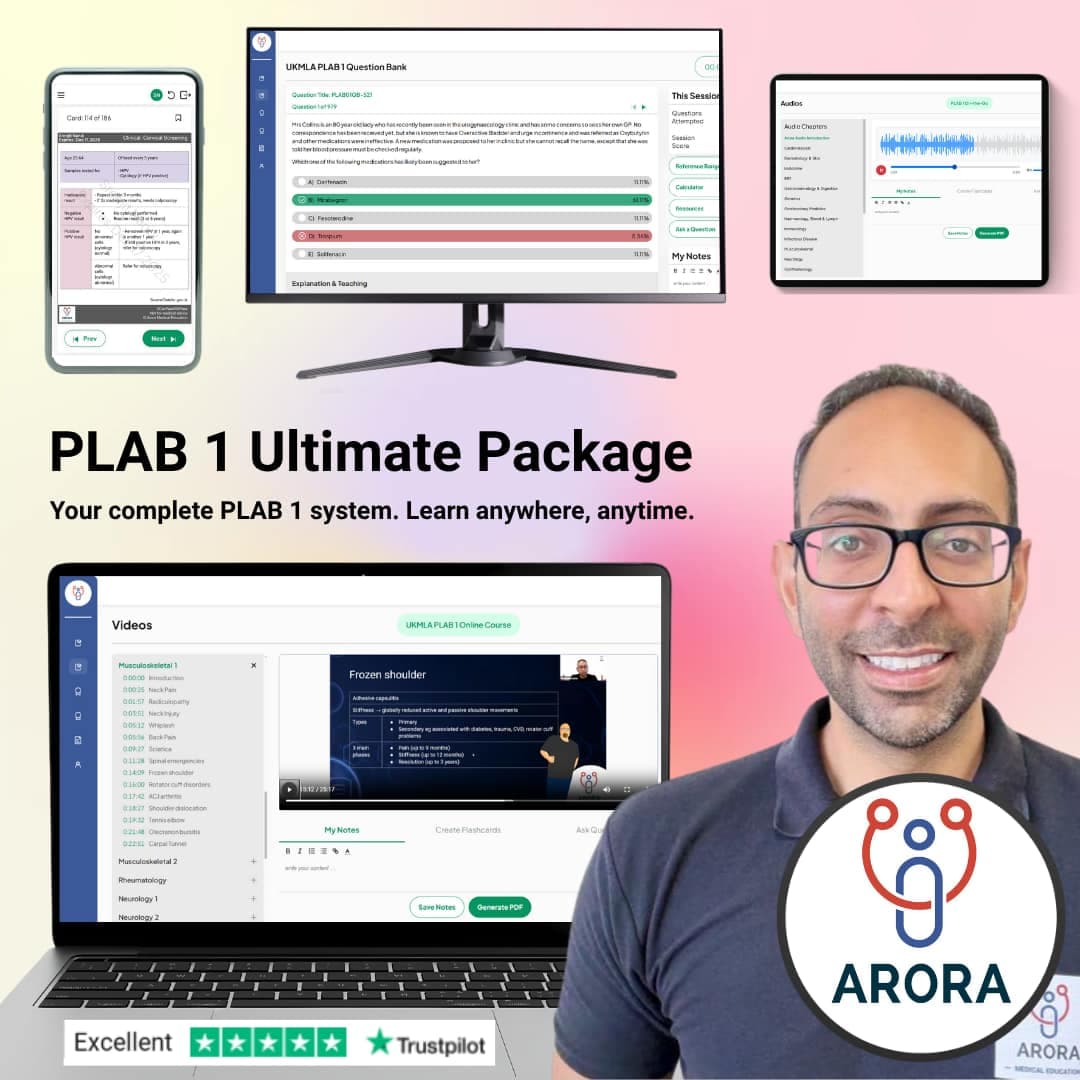
If preparing for UKMLA PLAB 1 then our resources are here (including our UKMLA PLAB 1 Ultimate Package).
If preparing for UKMLA PLAB 2 then our resources are here (including our UKMLA PLAB 2 Academy SMART Package).
How Arora Medical Education Can Support You for PLAB 1
Clear Teaching Built for Busy Doctors.
If you want a guided path, our PLAB 1 resources help you build confidence at each step. Everything is created by senior UK NHS clinicians and previous PLAB examiners with experience in the exam and in teaching.
You can choose:
– PLAB 1 Ultimate – a full PLAB 1 preparation system with question banks, videos, audios, live teaching, flashcards and mock exams.
– A live PLAB 1 Crammer course held a few weeks before each sitting.
– Individual resources such as audios, videos, question banks or mocks
Each option follows a clear plan that helps you stay organised and focused. Explore these more here.
Also:
– Get PLAB 1 Updates and Teaching Emails here.
– Register for next Free PLAB 1 Webinar here.

Lead PLAB Tutor - Dr Aman Arora
Hi! I’m Dr. Aman Arora, a Portfolio GP with over a decade of clinical and teaching experience, dedicated to helping doctors achieve their goals with confidence. Having had the privilege of supporting more than 50,000 doctors worldwide across exams such as MRCGP AKT, SCA, MSRA, PLAB 2 and PLAB 1, I understand the challenges you face and the strategies needed to overcome them. Through personalised face-to-face sessions, engaging online courses, mocks, audio and a vibrant social media community, we’re here to guide you every step of the way.
Whether you’re looking to pass crucial exams or take the next big step in your medical career, we’re here to help you succeed. Feel free to get in touch with any thoughts, questions, or ideas — I look forward to working with you and being part of your journey.

Senior PLAB Tutor - Dr Pooja Arora
Dr Pooja Arora is a GP with a background in Medical Politics, where she passionately focuses on improving the opportunities and working conditions for junior doctors. She is proud to hold FRCGP (Fellow of Royal College of General Practitioners).
You can find out more about Pooja’s previous roles and qualifications here.