


The CREST Form Explained: Who Needs It, Who Can Sign It and How to Avoid Common Mistakes
We regularly get asked about the CREST form by doctors preparing to apply for UK specialty training, and it is one of those documents that causes more anxiety than it needs to. CREST stands for Certificate of Readiness to Enter Specialty Training. It is the form that lets you demonstrate you have reached the same standard of foundation level competence as a UK doctor who completed the Foundation Programme, even though you have not gone through that programme yourself. Get it wrong and your application can be rejected before anyone even looks at your portfolio or interview score, so it is worth getting right well before your submission deadline.
In short: if you have not completed a UK Foundation Programme and are not already in UK specialty training, you almost certainly need a CREST form. Only the 2024 version is accepted. It must be signed by a consultant or equivalent who has supervised you continuously for at least 3 months within the past 3.5 years, and every single competency on it has to be signed off. The rest of this guide walks through the detail.
– Join National MSRA WhatsApp teaching group here
– Get MSRA Updates and Teaching Emails here
– Register for next Free MSRA Webinar here
– Pass with MSRA Ultimate Package here
What is the CREST form?
The CREST form is a sign-off from a senior doctor confirming you have achieved the professional capabilities expected of a UK Foundation Programme graduate. These cover good clinical care, safe prescribing, communication, working relationships with colleagues, teaching, professional behaviour, and recognising and managing an acutely unwell patient. If you have not completed a UK Foundation Programme and do not hold a Foundation Programme Certificate of Completion, this is how you prove you are ready to start at CT1 or ST1 level.
Which version of the CREST form is currently accepted?
Only the 2024 version is accepted, and there are two acceptable variants of it: the original 2023 release and the September 2024 update, which added an applicant checklist. Older versions, including the well known 2021 form, are no longer valid and will be rejected outright. The form has also been deliberately simplified compared to earlier years, with the detailed clinical care descriptors reduced to a smaller set of broader statements, which makes it considerably easier to get signed off during a normal working post.
NHS England reconfirms which recruitment rounds the 2024 form covers each year, and the wording on their site updates accordingly. Rather than quoting a specific entry year that will go out of date, our advice is simple: check the current confirmation on the official CREST page before you submit, to make sure the form still applies to the round you are applying into, and that no newer version has since replaced it.
Who actually needs to complete a CREST form?
You need a CREST form if you have not completed a UK Foundation Programme within the 3.5 years before your intended start date, and you are not already in UK specialty training holding a National Training Number or Deanery Reference Number. This is the situation most IMG doctors find themselves in, since most have completed an internship or equivalent clinical training in their home country rather than a UK-style Foundation Programme.
To be eligible, you generally need two things. First, 12 months of experience after achieving full GMC registration, or the equivalent post-licensing experience in your own country, by the time your specialty post starts. Second, a signatory who has personally supervised you for a continuous period of at least 3 months whole-time equivalent, within the 3.5 years before your post start date.
If you trained outside the UK without a formal internship, official guidance recognises a few accepted patterns for building up the necessary broad clinical exposure. Most commonly this is a 12 month pre-registration internship or FY1-equivalent post followed by a further 12 months of approved or acute clinical experience, which in practice often adds up to around 24 months in total. Because the exact route depends on your individual training history, it is worth reading the full Evidence of Foundation Competence Applicant Guide rather than assuming one figure applies to everyone.
When should I not use the CREST form?
A few situations call for a different document entirely. If you completed a UK Foundation Programme within the last 3.5 years, you need your Foundation Programme Certificate of Completion, not a CREST. If you are already working in UK specialty training and hold a National Training Number or Deanery Reference Number, your foundation competence is already considered assessed and you do not need to submit anything further. If you previously held an NTN or DRN in the same specialty and resigned voluntarily, you may also be exempt, provided you can show satisfactory progress through ARCP documentation, though this route is less common and worth confirming directly with your specialty’s recruitment office.
And if you started but did not satisfactorily complete a UK Foundation Programme or an FY2 standalone post, or only completed an F1 standalone post, the CREST form is not for you. In that case, approach the Foundation School Director where you previously trained to discuss returning to complete your training, or, where there were genuine exceptional circumstances such as illness or caring responsibilities, ask the relevant Postgraduate Dean to complete the Dean’s Supporting Declaration proforma on your behalf instead.
Who can sign the CREST form?
Your signatory has to be a consultant or equivalent: this covers consultants, GPs, clinical directors, medical superintendents, academic professors, locum consultants who hold a CCT or CESR and sit on the specialist register, and SAS doctors acting in an educational supervisor capacity. They must have supervised you continuously for at least 3 months whole-time equivalent, wholly within the 3.5 years before your advertised post start date. Clinical attachments or observerships do not count toward this, and they cannot be your spouse, partner, family member, or anyone with whom you have a close personal relationship.
It is worth knowing who can contribute supporting evidence without being the actual signatory, since this trips a lot of applicants up. A locum consultant who is not on the specialist register, a pharmacist, a consultant who was still a trainee while working with you, a retired consultant, or someone who qualified as a consultant before 1997 and so never joined the specialist register, can all provide evidence to your signatory. None of them can sign the certificate themselves.
If your signatory is not registered with the GMC, you need current evidence of their registration with their own country’s medical regulatory authority. This must be translated into English by a certified translator if it is not already in English, and historic GMC registration is not acceptable, even if your signatory was once on the register. Their contact details should come from an institutional email address rather than a personal one such as Gmail or Hotmail, and any hospital stamp used on the form needs to show the hospital’s details, not just the signatory’s name and title.
Can I reuse a previous CREST form?
No. Only the 2024 version is accepted, and you can only submit one CREST document per recruitment round. That single document is then used across every application you make within that round, including, where relevant, an Academic Clinical Fellowship application, since ACF recruitment is linked to Round 1 for CREST purposes.
Do all the competencies need to be signed off?
Yes, without exception. You must be rated as demonstrated for every single professional capability on the form. If your signatory marks even one as “unable to confirm,” you will not meet the eligibility requirement for that recruitment round, regardless of how strong the rest of your application is. If you have not had the chance to demonstrate a particular capability in one post, you can bring additional evidence to your signatory, who can use it in place of direct observation if they are satisfied it shows competence.
Does my signatory have to personally witness every competency?
Not necessarily. Your signatory can rely on evidence from senior colleagues who have observed specific competencies, provided those colleagues are working at ST5 level or above and their details are recorded on the form. A non-senior colleague, such as an FY2 or ST1 doctor, cannot be used as a witness even if they genuinely did observe the competency in question. If you have worked in the UK for 3 or more months in an acute post within the last 3.5 years, it is generally simpler to use a UK-based signatory from that post rather than an overseas one, since it avoids the extra registration evidence requirements.
What if my CREST form is rejected or incomplete?
It is not necessarily game over. You are usually given one opportunity to resubmit the correct, fully completed version, within 72 hours of being notified of the error. Any changes on a resubmitted form must be signed and dated by the same original signatory, not a different one. If the resubmission is still wrong or incomplete, your application will not progress any further in that round, so treat the 72 hour window as a genuine last chance rather than a safety net. Working through the checklist built into the 2024 form before you submit is the simplest way to avoid needing it at all, since recruiting teams do not have the capacity to check individual forms for errors before the deadline.
What about Advanced Life Support training?
Older versions of the CREST form asked for explicit confirmation of ALS-level training. The 2024 version moved away from naming a specific course and instead asks your signatory to confirm you can recognise and manage a patient who needs urgent intervention. In practice this means you do not need a specific ALS certificate to get your CREST signed, but you should still be genuinely comfortable managing an acutely deteriorating patient, since this underpins the person specification for CT1 and ST1 entry across every specialty.
Will the 2024 CREST form remain valid for future rounds?
For you personally, yes, provided the conditions you originally met still apply at your new intended start date. Separately, NHS England also confirms each year which recruitment rounds the 2024 form version itself covers, in case a newer version is introduced. Both of these are worth a quick check on the official CREST page before each new application cycle, rather than assuming nothing has changed.
A note for GP applicants
Some GP recruitment rounds offer an extended deadline for submitting your CREST form. If this applies to you, you need to actively tick the relevant box on your application to request it, and check the current GPNRO website for the exact dates in your round, since these can shift year to year. For a fuller picture of the GP application process itself, our guide on how to get into UK GP training walks through the route from registration through to ST1.
Where CREST fits into your wider specialty application
CREST is just one piece of a longer pathway. For most IMG doctors, the route runs from PLAB or UKMLA and full GMC registration, through building the clinical experience needed for CREST eligibility, sitting the MSRA where it applies to your specialty, and submitting a complete Oriel application. If you are still working out the earlier stages, our guide on the GMC PLAB exam is a good starting point, and our MSRA exam guide covers what comes next for most specialties, including GP, Psychiatry, Radiology, Emergency Medicine and Core Surgical Training. The CREST form itself is specialty-agnostic, so whichever pathway you are heading toward, the eligibility rules above apply in the same way.
How Arora Medical Education Can Support You
Clear Teaching Built for Busy Doctors
Once your CREST is sorted, the MSRA becomes the next major factor in most specialty applications, including GP, Psychiatry, Radiology and Core Surgical Training. Our MSRA resources are built by senior UK doctors with direct experience of the exam and the wider specialty recruitment process.
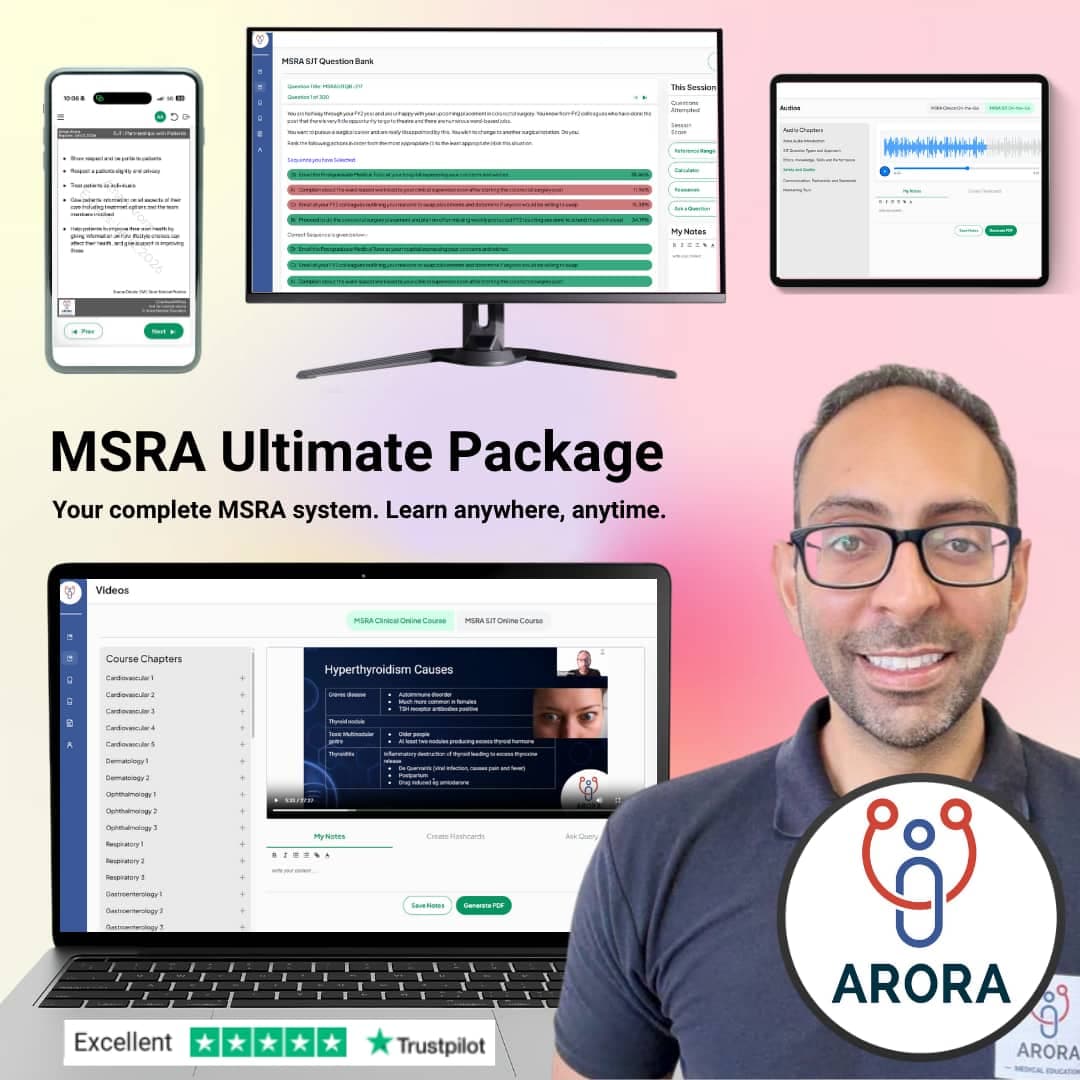
You can choose the MSRA Ultimate package, a complete preparation system with question banks, videos, audios, live teaching, flashcards and mock exams, a live MSRA Crammer course held a few weeks before each sitting, or individual resources such as audios, videos, question banks or mocks if you prefer to build your own plan. Explore these in more detail here.
You can also join the National MSRA WhatsApp teaching group here, get MSRA updates and teaching emails here, and register for the next free MSRA webinar here.
Final thoughts
Print out the CREST form early and read through every capability before you approach a potential signatory. Work out who has genuinely supervised you continuously for at least 3 months within the last 3.5 years, not just someone who has seen you around the department, and start gathering their registration evidence well before your deadline, especially if they are based outside the UK. The form is more straightforward than it used to be, but getting a detail wrong is still costly, so give yourself time rather than leaving it until the week your application is due.
If you are ever in doubt about how a rule applies to your specific situation, check directly with the relevant recruitment team, such as GPNRO for GP training, rather than relying on second-hand advice.

Author Bio — Dr Aman Arora
Hi! I’m Dr. Aman Arora, a Portfolio GP with over a decade of clinical and teaching experience, dedicated to helping doctors achieve their goals with confidence. Having had the privilege of supporting more than 50,000 doctors worldwide across exams such as MRCGP AKT, SCA, MSRA, PLAB 2 and PLAB 1, I understand the challenges you face and the strategies needed to overcome them. Through personalised face-to-face sessions, engaging online courses, mocks, audio and a vibrant social media community, we’re here to guide you every step of the way.
Whether you’re looking to pass crucial exams or take the next big step in your medical career, we’re here to help you succeed. Feel free to get in touch with any thoughts, questions, or ideas — I look forward to working with you and being part of your journey.

Author Bio — Dr Pooja Arora
Dr Pooja Arora is a GP with a background in Medical Politics, where she passionately focuses on improving the opportunities and working conditions for junior doctors. She is proud to hold FRCGP (Fellow of Royal College of General Practitioners).
You can find out more about Pooja’s previous roles and qualifications here.
Other blogs that may interest you