


7 Biggest Mistakes Doctors Make When Preparing for the MSRA (And How to Fix Them)
Most doctors who underperform in the MSRA are not short on ability. That is the pattern that keeps showing up, sitting after sitting, having worked with thousands of doctors preparing for this exam and having written questions for it myself. Candidates put in the hours, work through enormous numbers of practice questions, and still lose marks in the same handful of places.
None of the seven mistakes below come down to how hard someone has worked. They come down to where the effort gets pointed, and all seven are fixable once you can see them clearly. Three sit on the clinical side, two on the SJT, and two on how preparation is planned and paced. Here they are.
– Join National MSRA WhatsApp teaching group here
– Get MSRA Updates and Teaching Emails here
– Register for next Free MSRA Webinar here
– Pass with MSRA Ultimate Package here
Mistake 1: Preparing as if the MSRA were pass or fail
The MSRA has no fixed pass mark. Scores are scaled against everyone else sitting that year, to a mean of around 250 with a standard deviation of 40, so there is no ceiling and no single number to aim for. For General Practice, the score alone decides your ranking and where you are placed. For Core Psychiatry, it works the same way. For most other specialties it shortlists or contributes heavily to your interview invitation.
This changes what “enough preparation” actually means. A junior doctor who studies until the material feels comfortable, then stops, is optimising for a bar that doesn’t exist. The real question is not whether you know enough to get through. It is whether you are still improving relative to the thousands of other doctors sitting alongside you. That is a different kind of preparation. It means tracking your own trend over time, not just your raw score on any single mock, and continuing to push in the weeks before the exam even once your results start to feel solid.
This is one of the reasons the Arora MSRA question bank surfaces weak areas from your actual answered questions rather than leaving you to guess, because in a competitive ranking exam, the marks you don’t know you’re losing are the ones that cost the most.
Mistake 2: Revising the specialties you already feel confident in
The Clinical Problem Solving paper is built around twelve clinical topic areas, covering cardiovascular, respiratory, musculoskeletal, endocrine and metabolic medicine through to paediatrics, reproductive health, dermatology and psychiatry, weighted fairly evenly across the paper. In practice, most candidates don’t revise them evenly. Cardiology and respiratory medicine get the most attention because they show up daily on the wards. Paediatrics, obstetrics and gynaecology, ophthalmology and psychiatry get pushed down the list, not because they are harder, but because they are further from whatever a candidate’s current rotation happens to be.
That gap is entirely understandable. It is also exactly where marks are lost, because the exam doesn’t weight a topic by how recently you’ve seen it in practice. The safest way to catch this is to stop relying on how confident a topic feels and let your actual performance data show you where the gaps sit.
This is precisely what the AI-guided weak area targeting inside the Arora MSRA question bank is built to do, rather than leaving you to correctly guess which of the twelve areas needs more time.
Mistake 3: Trusting first instinct instead of reasoning it through
In Professional Dilemmas, the answer that comes to mind fastest is rarely the best one. Candidates read a scenario and go with their gut reaction, the response that feels intuitively right in the moment, rather than pausing to reason it through properly against what good professional practice actually requires. Under time pressure this happens more than people notice, because a scenario feels familiar and the instinctive answer feels obviously correct.
The trouble is that first instinct is often a reflex: keep things moving, avoid conflict, handle it quietly without involving anyone else. Worked through properly, against GMC Good Medical Practice and the principles of patient safety, honesty, timely escalation and working within your own competence, the better answer is frequently a different one. Take loyalty to a colleague versus protecting a patient. The instinctive response may often lean toward giving a colleague the benefit of the doubt or managing things quietly. Reasoned through properly, honest escalation is nearly always the safer and more professional course, even when it feels socially uncomfortable in the moment.
The fix isn’t to abandon your initial judgement. It’s to slow the reasoning down. Read the scenario, resist the pull of whatever answer arrives first, and work through what proper practice actually requires before committing to a ranking. That extra five or ten seconds of deliberate thought, rather than gut reaction, is often the whole difference between a strong and a weak score on this paper.
Mistake 4: Under-investing time because there's "less to revise"
Clinical Problem Solving has an obvious syllabus. Guidelines, drug doses, diagnostic criteria, management pathways, all things you can sit down and work through. Professional Dilemmas doesn’t have that same body of material to get through, and that difference quietly shapes how candidates split their time. If there’s nothing to memorise, it can feel like there’s nothing left to prepare, so Professional Dilemmas gets pushed to the side, or left as something to “figure out on the day” using common sense.
That’s a mistake, because less material to revise doesn’t mean less preparation is needed. It means a different kind of preparation. Scoring well on this paper comes from consistent, structured practice: working through scenarios methodically, applying GMC Good Medical Practice principles the same way every time, and recognising the patterns that keep showing up across different question types. That takes deliberate, repeated practice to build, in the same way consultation technique takes practice beyond just knowing the guidelines. Candidates who give Clinical Problem Solving the bulk of their revision time and assume Professional Dilemmas will sort itself out on the day are often surprised by how much it actually costs them.
The fix is simple: treat Professional Dilemmas as a paper that needs its own dedicated revision slots, not the leftover time once clinical revision is done.
Mistake 5: Never practising under real time pressure
The Clinical Problem Solving paper gives you under 47 seconds per question, 97 questions in 75 minutes. Professional Dilemmas gives you longer per item, but the stems are wordier and the ranking questions demand more processing before you can commit to an order. Candidates who only practise in relaxed, untimed blocks build clinical and ethical reasoning that works perfectly well when there’s no clock. On the day, that same reasoning collapses under real pace, and it’s almost always the back third of each paper where it shows, rushed answers, or questions left unread properly because time is running out.
The fix is straightforward but easy to skip: build timed practice in from early on, not just in the final fortnight. Full-length timed mocks, like the ones included in the MSRA Ultimate Package, train the specific skill of moving on from a question you’re unsure of rather than dwelling on it, which matters more in this exam than almost any other single piece of technique.
Mistake 6: Doing isolated practice but never the full exam sequence
The MSRA is sat as a single session. Professional Dilemmas comes first, followed by a five-minute break, then straight into Clinical Problem Solving. If the break runs over five minutes, the excess is taken directly off your Clinical Problem Solving time. Once Clinical Problem Solving begins, there is no going back to change a Professional Dilemmas answer.
Most candidates practise in separate blocks, a set of clinical questions here, an SJT session there, rarely both together in the order and time frame of the real thing. That means the specific fatigue of finishing 95 minutes of ethical reasoning and immediately switching into fast clinical decision-making is something they meet for the first time on exam day. Sitting a small number of full-length mocks that replicate the real sequence, ideally more than once, closes that gap before it costs marks. It’s a different kind of tired to what most revision prepares you for, and it’s worth knowing what that feels like in advance.
Mistake 7: Starting too late for how broad the syllabus is
Most candidates underestimate how much of the MSRA content sits outside their current day-to-day practice. Between the breadth of the twelve clinical topic areas and the full range of GMC-aligned professional scenarios, three months is a realistic minimum for most doctors, longer if it’s been a while since some of the less familiar specialties were part of your daily work. Candidates who start three or four weeks out consistently run out of runway on exactly the topics they’d have needed the most time for, usually the same ones flagged in mistake two.
A simple weekly plan against the twelve topic areas and the core SJT domains, built early rather than assembled under pressure later, solves most of this on its own. If it helps to start from something already built rather than from a blank page, the free Arora MSRA planner maps this out day by day across both papers.
What this means for your preparation
None of these seven mistakes are about how capable a candidate is. They’re about where attention goes, and a vague sense that “I should probably do more MSRA prep” is much harder to act on than a specific, named pattern.
What you can do about each one:
– Prepare to out-rank your cohort, not to scrape past an imaginary pass mark. Track your trend over time, not just a single score.
– Let your actual question bank performance decide which of the twelve clinical topics needs more time, not how comfortable a topic feels.
– Before answering a Professional Dilemmas question, ask what Good Medical Practice would say, not solely what your gut instinct says.
– Give Professional Dilemmas its own dedicated revision time, rather than assuming less material to memorise means less preparation is needed.”
– Build timed practice in from early in your revision, not just the final few weeks.
– Sit at least one or two full-length mocks that replicate the real Professional Dilemmas-then-Clinical Problem Solving sequence, break included.
– Start with a structured plan against the full syllabus, at least three months out where possible, rather than letting a question bank’s own order set your pace.
Doctors who prepare this way tend to see it show up directly in their ranking, not because they worked harder than everyone else, but because the effort went to the places actually being marked.
How Arora Medical Education Can Help
Clear Teaching Built for Busy Doctors
If you want a guided path, our MSRA resources help you build confidence at each step. Everything is created by senior UK doctors with experience in the exam and in teaching.
You can choose:
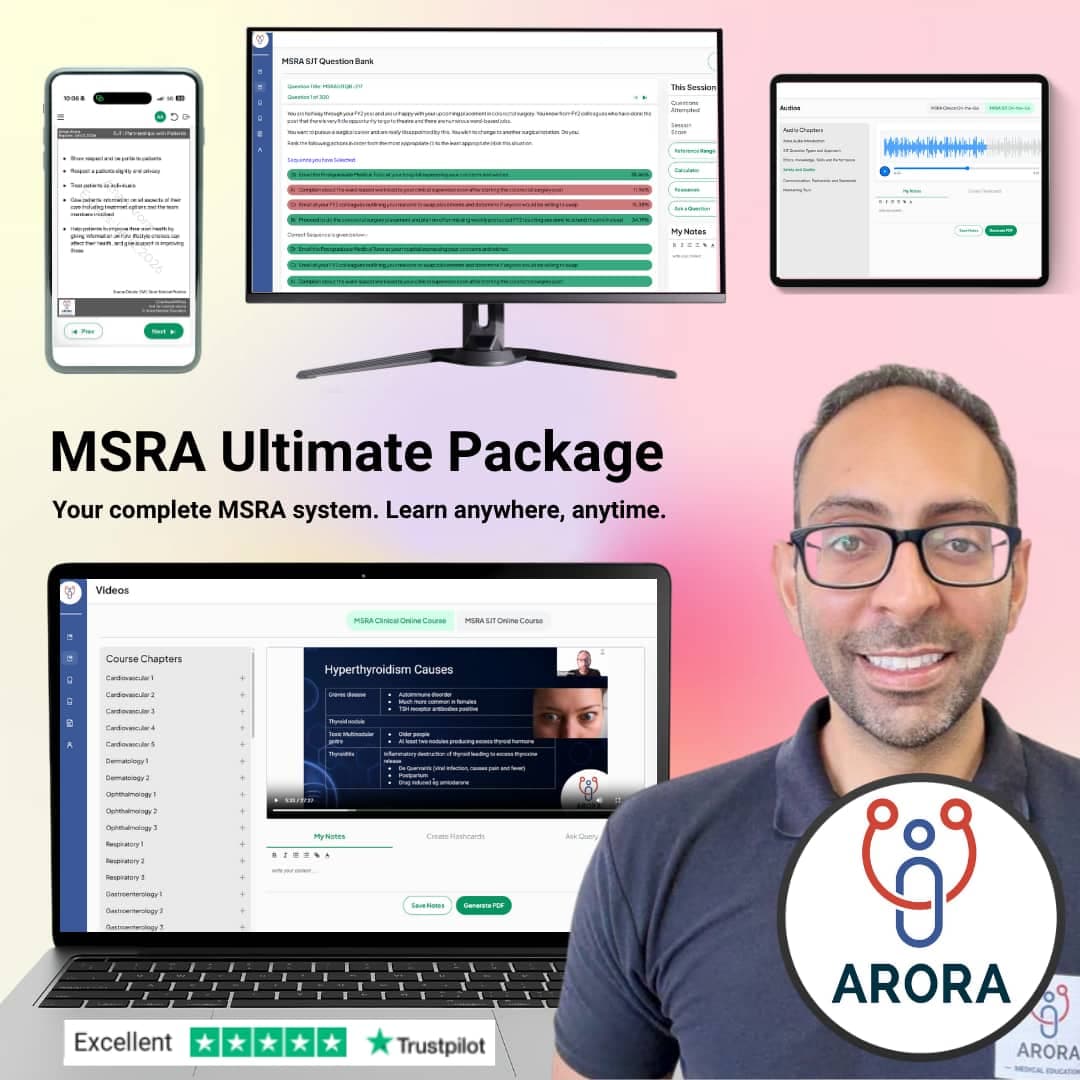
– MSRA Ultimate – a full MSRA preparation system with question banks, videos, audios, live teaching, flashcards and mock exams.
– A live MSRA Crammer course held a few weeks before each sitting.
– Individual resources such as audios, videos, question banks or mocks.
Each option follows a clear plan that helps you stay organised and focused. Explore these more here.
Also:
– Join National MSRA WhatsApp teaching group here
– Get MSRA Updates and Teaching Emails here
– Register for next Free MSRA Webinar here

Author Bio — Dr Aman Arora
Hi! I’m Dr. Aman Arora, a Portfolio GP with over a decade of clinical and teaching experience, dedicated to helping doctors achieve their goals with confidence. Having had the privilege of supporting more than 50,000 doctors worldwide across exams such as MRCGP AKT, SCA, MSRA, PLAB 2 and PLAB 1, I understand the challenges you face and the strategies needed to overcome them. Through personalised face-to-face sessions, engaging online courses, mocks, audio and a vibrant social media community, we’re here to guide you every step of the way.
Whether you’re looking to pass crucial exams or take the next big step in your medical career, we’re here to help you succeed. Feel free to get in touch with any thoughts, questions, or ideas — I look forward to working with you and being part of your journey.

Author Bio — Dr Pooja Arora
Dr Pooja Arora is a GP with a background in Medical Politics, where she passionately focuses on improving the opportunities and working conditions for junior doctors. She is proud to hold FRCGP (Fellow of Royal College of General Practitioners).
You can find out more about Pooja’s previous roles and qualifications here.