


MRCGP SCA Time Management: Why Speed Isn’t the Answer (And What Actually Works)
If you’re practicing for the MRCGP SCA, you have probably already had the experience of looking up at the clock with two minutes left and a management plan you have barely started. It is one of the most common frustrations GP trainees describe, and the usual advice, talk faster, cut the small talk, rush the examination findings, tends to make things worse rather than better. Speed is not the problem. The problem is almost always what you are spending your twelve minutes on. This blog explains how to think about SCA time management properly, using the structure we teach trainees who go on to pass with real time to spare.
– Join SCA WhatsApp Teaching Group here
– Get SCA Updates and Teaching Emails here
– Register for next Free SCA Webinar here
– Pass with SCA Ultimate Package here
What Most Trainees Get Wrong About SCA Time Management
The first thing to understand is that there is no single time template that works across every case. A hip pain case and a depression review do not deserve the same shape of consultation, because they are not asking you to do the same job. A hip pain case might need a tighter data gathering phase and more time on shared decision making, practical support and discussions around imaging or referral. A depression case might need almost the opposite balance, with more time spent understanding severity, risk and the patient’s own view of what has changed, and a shorter, clearer management discussion. Trainees who try to force every case into the same rigid split, six minutes for data gathering, six minutes for management, often find that the plan works for some cases and falls apart for others. The exam is not testing whether you can follow a stopwatch. It is testing whether you can adapt your consultation to the case in front of you.
This means the real skill is not learning to move faster. It is learning to recognise, quickly, what kind of case you are in and where the value actually sits within it.
Time Management Is About What You Leave Out, Not How Fast You Go
This is the part that catches most trainees out. When time is tight, the instinct is to speed up, to ask questions faster, to talk over the patient slightly, to rush through the same list you always ask. But a faster version of an unfocused consultation is still an unfocused consultation. It just happens to finish in eleven minutes instead of thirteen.
Real time management in the SCA comes from cutting the questions that make no difference to your diagnosis or management, not from asking every question more quickly. Every question you ask should be earning its place. If a question will not change what you think is going on, and will not change what you do about it, it is probably not worth the seconds it costs you. This is a mindset shift as much as a technical one. Instead of asking yourself “have I covered everything,” ask yourself “does this actually change anything.” Once that becomes automatic, most trainees find their consultations naturally tighten up, without ever feeling like they are rushing.
Use the Three Arora Bubbles to Find High Value Information Fast
This is where a structured approach to data gathering earns its keep. Rather than working through an exhaustive systems review on autopilot, focus your questioning around three areas: red flags, psychosocial context, and the patient’s ideas, concerns and expectations. We call these the ‘three Arora bubbles’, and the reason they work is that each one tends to surface information that genuinely changes your management, rather than information that simply fills time.
Red flag questions rule serious pathology in or out early, which matters both clinically and because examiners want to see that safety is front of mind from the start. Psychosocial questions often reveal links between life and medicine – frequently the detail that shapes a patient centred plan. And the patient’s ideas, concerns and expectations tell you what’s actually going on in their mind, which is usually not the same as what a textbook would assume.
Structuring your data gathering around these three ‘Arora Bubbles’ means you gather less information overall, but the information you do gather is doing far more work. That is what efficient data gathering looks like in practice, not fewer minutes spent, but fewer wasted questions.
The First Sixty to Ninety Seconds of Management Matter More Than You Think
Once you move into the management phase of a case, there is a strong temptation to take each issue one at a time, fully resolving the first before moving to the second. This feels methodical, but it is often where time management quietly falls apart. If you commit to finishing issue one completely before you even look at issue two, you have no way of knowing whether you have left yourself enough time for what comes next. By the time you realise you are short, you are already rushing, and rushing is what pushes trainees into talking faster, cutting the patient off and becoming doctor centred.
The alternative is what we teach as the Arora ‘golden first minute of management’ – through putting the issues on the table. Rather than diving straight into managing the first problem in detail, you take the first sixty to ninety seconds after data gathering to briefly name the issues you plan to address and give the patient a sense of the shape of the plan ahead. This does not mean resolving anything yet. It means showing, early and clearly, that you understand where the case needs to go, even if you cannot fully complete every element within the time available.
This one shift changes the whole feel of the remaining minutes. You are no longer racing through a list hoping to reach the end. You have already shown the examiner and the patient that you have a grip on the whole picture, and you can now work through it at a controlled pace, prioritising what matters most if time runs short rather than being caught out by it.
Aim for Endpoints, Not the Clock
Once the issues are on the table, the aim shifts from “finish the case in twelve minutes” to “reach certain endpoints by the time twelve minutes is up.” These endpoints include a clear working diagnosis that you have actually verbalised to the patient, a safe and specific management plan for the issues that matter most, and a safety net the patient will remember. If you are watching the clock and hoping to land somewhere sensible by the end, you are managing your anxiety, not your consultation. If you know exactly what you need to have achieved, and you have already told the patient what the plan will cover, you can check your progress at the halfway point and adjust deliberately, rather than only realising you are behind when there is no time left to fix it.
Watch for the Trap of Becoming Doctor Centred
There is an important warning here. When trainees feel time pressure, a common and understandable response is to take control of the consultation more tightly, talk a little faster, ask closed questions back to back, and stop leaving space for the patient to speak. This usually happens precisely when issues are being worked through one by one without ever being put on the table first, because the trainee feels they must get through everything before time runs out. It can feel like good time management in the moment, but it usually costs marks in Relating to Others, because cues get missed, the patient stops feeling heard, and the consultation starts to feel doctor centred rather than shared.
Good time management should never come at the cost of listening. If you find yourself talking over the patient or ignoring an emotional cue because you are worried about the clock, that is a sign to slow down for two or three seconds, acknowledge what you have just heard, and then continue. It costs almost no time and it protects marks that speed alone will never win you.
What You Can Do in Practice
– Before each practice case, take five seconds to ask what type of case this is and roughly where the value will sit, rather than defaulting to a fixed time split
– Run data gathering deliberately through the three Arora bubbles rather than a long systems checklist
– Practise the golden first minute of management: naming the issues you plan to cover before working through any of them in detail
– After each practice consultation, check whether you reached your endpoints, not just whether you finished on time
– Record yourself occasionally to check for signs of becoming doctor centred under time pressure, such as talking faster or missing an emotional cue
How Arora Medical Education Can Help
Clear Teaching Built for Busy Trainees.
If you want a guided path, our SCA resources help you build confidence at each step. Everything is created by senior UK GPs and educators with experience in the exam and in teaching.
You can choose:
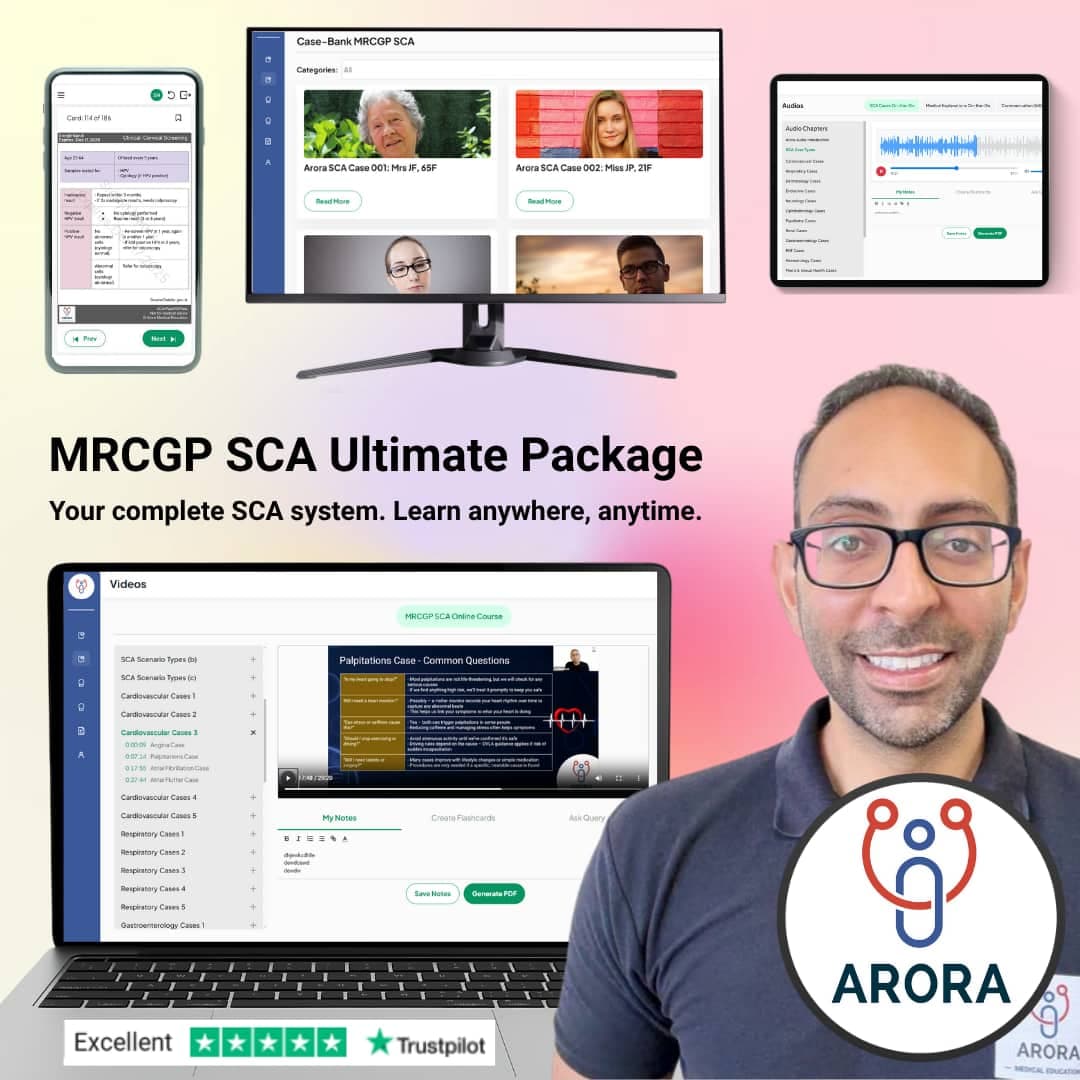
– SCA Ultimate – a full SCA preparation system with case banks, videos, audios, regular live teaching sessions, and flashcards.
– A focused 1-to-1 SCA Mock or Feedback session to work with a senior Arora GP tutor.
– Individual resources such as audios, videos, case banks or mocks.
Each option follows a clear plan that helps you stay organised and focused. Explore these more here.
Also:
– Join SCA WhatsApp Teaching Group here
– Get SCA Updates and Teaching Emails here
– Register for next Free SCA Webinar here
Other Blogs That May Help

Dr Aman Arora - Lead SCA Tutor
Hi! I’m Dr. Aman Arora, a Portfolio GP with over a decade of clinical and teaching experience, dedicated to helping doctors achieve their goals with confidence. Having had the privilege of supporting more than 50,000 doctors worldwide across exams such as MRCGP AKT, SCA, MSRA, PLAB 2 and PLAB 1, I understand the challenges you face and the strategies needed to overcome them. Through personalised face-to-face sessions, engaging online courses, mocks, audio and a vibrant social media community, we’re here to guide you every step of the way.
Whether you’re looking to pass crucial exams or take the next big step in your medical career, we’re here to help you succeed. Feel free to get in touch with any thoughts, questions, or ideas — I look forward to working with you and being part of your journey.

Dr Pooja Arora - Senior SCA Tutor
Dr Pooja Arora is a GP with a background in Medical Politics, where she passionately focuses on improving the opportunities and working conditions for junior doctors. She is proud to hold FRCGP (Fellow of Royal College of General Practitioners).
You can find out more about Pooja’s previous roles and qualifications here.
Other blogs that may interest you