


MRCGP International: What it is and How to Prepare
If you are a family doctor or GP working outside the UK, you may have come across the term MRCGP International, often written as MRCGP[INT].
It is a respected qualification linked to the Royal College of General Practitioners, and many doctors explore it as a way to demonstrate their commitment to high standards in family medicine.
But there is also a lot of confusion around it.
Does MRCGP International allow you to work as a GP in the UK? Is it the same as MRCGP UK? Do you need to take an AKT or clinical skills exam? Can UK MRCGP preparation resources help?
This guide explains what MRCGP International is, how it differs from MRCGP UK, who it is for and how to prepare effectively.
– Get MRCGP Updates and Teaching Emails here
– Register for next Free MRCGP Webinar here
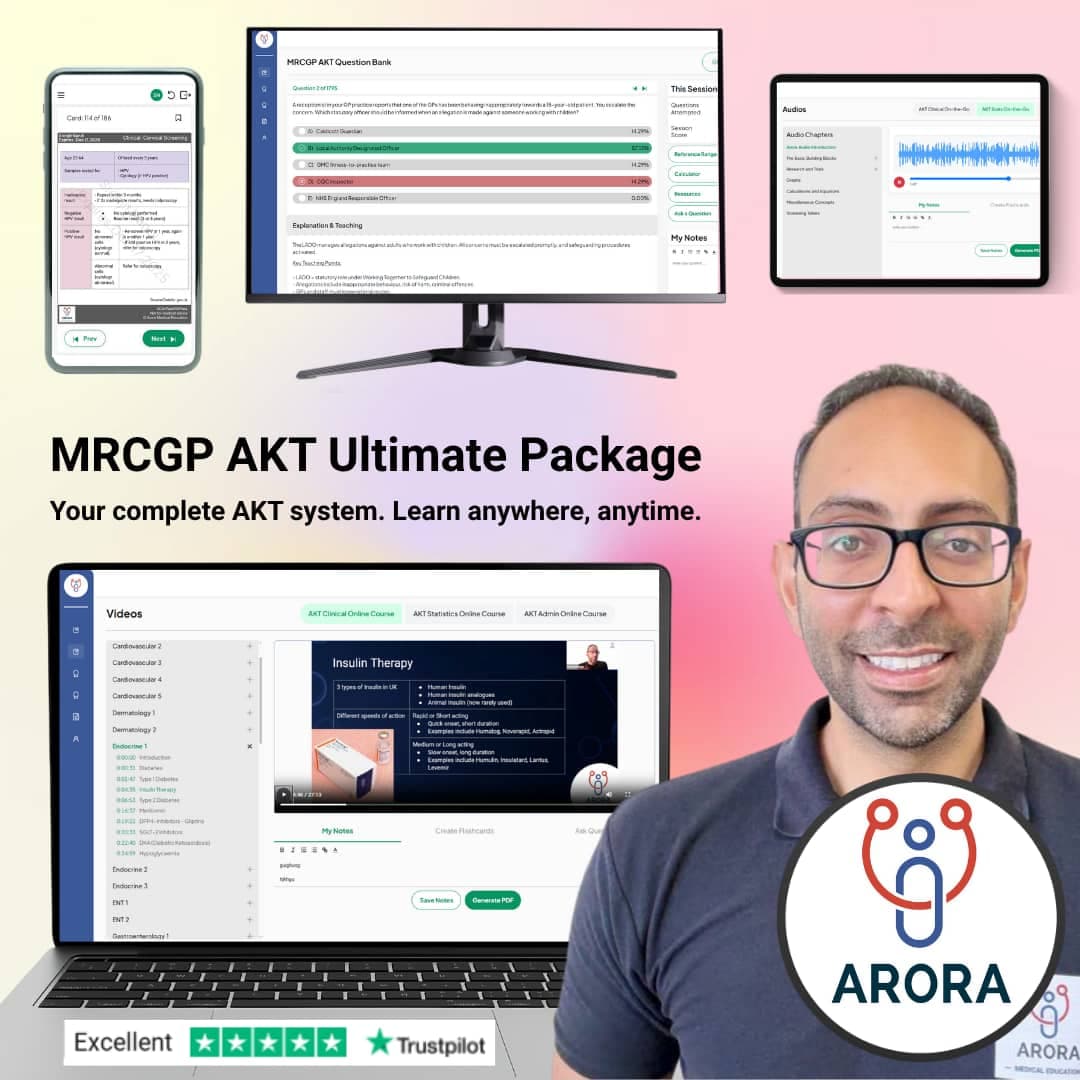
– Pass with AKT Ultimate Package here
– Pass with SCA Ultimate Package here
What is MRCGP International?
MRCGP International, or MRCGP[INT], is an international membership assessment accredited by the Royal College of General Practitioners.
It is designed for family doctors and GPs practising outside the UK. Passing an accredited MRCGP[INT] assessment allows doctors to apply for RCGP International Membership and use the post-nominals MRCGP[INT], as long as they remain members of the College.
The key point is that MRCGP[INT] is developed for the country or region where it is delivered. The RCGP states that each accredited assessment is suitable for candidates who plan to work in the country where they sit the assessment, and that local exams reflect local epidemiology, disease burden and medical practice.
So MRCGP International is not a single global exam taken in one identical format everywhere. It is an RCGP-accredited international assessment delivered through approved regional boards.
What does MRCGP International allow you to do?
Passing MRCGP[INT] can help demonstrate your commitment to family medicine, professional development and international standards in general practice.
It may support your career in the country or region where the exam is recognised. It can also allow you to apply for RCGP International Membership and access membership benefits linked to that grade.
However, one point must be very clear: MRCGP International does not give you the right to work as a GP in the UK.
The RCGP explicitly states that MRCGP[INT] accredited assessments do not give holders any right to practise as a GP in the UK.
This is one of the most common misunderstandings.
Can I use MRCGP International to work as a GP in the UK?
No. MRCGP International alone does not allow you to work as a GP in the UK.
To work as a doctor in the UK, you need appropriate GMC registration with a licence to practice. For many international medical graduates, this involves passing both parts of the PLAB route and completing the required internship or equivalent experience. The GMC states that IMGs applying through the PLAB route need to have passed both parts of PLAB within the required timeframe and completed an internship.
To work specifically as a GP in the UK, you also need to be on the GMC GP Register. MRCGP[INT] is not the same as completing UK GP specialty training and does not automatically place you on the UK GP Register.
If your long-term goal is to work as a GP in the UK, you should look carefully at the GMC and RCGP pathways to GP registration rather than assuming MRCGP International is enough.
MRCGP International vs MRCGP UK: what is the difference?
This is another common question.
MRCGP UK is the qualification completed by doctors in UK GP specialty training. It includes the UK MRCGP assessments: AKT, SCA and WPBA. The RCGP describes the AKT as assessing the knowledge base that underpins independent general practice in the UK NHS, the SCA as assessing clinical, professional and communication skills, and WPBA as assessing progress in areas best tested in the workplace.
MRCGP International is different. It is an accredited international assessment for doctors practising outside the UK, and each local version is based on the needs and curriculum of that country or region. The RCGP states that MRCGP[INT] curricula are unique to the country they were developed for and differ from the UK MRCGP curriculum.
In simple terms:
– MRCGP UK is for doctors completing UK GP training.
– MRCGP International is for family doctors practising outside the UK, through an accredited regional route.
They are linked to the same College, but they are not interchangeable.
Where is MRCGP International available?
MRCGP[INT] is available through accredited regional sites.
At the time of writing, RCGP lists accredited or region-specific MRCGP[INT] routes including Cyprus, Dubai, Egypt, Kosovo, Kuwait, Malta and South Asia. Eligibility and assessment format vary by region.
For South Asia, RCGP lists exam activity through regional centres in India, Pakistan, Sri Lanka and Bangladesh.
Because these arrangements can change, always check the official RCGP International Membership page and your regional MRCGP[INT] board before applying.
Who is eligible for MRCGP International?
Eligibility depends on the country or region where you are applying.
This is important. There is no single universal eligibility rule for every MRCGP[INT] route.
For example, RCGP lists different requirements for different regions. Dubai requires doctors either to have been eligible to practise independently as a GP or family physician for at least three years, or to be undertaking vocational GP training and have completed three years of training. South Asia requires completion of internship plus one of several recognised training or experience routes.
This means you must check the eligibility criteria for your specific region before spending time or money on preparation.
What does the MRCGP International exam involve?
The exact format depends on the region.
Many MRCGP[INT] routes include an applied knowledge component and a clinical skills component, but the details are set locally.
For example, South Asia has a two-part structure. The local regulations describe Part 1 as an Applied Knowledge Test and Part 2 as an OSCE. The same regulations state that candidates must pass both parts within a set period and that Part 2 attempts are limited.
Other regions may have different structures, depending on local accreditation and training arrangements.
The safest approach is to use the regional MRCGP[INT] website as the source of truth for:
– eligibility
– exam format
– application windows
– fees
– attempt limits
– results
– clinical exam structure
How should I prepare for MRCGP International?
The most important principle is this:
Prepare for the version of MRCGP[INT] you are actually sitting.
Because each regional exam reflects local practice, you should start with your regional board’s curriculum, regulations and sample materials.
That said, many doctors find UK MRCGP-style preparation helpful because the broad themes are similar:
– applied clinical knowledge
– safe decision-making
– evidence-based practice
– consultation structure
– communication skills
– managing uncertainty
– patient-centred care
This is where Arora Medical Education can help.
Our MRCGP AKT resources are useful for doctors preparing for applied knowledge style exams, especially where they need structured teaching, question practice, mock exams, audio learning and flashcards.
Our MRCGP SCA resources are useful for doctors preparing for consultation and clinical skills assessments, especially where they need help with structure, communication, case management and adapting to different patient scenarios.
You should still follow your local MRCGP[INT] guidance first, but UK MRCGP-style resources can strengthen the underlying skills that many international family medicine assessments are testing.
Arora MRCGP AKT courses: https://aroramedicaleducation.co.uk/course/mrcgp-akt
Arora MRCGP SCA courses: https://aroramedicaleducation.co.uk/course/mrcgp-sca
Common mistakes doctors make when preparing for MRCGP International
One common mistake is assuming MRCGP[INT] is identical to MRCGP UK. It is not. The RCGP is clear that MRCGP[INT] assessments are locally developed and based on the country where they are delivered.
Another mistake is preparing only with question banks. Questions are important, but they do not replace proper understanding of family medicine principles, local guidance and safe consultation technique.
A third mistake is leaving clinical skills preparation too late. If your regional exam includes an OSCE or simulated consultation, you need time to practise explaining, structuring and managing cases aloud.
The final mistake is not checking eligibility early. Some regions require specific training, internship or years of clinical experience. If you assume eligibility without checking, you may waste time preparing before you can actually apply.
Frequently asked questions about MRCGP International
Is MRCGP International the same as MRCGP UK?
No. MRCGP UK is completed by doctors in UK GP specialty training. MRCGP International is an accredited international assessment for family doctors outside the UK. The RCGP states that MRCGP[INT] curricula are unique to the country where they are developed and differ from the UK MRCGP curriculum.
Can I work as a GP in the UK with MRCGP International?
No. MRCGP[INT] does not give you the right to practise as a GP in the UK.
Does MRCGP International help my career?
It may help demonstrate professional commitment to family medicine and can make you eligible for RCGP International Membership if you pass an accredited assessment and register as an international member.
Is MRCGP International recognised everywhere?
Recognition depends on the country, employer and health system. It is designed for the country or region where the accredited assessment is delivered, so always check local recognition before applying.
Can Arora AKT and SCA resources help with MRCGP International?
Yes, they can help with underlying applied knowledge and consultation skills, especially if your regional exam includes an AKT-style written paper or clinical skills assessment. You should still use your regional MRCGP[INT] guidance as your main reference.
How Arora Medical Education Can Support You
If you want a guided path, our AKT and SCA resources help you build confidence at each step. Everything is created by senior UK doctors with experience in MRCGP exams and in teaching.
Arora MRCGP AKT courses: https://aroramedicaleducation.co.uk/course/mrcgp-akt
Arora MRCGP SCA courses: https://aroramedicaleducation.co.uk/course/mrcgp-sca
Final thoughts
MRCGP International can be a valuable qualification for family doctors practising outside the UK, but it needs to be understood correctly.
It is not the same as UK MRCGP.
It does not automatically allow you to work as a GP in the UK.
It is region-specific, locally developed and designed for doctors practising in the country where they sit the assessment.
If you are preparing for MRCGP[INT], start with your regional rules and curriculum. Then build strong foundations in applied knowledge, consultation structure and clinical decision-making.
That is where focused AKT and SCA-style preparation can make a real difference.
#CanPassWillPass

Dr Aman Arora
Hi! I’m Dr. Aman Arora, a Portfolio GP with over a decade of clinical and teaching experience, dedicated to helping doctors achieve their goals with confidence. Having had the privilege of supporting more than 50,000 doctors worldwide across exams such as MRCGP AKT, SCA, MSRA, PLAB 2 and PLAB 1, I understand the challenges you face and the strategies needed to overcome them. Through personalised face-to-face sessions, engaging online courses, mocks, audio and a vibrant social media community, we’re here to guide you every step of the way.
Whether you’re looking to pass crucial exams or take the next big step in your medical career, we’re here to help you succeed. Feel free to get in touch with any thoughts, questions, or ideas — I look forward to working with you and being part of your journey.

Dr Pooja Arora
Dr Pooja Arora is a GP with a background in Medical Politics, where she passionately focuses on improving the opportunities and working conditions for junior doctors. She is proud to hold FRCGP (Fellow of Royal College of General Practitioners).
You can find out more about Pooja’s previous roles and qualifications here.
Other blogs that may interest you