


How I Passed my MSRA Exam and got into GP Training: Dr Malvika Jayakanthan
If you are a doctor preparing for your MSRA exam, this blog is a must to help you pass. We are lucky to have Dr Malvika Jayakanthan – a doctor who recently passed her MSRA assessment and got accepted into GP Training – share her experience of how she prepared and passed…
– Join National MSRA WhatsApp teaching group here
– Get MSRA Updates and Teaching Emails here
– Register for next Free MSRA Webinar here
– Pass with MSRA Ultimate Package here
A little about me….
Hello! My name is Malvika and I’m an IMG from India. I am a GP trainee in Luton. I’ve worked in the NHS for over two years now rotating in Medicine, Surgery, ED and Rehabilitation medicine.
MSRA is a competitive exam and is often under-estimated! For full details about the exam click here. It definitely requires planning and peer consultation before you start revision. Below I’ll go through some of the tips, tricks and challenges that I faced in the prep process – hopefully helping you to plan your own MSRA success pathway!
Before you start….
– Make sure you are ready to dedicate a minimum couple of months. This in itself might be a challenge considering that you will have to balance work and studying. If your job involves quite a few on-calls, it may be worth trying to swap them for after the exam to maximise time for revision.
– Discussion with colleagues who have taken the exam, reading blogs from verified sources as well as doing your own research is vital before starting. Understanding resources, pitfalls, challenges and how to be wary of them before you start revision is crucial. Remember however, as much as this is useful, it is only for guidance – you need to work out what is best for you and your learning style.
– Know that resources are only blueprints or examples of materials that can be tested – they are NOT the entire syllabus. You will be subject to questions you may have never come across so it is important to understand which topics can come up in the papers.
– Learn the different types of questions, objectives and duration of the exam. As an IMG doctor, I was familiar with the clinical questions but found the Situational Judgement Test (SJT) component challenging and an area that required more practice.
Resources that I used…
In order to get a variety of questions, I did my revision with two different question banks for variety. I then finished it with multiple Arora MSRA Mock exams in order to get used to exam conditions and timings.
Another important resource that really helped me are the MSRA flashcards which helped with last minute recollection of facts before the clinical component of the exam.
For SJT, I also did foundation practice papers that I found online in addition to the SJT questions from the question banks and mocks.
Preparation Tips…
For the clinical component I went ‘system wise’ in the first question bank, completing all the questions in one section (eg respiratory), followed by small self tests in the second question bank to test my areas of weakness. I made my own notes and read them the very next day, helping to reinforce the content that was being tested. For details on the clinical topics watch this video.
For the SJT I would only suggest practice, practice, practice! This section is very subjective and you might find that almost all the options initially appear correct. It has both ‘choosing three or more right answers’ as well as ‘ranking the best to worst actions’ when faced with an ethical challenge so you need practice with both types. Ultimately it all comes down to basics such as patient safety, confidentiality etc, which you would be applying throughout your medical career – but practicing technique to answer questions is important. For tips on handling SJT questions watch this video.
During the exam…
Everyone starts with the SJT part first, followed by a break and then the clinical part. It is a computer based exam and if you are not familiar with this format, mock exams at home are a great way to practise. If you do mocks, even practice the order – eg do an SJT mock immediately followed by a clinical mock.
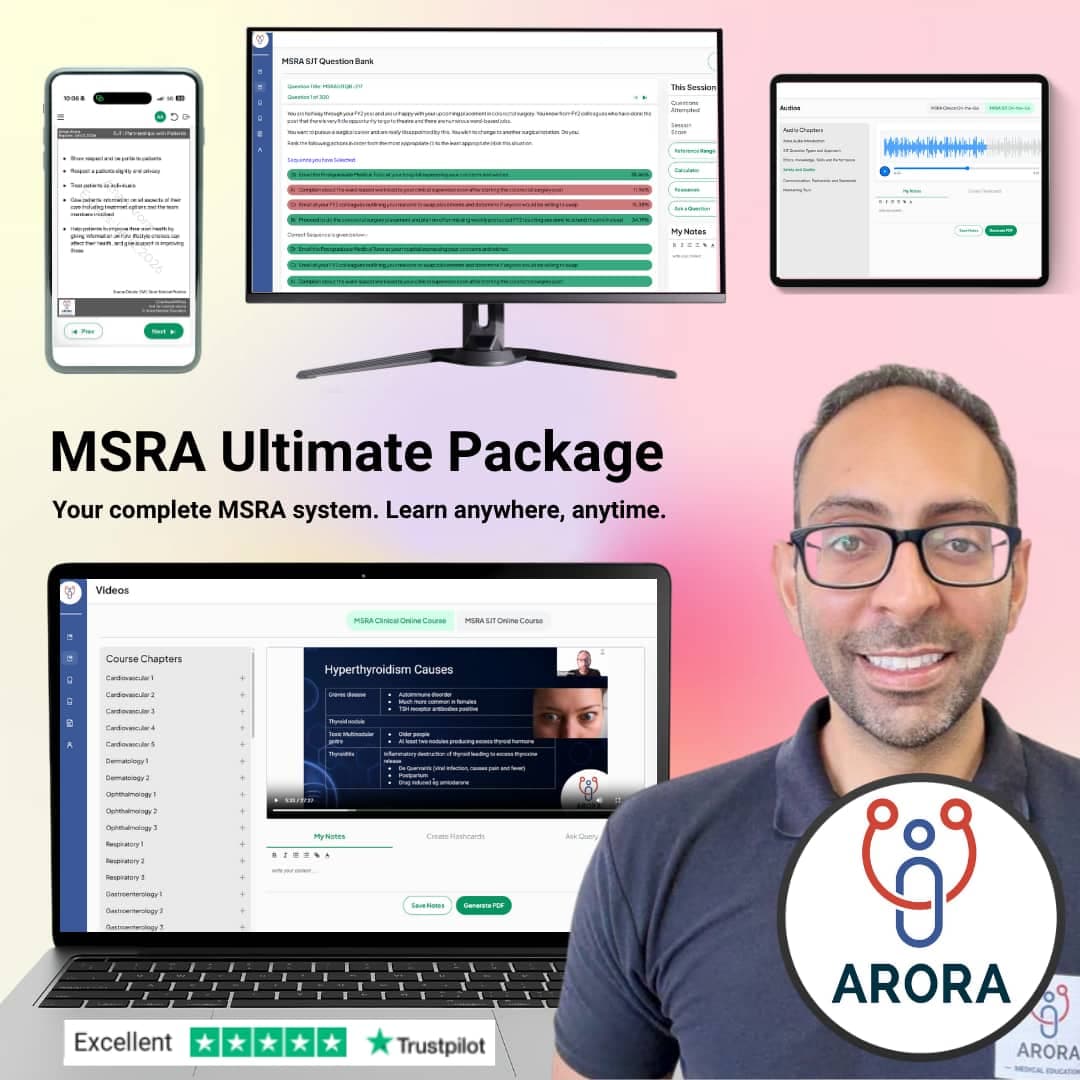
For all MSRA mocks, videos, audios, live teaching and flashcards, see our all-in-one MSRA Ultimate Package.
My Challenges…
– Juggling revision and work was quite difficult. For this reason, starting early and having a clear timeline and plan is essential. Although this is easier said than done, trust in your abilities and try to stay positive throughout. This was my first attempt and I was told it could take a couple more attempts to get a decent score or even to pass!!! For free MSRA timelines and programmes click here.
– You might feel overwhelmed at different times during revision with intrusive thoughts, self doubt and exhaustion post work. During these times it is essential to pause, relax and restart from where you stopped.
– The SJT was very difficult for me to understand initially as I failed to grasp the concept of the questions and what was actually tested. However, with practice and focus on technique, I slowly started to improve.
– The exam is always an eye opener for first timers. You may find totally different from what you expected so being flexible and mindful during the exam is the best way to approach.
I wish you all the best in preparation and in the exam! Dr Malvika 🙂
How Arora Medical Education Can Support You
Clear Teaching Built for Busy Doctors
If you want a guided path, our MSRA resources help you build confidence at each step. Everything is created by senior UK doctors with experience in the exam and in teaching.
You can choose:
– MSRA Ultimate – a full MSRA preparation system with question banks, videos, audios, live teaching, flashcards and mock exams.
– A live MSRA Crammer course held a few weeks before each sitting.
– Individual resources such as audios, videos, question banks or mocks.
Each option follows a clear plan that helps you stay organised and focused. Explore these more here.
Also:
– Join National MSRA WhatsApp teaching group here
– Get MSRA Updates and Teaching Emails here
– Register for next Free MSRA Webinar here

Author Bio — Dr Aman Arora
Hi! I’m Dr. Aman Arora, a Portfolio GP with over a decade of clinical and teaching experience, dedicated to helping doctors achieve their goals with confidence. Having had the privilege of supporting more than 50,000 doctors worldwide across exams such as MRCGP AKT, SCA, MSRA, PLAB 2 and PLAB 1, I understand the challenges you face and the strategies needed to overcome them. Through personalised face-to-face sessions, engaging online courses, mocks, audio and a vibrant social media community, we’re here to guide you every step of the way.
Whether you’re looking to pass crucial exams or take the next big step in your medical career, we’re here to help you succeed. Feel free to get in touch with any thoughts, questions, or ideas — I look forward to working with you and being part of your journey.
Author Bio — Dr Pooja Arora
Dr Pooja Arora is a GP with a background in Medical Politics, where she passionately focuses on improving the opportunities and working conditions for junior doctors. She is proud to hold FRCGP (Fellow of Royal College of General Practitioners).
You can find out more about Pooja’s previous roles and qualifications here.
Other blogs that may interest you