


Passing MSRA and getting into GP Training – Dr Mehek Arora
If you are a doctor preparing for your MSRA exam, this blog is a must to help you pass. We are lucky to have Dr Mehek Arora – a doctor who recently passed her MSRA assessment and got into GP training – share her experience of how she prepared and passed.
– Join National MSRA WhatsApp teaching group here
– Get MSRA Updates and Teaching Emails here
– Register for next Free MSRA Webinar here
– Pass with MSRA Ultimate Package here
Introduction
Moving to the UK for training was always the dream. A dream that took many years to accomplish. Throughout the entire journey to get here, the MSRA was by far the most significant hurdle to clear – and navigating it became considerably more manageable with the help of Arora Medical Education.
Who am I?
My name is Mehek Arora, and I am an International Medical Graduate who recently moved to the UK to begin GP Training in the North West, in Manchester. I am from India and completed my MBBS at Manipal in Nepal. I have sat countless exams to get here – PLAB 1, PLAB 2, the FY2 SJT, the FY2 Standalone Interview, and finally the MSRA. I stayed with Arora Medical Education throughout, and not only because I share the same last name. I share their vision of helping people not just pass these challenging exams, but become competent enough to thrive in the demanding landscape of the NHS.
Understanding the MSRA
Like any exam, before diving into preparation, it is important to understand the psychology behind it. More than the “what”, it is the “why” and the “how” that matter most.
Why does this exam exist? On the surface, it is the gatekeeper to several specialties – GP, Psychiatry, Anaesthesia and others. But it also exists to ensure that every doctor sitting it has a solid grounding in UK management guidelines for core conditions, regardless of which specialty they enter. Even a future radiologist should know how to manage a cardiac arrest. It may not always feel logical, but it does embed essential foundational knowledge before training begins – because everyone is first a doctor, and then a specialist.
Understanding how the exam is constructed is equally important. I have never written questions for the actual exam, so I won’t claim expertise there – but Dr Aman and his team have, and the Arora resources are built on that insider knowledge. That is a significant part of why I trusted this course.
From my own experience sitting the exam, the Situational Judgement Test section is clearly designed to assess ethics, professional integrity and the ability to sustain sound judgement under the pressures of day-to-day NHS practice. The Clinical Problem Solving section tests the clinical knowledge that goes without saying in this field.
One thing that cannot be overstated is the time pressure. It is very real. Do not underestimate the importance of completing numerous timed mocks before the actual exam. The NHS runs under constant time pressure, and the exam is designed to test your ability to make quick, correct and ethical decisions. It is also an exam where a reasonable degree of memorisation is required, which is something I will come to in the next section.
Read more about what the MSRA exam is here.
My Preparation: Strategy Over Stress
As with every exam before this one, I knew I would be using Arora Medical Education. Once I understood the exam itself, I knew that strong strategic planning would be essential – because two significant challenges were looming throughout my preparation.
The first was time. I had exactly three months to prepare while working full-time in Internal Medicine. The second, and frankly more unsettling, was the growing conversation around UK medical prioritisation. It had not yet come into force, but the direction of travel was clear. I knew this could well be my last realistic opportunity to get to the UK and begin training. Now that it has come into play, I consider myself fortunate.
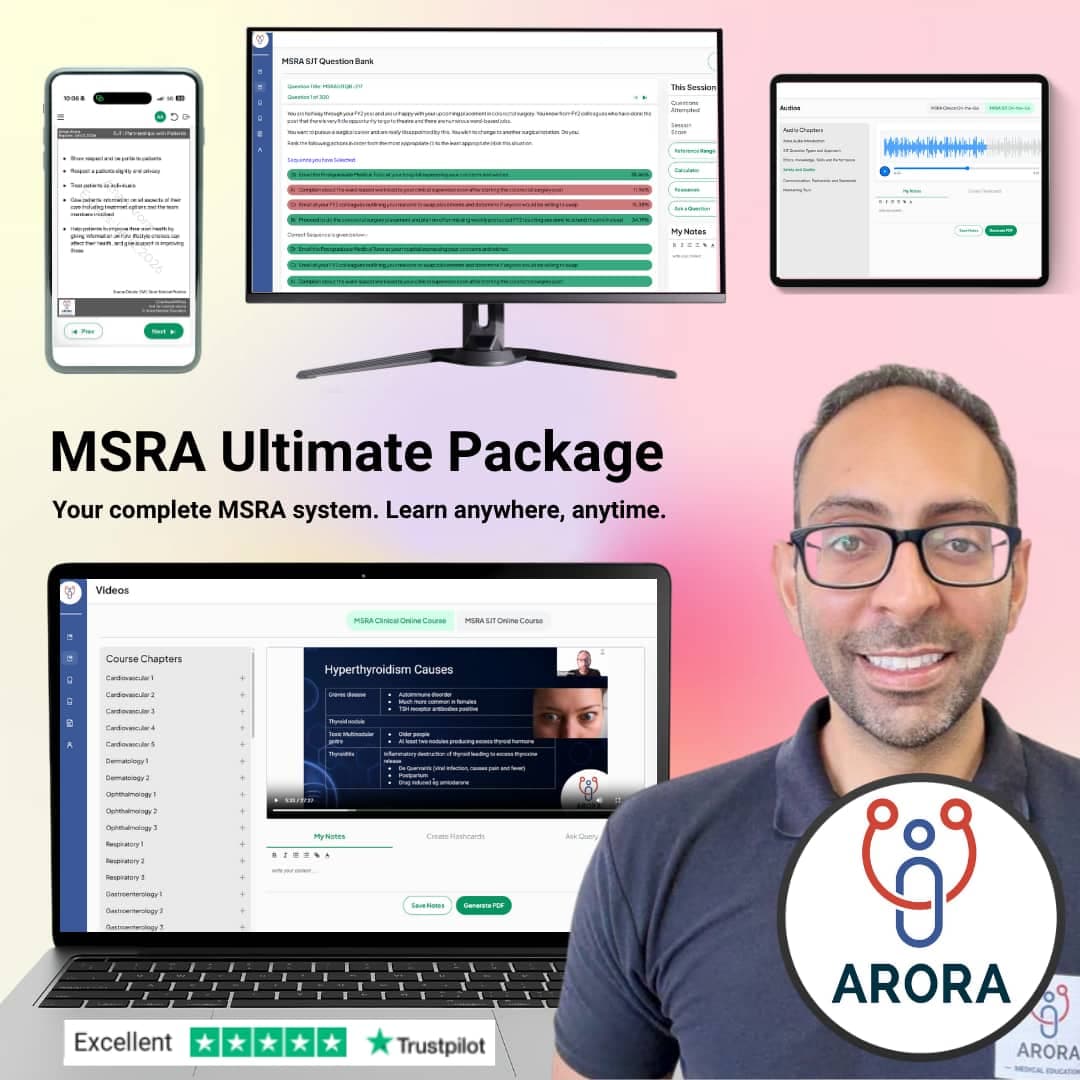
The Arora MSRA Ultimate Package gave me the structure I needed to organise my preparation around a demanding work schedule.
I used the video courses to address the knowledge gaps I knew I had in certain specialties.
The question banks formed the core of my preparation. With the AI-powered adaptive model, I could quickly identify my weaker areas and focus more time there, while still revisiting stronger topics to maintain confidence.
The audiobooks were invaluable during long commutes to and from work. As the exam drew closer, I returned to question banks more heavily – fitting in questions wherever I had spare time, including at work. That combination carried me through to the final stretch of preparation.
For quick revision bursts, which are a key part of effective exam prep, the flashcards worked well. I found them genuinely enjoyable and they gave me a real confidence boost.
The live crammer course was one of the main reasons I chose this package. I knew Dr Aman would not simply run through questions in a standard Q&A format – and he didn’t. The focus was on the psychology behind the questions and how to recognise and avoid the common distractors that regularly appear.
Finally, as I mentioned earlier, the time pressure in the actual exam is real – and so is the anxiety that comes with it. The last thing I wanted on the day was to be worrying about whether I would finish in time. So in the final two weeks, I completed the mocks repeatedly. On the day itself, even though nerves were still present, I had enough muscle memory to finish with a good ten minutes to spare. That time allowed me to review my answers before reaching that life-changing moment – and clicking submit.
Conclusion
The MSRA was a defining exam for me. Passing it and securing my place while beating the odds has been a humbling experience, as I imagine it is for many IMGs in a similar position.
I will end with a few tips:
The stress, anxiety and pressure of this exam cannot be eliminated – but they can be overcome.
– Understand the psychology of the exam
– Recognise that it is not purely about memorisation
– Stay true to your ethics as a person and as a doctor, as set out in the GMC’s Good Medical Practice – this will serve you in the SJT
– Stay disciplined day to day – even half an hour of study on a difficult day is still progress
– Strategise early and stick to the plan
– And finally: mocks, mocks, mocks.
How Arora Medical Education Can Support You
Clear Teaching Built for Busy Doctors
If you want a guided path, our MSRA resources help you build confidence at each step. Everything is created by senior UK doctors with experience in the exam and in teaching.
You can choose
– MSRA Ultimate – a full MSRA preparation system with question banks, videos, audios, live teaching, flashcards and mock exams.
– A live MSRA Crammer course held a few weeks before each sitting.
– Individual resources such as audios, videos, question banks or mocks.
Each option follows a clear plan that helps you stay organised and focused. Explore these more here.
Also:
– Join National MSRA WhatsApp teaching group here
– Get MSRA Updates and Teaching Emails here
– Register for next Free MSRA Webinar here

Author Bio — Dr Aman Arora
Hi! I’m Dr. Aman Arora, a Portfolio GP with over a decade of clinical and teaching experience, dedicated to helping doctors achieve their goals with confidence. Having had the privilege of supporting more than 50,000 doctors worldwide across exams such as MRCGP AKT, SCA, MSRA, PLAB 2 and PLAB 1, I understand the challenges you face and the strategies needed to overcome them. Through personalised face-to-face sessions, engaging online courses, mocks, audio and a vibrant social media community, we’re here to guide you every step of the way.
Whether you’re looking to pass crucial exams or take the next big step in your medical career, we’re here to help you succeed. Feel free to get in touch with any thoughts, questions, or ideas — I look forward to working with you and being part of your journey.

Author Bio — Dr Pooja Arora
Dr Pooja Arora is a GP with a background in Medical Politics, where she passionately focuses on improving the opportunities and working conditions for junior doctors. She is proud to hold FRCGP (Fellow of Royal College of General Practitioners).
You can find out more about Pooja’s previous roles and qualifications here.
Other blogs that may interest you