


Passing the MSRA exam – How I got my first choice training rotation – Dr Anjani Durga
If you are a doctor preparing for your MSRA exam, this blog is a must to help you pass. We are lucky to have Dr Anjani Durga – a doctor who recently passed her MSRA assessment and got accepted into her first choice training programme – share her experience of how she prepared and passed…
– Join National MSRA WhatsApp teaching group here
– Get MSRA Updates and Teaching Emails here
– Register for next Free MSRA Webinar here
– Pass with MSRA Ultimate Package here
About me
Hello all! My name is Anjani, and I’m an international medical graduate from India. I am a GP trainee in Exeter, and I previously worked in the NHS for two years – mainly in ED. Having worked in the emergency department I enjoyed the challenges, but I realised my heart is in general practice. I took the MSRA exam as part of GP training application, and I’m pleased to say I secured my top preference job offer.
MSRA or MRSA?
The MSRA (Multi-Specialty Recruitment Assessment) is part of the selection process for entering GP training as well as several different postgraduate medical specialities. For full details about the exam itself click here.
Although it is a competitive exam, a good result is achievable with careful preparation. I’ll outline some of the ideas, approaches and hurdles I experienced in the preparation process below with the goal that they will help you create your own MSRA success journey.
Preparation Time
I know how overwhelming it gets to prepare for any competitive exam when you have a full-time job, but try to dedicate at least 3-4 months.
I know it sounds tough to dedicate some time every day for preparation, especially after tiring shifts and the need to prepare meals/manage household chores/the ones with young children etc; it sounds impossible! But try and set up an hour every day and make a proper timetable beforehand. You can find free planner schedules here.
I took little steps every day, investing at least an hour every day trying to cover different systems. Since I was working in ED, I didn’t have a 9-5 job so I sometimes had some time before going to work or after coming back. I also managed to get some time off around the exam date which helped significantly.
Do try and talk to people around you about how they prepared, how much time they spent and which resources they used; then make a plan based on your learning style.
Personally I found reading blogs from trusted sources helped me to get an initial overview and good grounding of the exam.
Resources
First of all, know your learning style! My learning style has always been any form of Lectures (to prepare notes) and questions to practice, including question banks, mocks.
Step 1
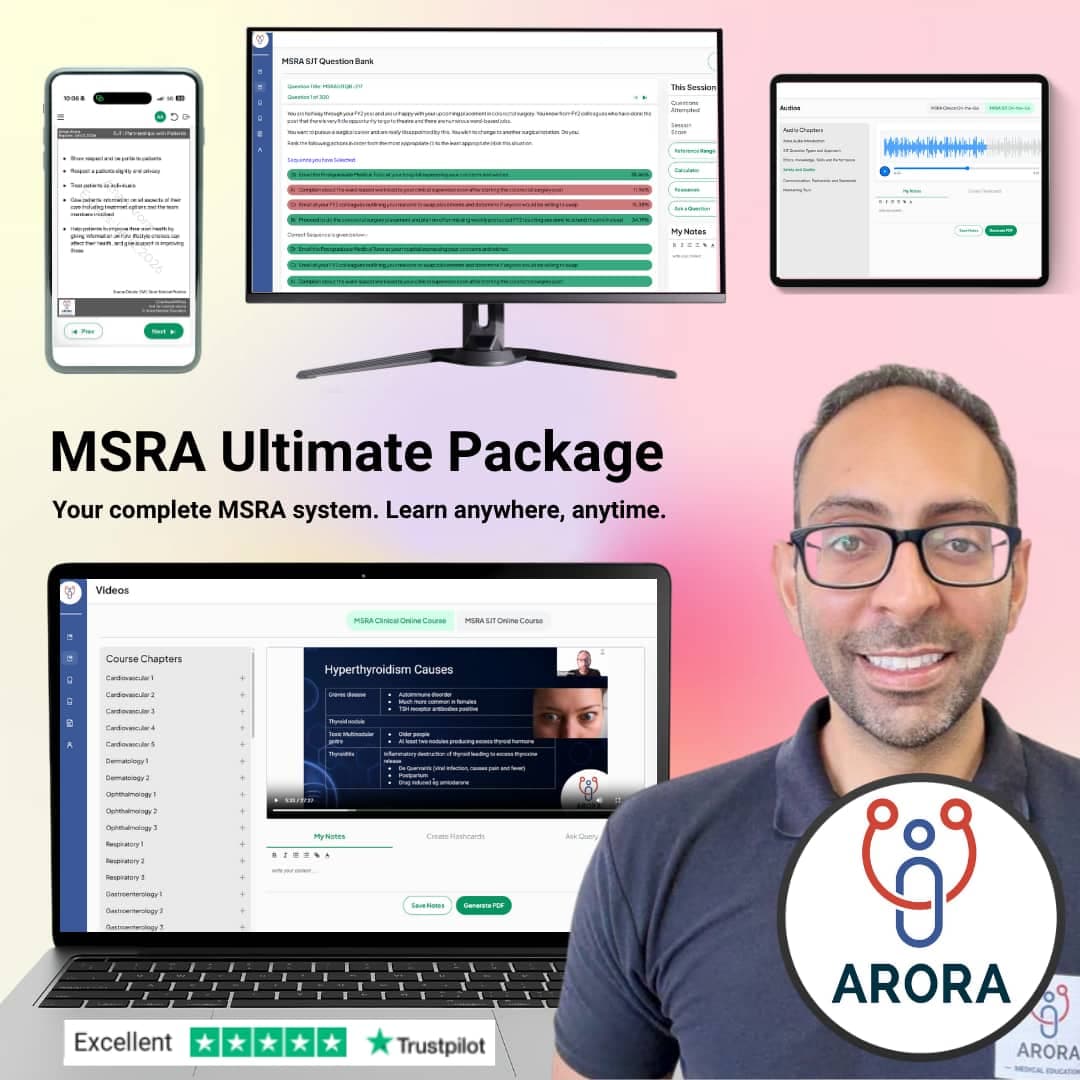
I found many question bank sites with explanations, but only one place where I can have teaching and notes first – the Arora MSRA Ultimate Package – by far my most considerable revision aid. Without the package – which contains video lectures, question banks, mocks, audios and flashcards), I’m not certain I could have succeeded so well.
Step 2
An MCQ question bank for general question practice. Along with the video lecture notes, I used to write down some key explanation learning points from the questions I got wrong.
Step 3
Re-revising the notes taken from the Arora video lectures and the explanations of the questions that I got wrong the first time.
Step 4
I then finished it with all the Arora MSRA mock exams – clinical and SJT – to get familiarised with the exam pattern and get used to the time pressure.
In between: I used to read the MSRA flashcards whenever I was bored or before going to sleep – these helped in the recollection of what I was preparing
Exam pattern
MSRA is a computer-based exam taken in Pearson Vue centres. The exam comprises two parts: a Professional Dilemmas (PD) paper and a Clinical Problem Solving (CPS) paper, lasting 110 and 75 mins respectively. Please find the full MSRA exam format, including the competency domains being assessed on the GP Recruitment website as well as this blog.
Clinical questions:
I did the system-wise lectures of the clinical crammer video course, followed by questions from the question banks.
Personally I felt comfortable doing clinical questions, but the main hurdle was the SJT part.
For details on the clinical topics watch this video.
Professional dilemma questions:
As an IMG, I was less aware of SJTs – hence I found this most challenging, Knowing this I focused more on this area.
I initially went through the SJT principles audiobook from the Gold Package – which helped me to understand the concept of SJTs. These are covered in much more detail in the SJT online course. I also did many (many!) SJT questions for regular practice..
There isn’t necessarily a perfect option for SJTs – lots of my colleagues had different approaches – but you need a plan for these questions, especially if you haven’t tackled them before.
In my view you can’t go far wrong if you are thinking about patient safety and helping colleagues! Confidentiality is another key component to bear in mind in SJTs. In addition to these, evaluating capability to deal with stress, showing empathy and sensitivity and identifying key challenges are all important to bear in mind.
Try to narrow down your answers by deleting those that are wrong if you are stuck. Do not forget that no negative marking exists, so don’t hesitate to guess intelligently if necessary.
For tips on handling SJT questions watch this video.
Tips but no tricks
– I made sure to eat, drink and get enough rest whenever I was exhausted
– I also studied while at work by seeing as many patients as I could, talking with colleagues about anything I was unsure of and researching it online.
– On the evening before the exam, try to relax as much as you can. I unwinded and went to bed early. I believe that staying up late and worrying about the exam the night before is a terrible idea. I know the adrenaline rush will be there, but try to stay calm – you have done your best by now.
– Plan your travel time and ensure you attend the exam centre a little early.
– Make sure you take your ID to the exam!
The big day
There may be some pilot questions. The purpose of these pilot questions is to evaluate their quality; your score will not be affected by them.
If a question seems unclear, confusing, or challenging to read, try not to get stressed out. Move on to the next question. I was telling myself that if a question is difficult, it’s probably a pilot and won’t count – definitely helped me to stop worrying about that specific question and reduce wasted time.
Thank you for reading this – I hope it helped! Try to enjoy every step in your preparation time (I know easier said than done)!! And good luck 🙂
How Arora Medical Education Can Support You
Clear Teaching Built for Busy Doctors
If you want a guided path, our MSRA resources help you build confidence at each step. Everything is created by senior UK doctors with experience in the exam and in teaching.
You can choose
– MSRA Ultimate – a full MSRA preparation system with question banks, videos, audios, live teaching, flashcards and mock exams.
– A live MSRA Crammer course held a few weeks before each sitting.
– Individual resources such as audios, videos, question banks or mocks.
Each option follows a clear plan that helps you stay organised and focused. Explore these more here.
Also:
– Join National MSRA WhatsApp teaching group here
– Get MSRA Updates and Teaching Emails here
– Register for next Free MSRA Webinar here

Author Bio — Dr Aman Arora
Hi! I’m Dr. Aman Arora, a Portfolio GP with over a decade of clinical and teaching experience, dedicated to helping doctors achieve their goals with confidence. Having had the privilege of supporting more than 50,000 doctors worldwide across exams such as MRCGP AKT, SCA, MSRA, PLAB 2 and PLAB 1, I understand the challenges you face and the strategies needed to overcome them. Through personalised face-to-face sessions, engaging online courses, mocks, audio and a vibrant social media community, we’re here to guide you every step of the way.
Whether you’re looking to pass crucial exams or take the next big step in your medical career, we’re here to help you succeed. Feel free to get in touch with any thoughts, questions, or ideas — I look forward to working with you and being part of your journey.

Author Bio — Dr Pooja Arora
Dr Pooja Arora is a GP with a background in Medical Politics, where she passionately focuses on improving the opportunities and working conditions for junior doctors. She is proud to hold FRCGP (Fellow of Royal College of General Practitioners).
You can find out more about Pooja’s previous roles and qualifications here.
Other blogs that may interest you