


How I scored over 90% in my AKT Exam: Dr Irbaz Khan
If you are a GP trainee preparing for your MRCGP AKT exam, this blog is a must to help you pass. Dr Irbaz Khan – a GP trainee who recently passed his AKT, scoring over 90% – shares his experience of how he prepared and how he scored such a high score.
– Join National AKT WhatsApp Teaching Group here
– Get AKT Updates and Teaching Emails here
– Register for next Free AKT Webinar here
– Pass with AKT Ultimate Package here
Getting started…
First of all, clear your mind and start afresh. Forget what you think you know and start from scratch. You may wonder what am I talking about? Why am I asking you to forget what you think you know? This is because AKT is very different from any exam you may have sat before. This exam requires a solid grasp of the most up-to-date guidelines, requires repetitive revision and actual clinical experience which means being proactive in your rotations by asking a lot of questions.
How early should you start revision?
This is a very hard question and it’s very subjective. In general people say to be safe, you need about 3 to 4 months. In my opinion three months is decent. This is because for the first half of that three months the revision pace will be very slow – it’s hard to build momentum or have motivation with the exam so far away. But if you start three months away, over time you will accumulate knowledge, a pattern of revision and hopefully momentum. For me, doing even small amounts in the first few weeks of that 3 months allowed me to build a pattern, alerted me to my weak areas and allowed me to generate key ideas that motivated me to work (which I will mention below). In the last 6 weeks enough pressure had been generated for me to stop being lazy and work considerably harder.
Is going through question banks enough?
Some people may say that doing Question banks is enough. There are some popular ones out there – this is what I initially tried, however my revision was scattered. I felt frustrated because my score average was close to 67% and to me that was not enough to pass the AKT. Although I was doing a lot more questions it was difficult to remember information. Guidelines were tedious to learn and I felt multiple sources would be useful to solidify the knowledge.
So which other resources are there?
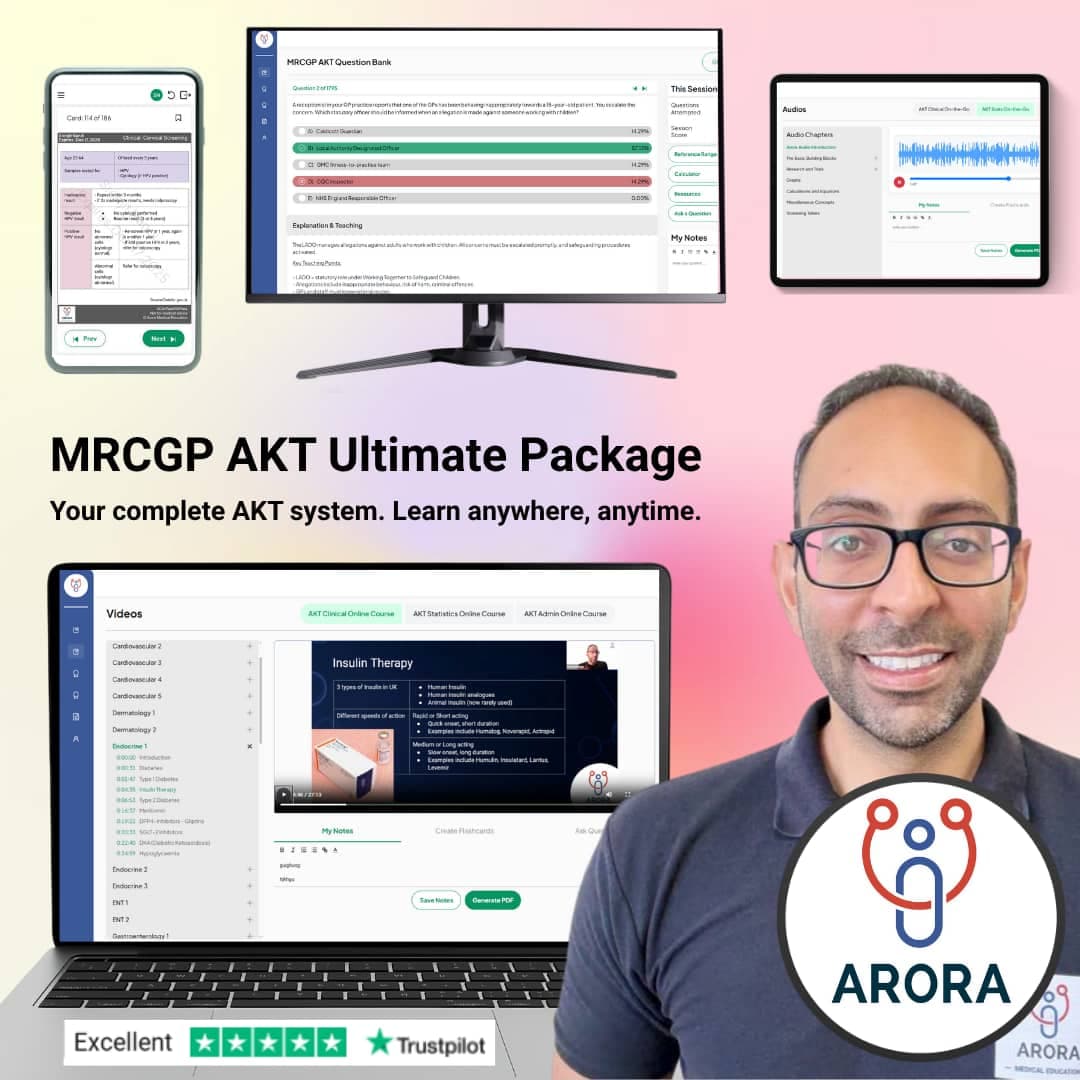
This is also a common question in the minds of trainees. Unlike previous exams I was struggling with retention of knowledge with just question banks, so I ventured out looking for other resources. At this point it was only 5 to 6 weeks left and I took into account the possibility of potential unforeseen circumstances such as illness, as well as days where I wanted to give myself a break – so in reality it felt like in my mind I really only had four weeks left. I had already attended a couple of free webinars from Dr Aman Arora (Arora Medical) as well as a few others. At this point however, I felt I needed structured revision with only the most essential information. This was close to Christmas and I came across a wonderful discounted deal with Arora – I signed up for the Arora Live Programme as part of the AKT Ultimate Package. Firstly this allowed me to revise the admin and statistics sections in the shortest possible time – getting the basic theory right. If you are like me and you hate statistics this is probably one of the best ways to learn it. I also got the book ‘Statistics made easy’ from the library, but I felt it did not help me in answering the questions correctly. I felt I needed clear and concise lecturing which this course provided.
In addition the All-in-One Package provided a full question bank, audiobooks, clinical online lectures covering the essential curriculum parts, as well as the admin and statistics resources mentioned. It also contained various flash cards, as well as multiple extra mock exams. All of these provided an avenue for repetitive revision, whilst using different resources – a game changer for me as it allowed for the cyclical revision that I wanted, without it becoming too boring.
I found studying in a café helped me focus so I made it a routine to sit in my favourite cafés with my favourite cakes/coffees whilst going through flashcards or listening to audio recordings of difficult topics – this is how I learned some of my most difficult topics such as genetics and childhood development in my last 3 weeks.
There are also free resources available such as the 30 day challenges that Arora and others provide on YouTube. If you combine all of these, there are plenty of videos covering high yield areas that you can cover as well.
The importance of colleagues
Friends and colleagues can be very helpful and I feel blessed to have Sachin – a friend and final year GP trainee in London – who shared his summarised notes. It was also useful for me as it provided a benchmark of how much detail I should know (my friend also scored well over 80%). If needed, you can find colleagues to prepare with in the Arora AKT Telegram Teaching Group.
Daily patients
One of the most important resources are the patients that you see in day-to-day practice. If you’re a reflective practitioner, you’ll be surprised by how much you retain, as well as how much you already actually know! If you see an interesting or even a very simple case, over a cup of tea or coffee just think about what made it interesting, glance through the guidance or ask a senior colleague about what they would do. This is absolute gold as a few times in the exam I felt my reflections helped me find the right answer.
The final week
In the very last week I felt my statistics and admin could still improve. I remembered words from a brilliant teacher who taught me maths – ‘I know you hate this but if you put enough effort in you can score 100%’ – I knew I needed to put a bit more effort into this particular area. I bought an additional medical statistics/admin course at a discounted rate and it provided a different way for me to learn. I only got the recording though as the live sessions were a few weeks earlier – still the way the course was done made it quite interactive.
How to get motivation to study?
Exam stress and pressure will eventually force you to study but it still will not make studying fun. 4-6 weeks before your exam, the exam should be your priority but do try and add variety. Try to make it as fun as possible – for instance go to your favourite café, flip between questions and flashcards (bought or your own), listen to audios or summarise key learning points (by yourself or with a friend).
It is important to aim high! If you are aiming for just a ‘pass’ and you score close to the average passing mark, you may not push just that little bit harder – there is a high chance that this could make all the difference.
Summary of my strategy
(which sort of just developed as I went a long but am happy to share as it helped in hindsight!)
- buy a question bank from anywhere to know where you are at 3-4 months before.
- ask lots of questions in your rotations – if you are in ST1 reading this, start now, be reflective, enjoy learning! Then apply to next case you see.
- I needed structure – different ways to learn and All-in-One Package worked out because it gave me structure to solidify my foundations, and audio versions to back it up. I also used the free AKT daily planner as I really pushed myself in my last 4-6 weeks, making sure I had covered all the topics.
- for extra boosts don’t hesitate to spend on additional resources for areas that you feel a little weak on – additional admin/stats resources helped for me.
- towards the end MOCK MOCK MOCK. Do NOT ignore right answers because it may have been a fluke – go through every answer if possible to obtain high yield knowledge! This is what I did and although very tiring, the stress and adrenaline kept me going!
- flashcards (either bought or your own) are useful in the last 2 weeks because it helps revise quicker and smarter.
- try to do a live mock course (or do a question bank mock exam under strict exam conditions at the very least!) I had the live AKT Crammer programme as part of the All-in-One Package, and used that to do the exam under strict conditions. With this course, Dr Arora then went through each and every answer in one day – both going through guidelines, as well as looking at exam technique. Other companies offer similar courses as well and question banks may also have good mock exam options – as well as does the RCGP website question bank (another brilliant resource).
- speak to colleagues, find a cafe, find a peaceful spot to revise such as a park. If you are like me and have not sat a high impact exam for years, then AKT is an opportunity to revisit and upgrade your knowledge! Think of it this way – even if you fail, the effort goes into making you a more knowledgeable doctor.
Good luck to all who are preparing for AKT!
I would like to thank my educational supervisor (who motivated me to sit the exam early in training), my friend and fellow GP trainee colleague Sachin and all my colleagues in the North East who gave me wonderful advice. I’d like to thank my family who sacrificed a lot to help me revise. Finally I’d like to thank my teachers – in particular Dr Arora for his absolutely amazing range of AKT courses with a whole range of options to study from.
Dr Irbaz Khan
How Arora Medical Education Can Support You
Clear Teaching Built for Busy Doctors
If you want a guided path, our AKT resources help you build confidence at each step. Everything is created by senior UK doctors with experience in the exam and in teaching.
You can choose:
– AKT Ultimate – a full AKT preparation system with question banks, videos, audios, live teaching, flashcards and mock exams.
– A live AKT teaching programme held over a few months before each sitting.
– Individual resources such as audios, videos, question banks or mocks.
Each option follows a clear plan that helps you stay organised and focused. Explore these more here.
Also:
– Join National AKT WhatsApp Teaching Group here
– Get AKT Updates and Teaching Emails here.
– Register for next Free AKT Webinar here

Author Bio — Dr Aman Arora
Hi! I’m Dr. Aman Arora, a Portfolio GP with over a decade of clinical and teaching experience, dedicated to helping doctors achieve their goals with confidence. Having had the privilege of supporting more than 50,000 doctors worldwide across exams such as MRCGP AKT, SCA, MSRA, PLAB 2 and PLAB 1, I understand the challenges you face and the strategies needed to overcome them. Through personalised face-to-face sessions, engaging online courses, mocks, audio and a vibrant social media community, we’re here to guide you every step of the way.
Whether you’re looking to pass crucial exams or take the next big step in your medical career, we’re here to help you succeed. Feel free to get in touch with any thoughts, questions, or ideas — I look forward to working with you and being part of your journey.

Author Bio — Dr Pooja Arora
Dr Pooja Arora is a GP with a background in Medical Politics, where she passionately focuses on improving the opportunities and working conditions for junior doctors. She is proud to hold FRCGP (Fellow of Royal College of General Practitioners).
You can find out more about Pooja’s previous roles and qualifications here.
Other blogs that may interest you