


7 Ways to Beat the “I Can’t Be Bothered” Feeling When Revising for MRCGP AKT
If you are preparing for MRCGP AKT and keep finding yourself thinking, “I just can’t be bothered today”, you are not lazy, disorganised, or lacking discipline. You are overwhelmed.
AKT is a broad, demanding exam. It tests clinical medicine, evidence-based practice, statistics, guidelines, and administrative topics, all under significant time pressure. Many trainees struggle not because they are incapable, but because the workload feels endless and motivation quietly disappears.
The good news is this: motivation is not what gets most people through AKT. Systems do.
Below are seven practical, realistic strategies that work within real GP training life and help you keep going when motivation is low.
– Join National AKT WhatsApp Teaching Group here
– Get AKT Updates and Teaching Emails here
– Register for next Free AKT Webinar here
– Pass with AKT Ultimate Package here
1. Reduce the effort needed to start
When motivation drops, the biggest barrier is starting. Most trainees wait until they “feel ready”, which often means nothing happens for days.
Instead, remove the pressure completely.
Tell yourself you are only going to revise for two minutes. Open your question bank, answer three questions, then stop. Even if you feel capable of doing more, stopping early is part of the strategy.
This retrains your brain to associate revision with low effort. Once starting becomes automatic, volume and consistency follow naturally. This is far more effective than forcing long sessions that lead to burnout.
If decision fatigue is part of the problem, using a daily plan removes the need to think at all. You simply open the plan and follow it. Find a range of free daily AKT planners here.
2. Stop revising passively and start making decisions
One of the most common AKT traps is passive revision. Reading guidelines, watching videos, highlighting notes, and feeling productive, but not actually improving scores.
AKT is not testing memory alone. It tests decision-making. You must practise choosing an answer under time pressure, then understanding why it was right or wrong.
A simple rule works well here: match content with questions. If you spend 20 minutes on a topic, spend 20 minutes answering questions on it. When reviewing, do not just read the explanation and move on. Ask yourself what specifically led you to choose the wrong answer, and what you would do differently next time. Try this today – watch a chapter in the video course, and then hit the same topic in the question bank.
This is how knowledge turns into marks.
3. Work on your weakest area first, not your favourite
When motivation is low, most people gravitate towards topics they enjoy or already feel confident in. It feels productive, but it rarely shifts overall performance.
AKT scores usually improve when the weakest area improves.
For many trainees, that weak area is statistics or evidence-based practice. For some it is a particular clinicla area – haematology, women’s health or genetics for example. Avoiding it only stores up stress for later. A better approach is to choose one weak area per week and give it focused, contained attention.
Sixty questions across a week, short daily exposure, and a small set of flashcards from mistakes can transform a weak area without it taking over your life. Progress in your weakest topic often brings a noticeable confidence boost across everything else.

4. Turn stats into something boring and automatic
Most trainees do not fail AKT because they have never heard of sensitivity, specificity, or number needed to treat. They fail because they cannot apply them quickly in stats questions.
The goal with stats is not deep understanding. It is core principles, speed and familiarity.
Short, daily exposure works best. Ten minutes a day, every day, focusing on one stats concept at a time. Repeat it until it feels dull. That boredom is a good sign. It means your brain no longer treats the topic as a threat. Start with our stats video course or stats flashcards – whichever option feels less like a barrier.
Once stats stop triggering avoidance, AKT preparation becomes much less draining overall.
5. Practice fatigue, not just knowledge
Many trainees revise in short bursts but never practise what AKT actually feels like. The exam is long, and fatigue matters.
A useful technique is to practise in blocks. For example, complete a timed block of questions, take a very short break, then complete another block immediately after. This trains your ability to refocus after a poor run of questions and prevents the common spiral of thinking the whole session is ruined.
This approach also improves pacing and concentration, which are just as important as knowledge on exam day.
6. Create accountability you cannot quietly ignore
Accountability only works if it is specific. Vague plans like “we’ll revise together sometime” rarely survive busy GP training schedules.
Effective accountability has a fixed time, a fixed task, and a clear output. Whether that is a weekly session with colleagues or a booked mock exam or one-to-one session, the key is commitment.
Deadlines change behaviour. Knowing that someone else will see your performance often provides the push that motivation alone cannot.
7. Have a plan for bad weeks
Almost everyone who struggles with AKT describes the same pattern. One bad week leads to avoidance, which leads to panic.
You can prevent this by having a preset “bad week” plan. This might be as simple as doing a small number of questions daily, listening to short audio teaching during commutes, and setting aside one catch-up session at the weekend.
The aim during a bad week is not to catch up. It is to not stop completely. Momentum, even at low speed, is far easier to regain than restarting from zero.
How Arora Medical Education Can Support You
Clear Teaching Built for Busy Trainees
If you want a guided path, our AKT resources help you build confidence at each step. Everything is created by senior UK doctors with experience in the exam and in teaching.
You can choose:
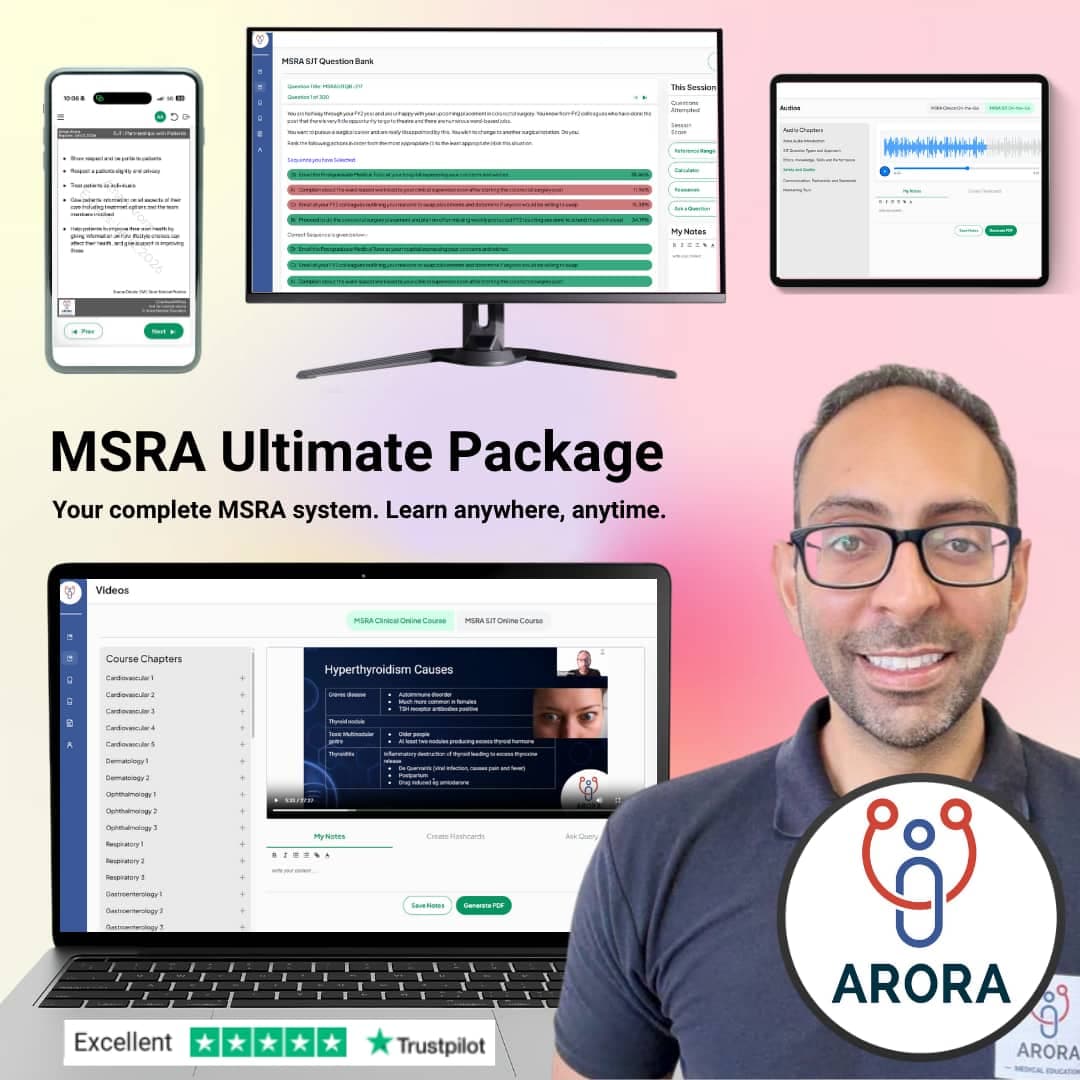
– AKT Ultimate – a full AKT preparation system with question banks, videos, audios, live teaching, flashcards and mock exams.
– A live AKT teaching programme held over a few months before each sitting.
– Individual resources such as audios, videos, question banks or mocks.
Each option follows a clear plan that helps you stay organised and focused. Explore these more here.
Also:
– Join National AKT WhatsApp Teaching Group here
– Start using a Free AKT Daily Planner here.
– Get AKT Updates and Teaching Emails here.
– Register for next Free AKT Webinar here.
Final thoughts
You do not need to feel motivated every day to pass AKT. You need a system that still works when motivation is low.
Pick two strategies from this blog and commit to them for the next seven days. Most trainees find that once structure replaces uncertainty, the “can’t be bothered” feeling fades on its own.
AKT is demanding, but it is very passable with the right approach.
#CanPassWillPass

Lead AKT Tutor - Dr Aman Arora
Hi! I’m Dr. Aman Arora, a Portfolio GP with over a decade of clinical and teaching experience, dedicated to helping doctors achieve their goals with confidence. Having had the privilege of supporting more than 50,000 doctors worldwide across exams such as MRCGP AKT, SCA, MSRA, PLAB 2 and PLAB 1, I understand the challenges you face and the strategies needed to overcome them. Through personalised face-to-face sessions, engaging online courses, mocks, audio and a vibrant social media community, we’re here to guide you every step of the way.
Whether you’re looking to pass crucial exams or take the next big step in your medical career, we’re here to help you succeed. Feel free to get in touch with any thoughts, questions, or ideas — I look forward to working with you and being part of your journey.

Senior AKT Tutor - Dr Pooja Arora
Dr Pooja Arora is a GP with a background in Medical Politics, where she passionately focuses on improving the opportunities and working conditions for junior doctors. She is proud to hold FRCGP (Fellow of Royal College of General Practitioners).
You can find out more about Pooja’s previous roles and qualifications here.
Other blogs that may interest you