


GP Training Structure Explained: What Happens in ST1, ST2 and ST3
Getting a GP training number is one of the best pieces of news a junior doctor can receive, and one of the most disorientating. Within weeks you are hearing about ST1, ST2, ST3, WPBA, ARCP and a portfolio system called FourteenFish, often in the same sentence, with nobody stopping to explain how the three years fit together. This guide does that. It walks through what each training year involves, where the AKT and SCA sit inside the timeline, how you are assessed along the way, and what the whole three years build towards. If you are still deciding whether to apply, there is a section for you too.
– For GP trainee update and teaching emails click here
– Join National AKT WhatsApp teaching group here
– Join National SCA WhatsApp teaching group here
The three-year shape of GP training
GP specialty training normally begins once you have completed the UK Foundation Programme, or demonstrated equivalent competence, and been successful in the national recruitment process. Training runs for three years, split into ST1, ST2 and ST3, and leads to a Certificate of Completion of Training, or CCT, which allows you to join the GP Register and practise independently. Entry is at ST1 level for almost everyone. The only common exception is Broad Based Training, where doctors enter at the start of ST2 instead.
Two things run underneath all three years and tie them together. The first is the RCGP curriculum, which describes the capabilities you must demonstrate before you can be signed off as safe to practise independently. The second is your Trainee Portfolio, most commonly hosted on FourteenFish, where you log evidence of that development as you go. Everything below sits inside that structure.
ST1: finding your feet
Your first year is built around breadth rather than depth. Most trainees rotate through hospital-based specialties such as paediatrics, psychiatry or emergency medicine, though the exact mix depends on your deanery, and some programmes include GP placements in ST1 too. The point of these rotations is not to make you a specialist in each area. It is to give you clinical exposure and transferable skills that will make you a stronger GP later, particularly around managing uncertainty, working in teams and recognising when a patient needs more than a routine review.
Alongside the clinical work, ST1 is when the administrative side of training starts. You will meet your Clinical Supervisor in each post and your Educational Supervisor, who reviews your overall progress at set intervals through the year. You will begin logging entries in your Trainee Portfolio, complete your first Workplace Based Assessments, and start attending regular deanery teaching sessions. None of this needs to be perfect in ST1. It needs to be started, honestly and consistently, so a pattern of good practice is already in place before the pressure increases in ST2 and ST3.
What tends to help in ST1:
– Treat your portfolio as a weekly habit rather than a termly panic, even five or ten minutes at a time
– Ask your Clinical Supervisor early what a strong entry looks like, rather than guessing
– Use hospital placements to build the safety-netting and escalation instincts that carry directly into general practice
ST2: building toward independence
ST2 is where training starts to feel less like induction and more like preparation. You will usually move into a further hospital, community or GP-based post, sometimes a mix, continuing to build your portfolio and working toward the capabilities you have not yet evidenced. Six-monthly reviews with your Educational Supervisor continue, using the evidence you have gathered to flag anywhere that needs more focused attention before ST3.
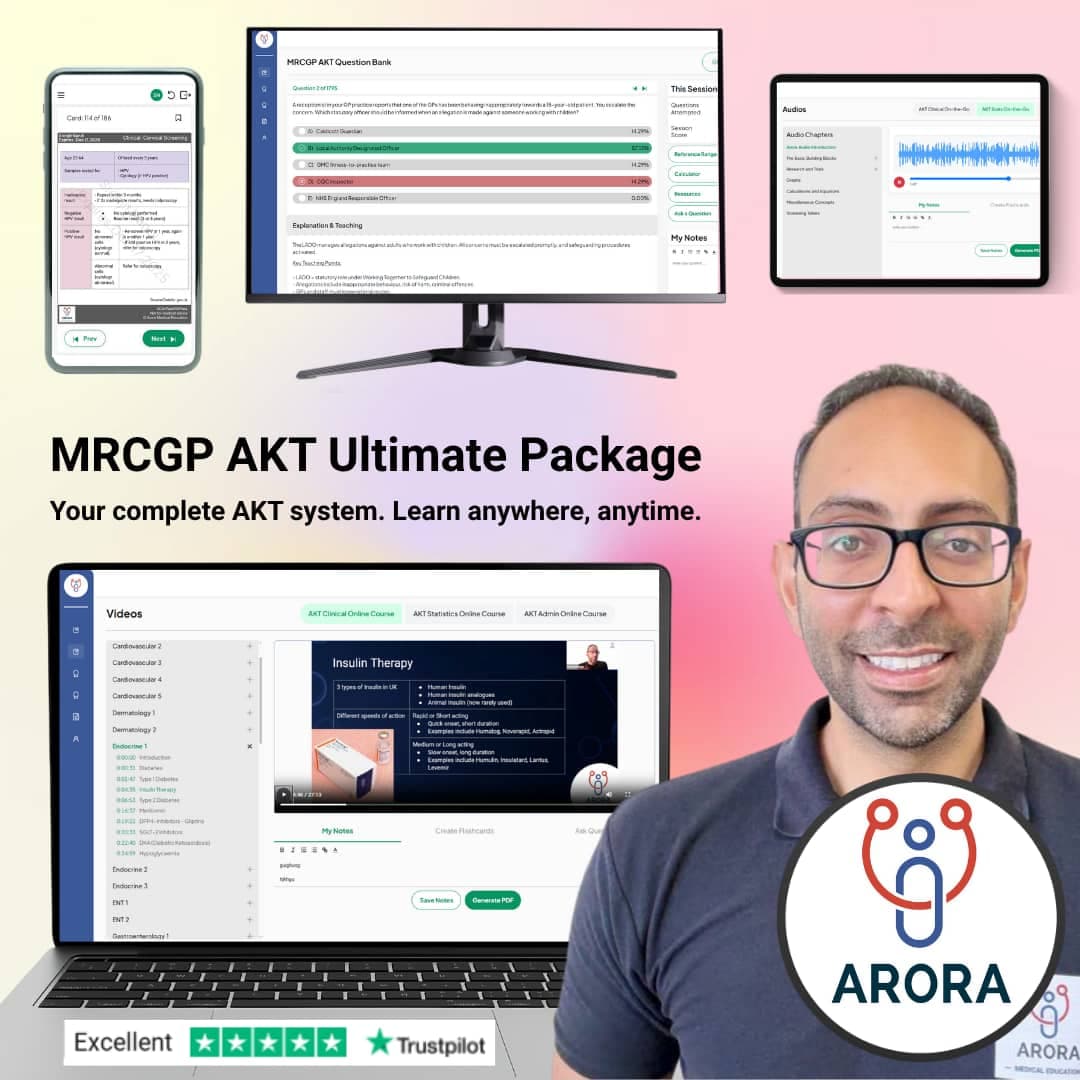
ST2 is also the year most trainees sit the MRCGP AKT for the first time. You become eligible from ST2 onwards, and the RCGP’s own guidance is that most registrars are better off attempting it in ST2 rather than pushing it into ST3, when SCA preparation and full-time general practice are already competing for attention. The AKT tests the knowledge base underpinning independent general practice across clinical medicine, evidence-based practice and primary care organisation, so a GP placement is not a prerequisite, though most trainees find that some grounding in general practice makes the applied, scenario-based questions easier to reason through. If you are weighing up timing, our AKT Ultimate Package is built around this ST2 window, with a structured question bank, mock papers and a live course sequenced to a realistic 10 to 12 week run-in.
ST3: becoming a GP
Your final year is usually spent entirely in a GP practice. This is the year the previous two have been building toward. You take on more clinical responsibility, run your own surgeries under the supervision of a GP trainer, and are expected to consolidate consultation skills, time management and independent decision-making rather than continuing to acquire new clinical breadth.
ST3 is also when you sit the MRCGP SCA, the clinical skills component of MRCGP, assessed across twelve simulated consultations. You become eligible from ST3 onwards, and while there is no formal rule requiring you to pass the AKT first, most trainees and trainers recommend doing so, since AKT revision naturally reinforces the clinical reasoning the SCA depends on. ST3 also brings a leadership activity with accompanying multi-source feedback, and a prescribing assessment designed to help you reflect on your own prescribing patterns before you are practising unsupervised.
By the end of ST3, assuming your portfolio evidence and final review are satisfactory, you will be awarded your CCT and can join the GP Register. What “satisfactory” looks like, and what happens if a review does not go the way you hoped, is a substantial enough topic that we will cover it properly in a dedicated guide on ARCP.
Is GP training ever four years?
For most trainees, no. Standard GP training remains three years across all four nations. Where a fourth year exists, it typically falls into one of two categories, and the distinction matters. Academic Clinical Fellowship routes, such as the GPSAT programme in Wales, allow a small number of trainees to extend into an ST4 year split between clinical general practice and academic training, entered competitively during ST2. Separately, some post-CCT fellowships, such as Scotland’s Rural GP Fellowship, offer newly qualified GPs a further year of supported practice after they have already completed the standard three years and been awarded CCT. Neither is the default path, and RCGP’s long-standing call for a mandatory four-year minimum has not been adopted nationally. If your programme runs to three years, that is the standard, not a shortened version of something else.
WPBA and ARCP: the thread that runs through all three years
Workplace Based Assessment, or WPBA, is the mechanism that ties ST1, ST2 and ST3 together. It exists because some things that matter in general practice, such as professionalism, communication and day-to-day clinical judgement, are difficult to test in a written or simulated exam and are better assessed through real practice over time. Across your three years you collect evidence against 13 areas of professional capability, using tools such as case-based discussions, consultation observation, multi-source feedback and patient satisfaction questionnaires, alongside your ongoing learning log entries.
That evidence feeds two related processes. Every six months, your Educational Supervisor reviews your portfolio and produces a report on your progress. At least once every twelve months, an ARCP panel reviews the same evidence formally and judges whether you are ready to move to the next stage of training, or, in your final year, whether you have met the standard for CCT. Because WPBA, AKT and SCA together make up the full MRCGP, and because the ePortfolio is where this evidence lives, both are worth reading about in more depth than fits here. Our guides on WBPA, what the MRCGP is and on using the GP ePortfolio well from day one cover it properly.
If you are still deciding whether to apply for GP training
If you have not yet secured a training number, the structure above is useful context, but the more immediate question is how to get there. GP training applications are managed nationally, with entry points usually in August and February each year, and for most applicants the MSRA is the deciding factor in whether you are shortlisted. If you are UK-trained, an IMG doctor, or weighing up GP training against another specialty, our guide on how to get into UK GP training covers eligibility, the CREST form where relevant, the MSRA exam and how to strengthen an application before you apply.
– Join National MSRA WhatsApp teaching group here
How Arora Medical Education Can Help
Arora Medical Education was founded by Dr Aman Arora, a GP with over 15 years of experience supporting GP trainees through every stage of training, from the first weeks of ST1 through to the MRCGP AKT and SCA. If you are also preparing for the AKT or SCA, our AKT resources and SCA resources are built around how GP trainees actually learn and are assessed, with a strong focus on applied clinical reasoning rather than rote memorisation. You can also join the free national AKT and SCA WhatsApp teaching groups for daily teaching from Dr Arora, at no cost.
– For GP trainee update and teaching emails click here
– Join National AKT WhatsApp teaching group here
– Join National SCA WhatsApp teaching group here
Other Blogs That May Help
– What Is the MRCGP? AKT, SCA and WPBA Explained
– The GP ePortfolio Explained: A Beginner’s Guide for New GP Trainees
– The MRCGP AKT Exam: What It Is and How to Prepare
– The MRCGP SCA: What It Is and How to Prepare
– QIP and QIA in GP Training: Requirements and How to Complete Yours
– New GP Trainee Rotation: 5 Things to Consider
– How to Get Into UK GP Training: UK-Trained or IMG Doctor

Author Bio — Dr Aman Arora
Hi! I’m Dr. Aman Arora, a Portfolio GP with over a decade of clinical and teaching experience, dedicated to helping doctors achieve their goals with confidence. Having had the privilege of supporting more than 50,000 doctors worldwide across exams such as MRCGP AKT, SCA, MSRA, PLAB 2 and PLAB 1, I understand the challenges you face and the strategies needed to overcome them. Through personalised face-to-face sessions, engaging online courses, mocks, audio and a vibrant social media community, we’re here to guide you every step of the way.
Whether you’re looking to pass crucial exams or take the next big step in your medical career, we’re here to help you succeed. Feel free to get in touch with any thoughts, questions, or ideas — I look forward to working with you and being part of your journey.

Author Bio — Dr Pooja Arora
Dr Pooja Arora is a GP with a background in Medical Politics, where she passionately focuses on improving the opportunities and working conditions for junior doctors. She is proud to hold FRCGP (Fellow of Royal College of General Practitioners).
You can find out more about Pooja’s previous roles and qualifications here.