


F2 (FY2) Standalone Programme 2026 Application – a comprehensive guide
If you are applying for the 2026 standalone FY2 programme, this blog is for you!
– Get FY2 Updates and Teaching Emails here
– Register for next Free FY2 Webinar here
– Pass with FY2+ Packages here
Every year the UKFPO (UK Foundation Programme Office) recruits doctors who hold (or will hold) a full GMC registration for Foundation Year 2 (FY2/ F2) standalone jobs. In 2024 there were 240 of these jobs available across different foundation schools.
F2 standalone posts enable doctors to train across various specialities in a supervised training programme over a 1 year period.
They offer the same educational and teaching opportunities as F2 doctors who are part of the formal 2-year Foundation Programme. Upon completion of the F2 Standalone programme, applicants will have met the Foundation Core Competencies and will be eligible to apply for specialty training.
What is a Foundation Year 2 (FY2) post?
Foundation Year 2 (FY2) doctors are doctors who have completed their internship, but still require clinical supervision.
This is different to a Foundation Year 1 (FY1) doctor who has just graduated from medical school and has little clinical experience.
FY2 doctors are expected to take more responsibility for patient care and make some management decisions as they become more experienced doctors.
Eligibility Criteria to apply to FY2 Standalone (FY2 Competencies list)
Applicants need to hold – or are expected to hold – full GMC registration by the start of the programme in August 2026 – (you may need to take the PLAB exam for this)
Applicants need to be eligible to work in the UK by the start of the programme in August 2026.
Applicants will need to complete ILS/ALS by the start of the programme. If you do not have ILS/ALS at the time of the application please inform the foundation school if you are successful that you need to complete ILS/ALS.
Key points to consider when applying – UKFPO will not accept application if the following are not met:
– Primary Medical Qualification (PMQ) – your PMQ needs to be accepted by the GMC. You can check if your PMQ will be accepted on the GMC website.
– Need to provide evidence of English Language Proficiency – this may be via a valid IELTs/OET certificate
What is the FY2 recruitment process & timeline
Apply to FY2 Standalone via Oriel (6-20 Jan 2026 )
Applicants are longlisted according to the person specification
Longlisted applicants are invited to book for the SJT test (5-11 Feb 2026)
Applicants undertake the SJT assessment (3-10 Mar 2026)
Applicants who achieve a satisfactory score in SJT (Results 7 Apr 2026) are invited to book interview slot
Applicants undertake interview (28-30 Apr 2026)
Successful applicants are asked to preference individual Foundation programmes across the different Foundation schools
Applicants are offered places based on interview scores and preferences they have 48 hours to respond
If available there are 2nd and 3rd round offers
Those without an offer after 3 rounds may be invited to the clearing process
What is F2 Situational Judgement Test (SJT)?
Candidates who meet the longlisting criteria are required to complete the Situational Judgement Test (SJT) as part of the recruitment process. Applicants who achieve the highest scores on the SJT will be invited for an interview, where a more comprehensive assessment of their clinical skills will take place.
The SJT is a professional dilemma paper assessing how you would respond to various professional dilemmas based on the GMC Good Medical Practice. It assesses if you have the attributes of a doctor working in the UK. The test lasts for 45 minutes and the highest scoring applicants will be invited to interview.
The assessment consists of 20 different scenarios – with you usually ‘rating’ different actions or options. You are awarded a maximum of 4 marks per option, and there will be a maximum of 32 marks per scenario.
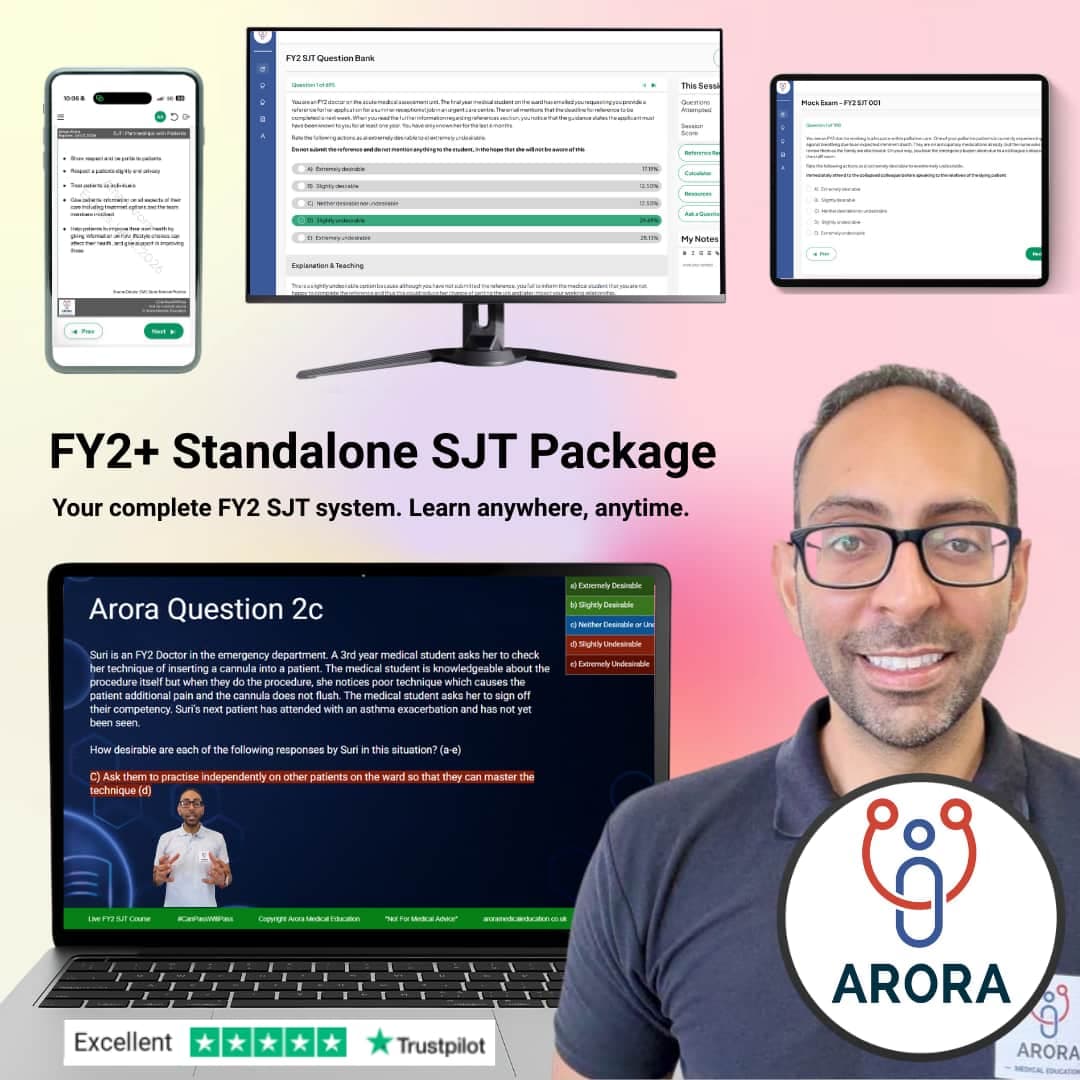
We have plenty of FY2 SJT practice questions in our Question Bank – part of our FY2 SJT+ Preparation Package. An example question can be seen below:
You are an FY2 doctor on a busy colorectal ward. One of the FY2 doctors on your ward has called in sick today for his day shift and is meant to be on annual leave from tomorrow. However, later that evening on social media you see from a mutual friend’s Facebook photos that he is now on holiday in France.
Rate the following action from a) Extremely desirable to e) Extremely undesirable.
1) Comment immediately on the post sarcastically stating he does not look sick in the photos
This is a slightly undesirable option as it does nothing in the immediate setting to escalate this to your consultant or find out more about when he travelled.
2) Ensure you take a sick day yourself in this rotation to leave your colleague with a greater workload
This is an extremely undesirable option as you fail to act on his unprofessional behaviour and also lack any integrity yourself by doing the same thing. It has the greatest risk to patient safety as by calling in sick you are also leaving the ward potentially understaffed
3) Inform your consultant about the post the following day
This is a slightly desirable option as it escalates his behaviour in a timely manner to the consultant, who is in an appropriate position to commence disciplinary procedures. However, it would have been better to confirm what took place by discussing with your colleague in the first instance.
4) Take a picture on your phone of the post in case it gets deleted, and message your colleague stating you are aware of his lie and are considering reporting it
This is slightly desirable as although you are making your colleague aware that his behaviour has not gone unnoticed and keeping the photo as evidence; you fail to escalate this to your consultant and only ‘consider’ reporting it.
5) Report him directly to the GMC for unprofessional conduct
This is neither desirable or undesirable as you are acting directly on your concerns but they are drastic. It would be better to escalate this initially on a local level, so your team are aware of his wrongdoing. Escalating to the GMC would be more appropriate if you were certain that he travelled during his working hours and had not felt that the department locally dealt with the issue.
We offer live teaching using sample questions in our live SJT course – this is also part of the Arora FY2 SJT + Preparation Package.
Watch-back recent FY2 SJT Booster Webinar here
F2 Interview process
If successful in the SJT assessment, applicants will be invited to book for an interview. This is carried out virtually via Microsoft Teams.
Applicants will need to ensure they have adequate facilities to undertake the interview as technical issues will not be excusable and they will not be allowed to rebook the interview. It is advisable that applicants are available 20 minutes before the interview to allow time for registration and identification processes.
The interview itself will last approximately 20 minutes. There will be two people in the panel who are familiar with the assessment process and curriculum for the Foundation programme. At least one person on the panel will be a clinician.
The interview usually consists of a discussion around the applicant’s CV, a clinical scenario and a general discussion about you as an individual. It is therefore advisable to know your CV inside out prior to the interview.
Following the interview, those with satisfactory scores will then be invited to preference the individual Foundation programmes across the Foundation schools.
We run one-to-one Mock FY2 Interviews in the few weeks before the real interviews run. Contact us if you would like more information or if you would like to book.
How Arora can help with F2 SJTs
Clear Teaching Built for Busy Doctors
If you want a guided path, our FY2 Standalone resources help you build confidence at each step. Everything is created by senior UK doctors with experience in the exam and in teaching.
You can choose:
– FY2 SJT+ – a full FY2 SJT preparation system with question banks, mocks, live teaching and flashcards.
– A live FY2 SJT Crammer course held a few weeks before the exam.
– FY2 Mock Interview held a few weeks before the FY2 interviews.
Each option follows a clear plan that helps you stay organised and focused. Explore these more here.
Also:
– Get FY2 Updates and Teaching Emails here.
– Register for next Free FY2 Webinar here
In Conclusion
Given the exams that you have passed already, you have enough skills and knowledge to pass the FY2 assessment. Like any exam, however, it does need a focused approach and appropriate practice.
We’re always happy to answer questions so feel free to get in touch if needed. We hope that the Arora FY2+ package can help in your preparation and wish you every success in your application
Finally we would like to wish you every success and hope we can help you prepare for success in the F2 standalone programme!

Author Bio — Dr Aman Arora
Hi! I’m Dr. Aman Arora, a Portfolio GP with over a decade of clinical and teaching experience, dedicated to helping doctors achieve their goals with confidence. Having had the privilege of supporting more than 50,000 doctors worldwide across exams such as MRCGP AKT, SCA, MSRA, PLAB 2 and PLAB 1, I understand the challenges you face and the strategies needed to overcome them. Through personalised face-to-face sessions, engaging online courses, mocks, audio and a vibrant social media community, we’re here to guide you every step of the way.
Whether you’re looking to pass crucial exams or take the next big step in your medical career, we’re here to help you succeed. Feel free to get in touch with any thoughts, questions, or ideas — I look forward to working with you and being part of your journey.

Author Bio — Dr Pooja Arora
Dr Pooja Arora is a GP with a background in Medical Politics, where she passionately focuses on improving the opportunities and working conditions for junior doctors. She is proud to hold FRCGP (Fellow of Royal College of General Practitioners).
You can find out more about Pooja’s previous roles and qualifications here.