


Core Surgical Training In The UK | CST | A Guide
If you are a junior doctor planning to apply for UK Core Surgical Training (CST), this guide is for you.
Core Surgical Training is a highly competitive programme and requires early, structured preparation. Applications are now closely linked to performance in the MSRA, alongside portfolio evidence and interview performance. Many doctors underestimate how early these elements need to come together.
In this blog, we explain:
– What CST actually involves
– Who is eligible to apply
– How the application and interview process works
– How the MSRA fits into CST selection
– What you should be doing now to prepare effectively
This overview is based on current official NHS England recruitment guidance and reflects how CST is assessed and selected in real terms, not assumptions or outdated advice. We suggest also checking regularly for official updates here as information can change at short notice.
Whether you trained in the UK or overseas, understanding the CST pathway clearly will help you plan realistically and avoid common mistakes that cost applicants places each year.
– Join National MSRA WhatsApp teaching group here
– Get MSRA Updates and Teaching Emails here
– Register for next Free MSRA Webinar here
– Pass with MSRA Ultimate Package here
Understanding Core Surgical Training
Core Surgical Training (CST) is the structured, two-year training programme that forms the foundation of a surgical career in the UK.
It is a highly competitive national programme, with demand consistently exceeding the number of available posts. In most recruitment rounds, all CST places are filled, which means applicants need to prepare early and strategically.
CST runs over two years, CST1 and CST2, and is designed to:
– Develop core surgical knowledge and technical skills
– Build clinical judgement and decision-making in surgical settings
– Provide exposure to a range of surgical specialties
– Prepare trainees for competitive entry into ST3 specialty training
During CST, trainees rotate through different surgical placements, allowing them to gain experience across specialties such as general surgery, orthopaedics, urology, vascular surgery and others, depending on the rotation structure.
A key aim of CST is to help trainees confirm their intended surgical specialty and build the portfolio, experience and competence required for the next stage of training.
The role of MSRA in CST
The MSRA now plays a central role in Core Surgical Training recruitment. Performance in the MSRA is used as part of the shortlisting and selection process, alongside portfolio evidence and interview performance.
This means CST preparation is no longer just about surgical exposure or portfolio points. Strong MSRA preparation is essential and should be factored into your CST planning well in advance of application.
How does Core Surgical Training Work?
Core Surgical Training is a two-year programme structured around a series of supervised surgical placements designed to build breadth, competence and progression-readiness.
Most CST programmes consist of six placements of four months each, giving exposure to a range of surgical environments. Depending on the rotation, these may include specialties such as general surgery, trauma and orthopaedics, urology, vascular surgery, plastics or other surgical disciplines.
Across these placements, trainees are expected to develop experience in:
– Acute and elective inpatient care
– Outpatient clinics
– Theatre-based surgical procedures
– On-call and emergency surgical work
The focus is not just technical skill, but also decision-making, prioritisation and safe management of surgical patients in NHS settings.
Themed versus non-themed CST programmes
Some CST posts are themed, meaning a greater proportion of training time is concentrated within a particular specialty group. These programmes usually offer 12 to 18 months of experience aligned to a chosen specialty, such as general surgery or orthopaedics, alongside related sub-specialties.
Non-themed CST programmes provide broader exposure, with rotations across multiple surgical specialties, typically in four- or six-month blocks. This route is often preferred by applicants who are still exploring their long-term specialty choice.
Examinations during CST
Progression through CST requires completion of the Membership of the Royal Colleges of Surgeons (MRCS) examinations.
– MRCS Part A is expected to be passed during Core Surgical Training
– MRCS Part B must be passed before entering ST3 specialty training
These exams are a key requirement for progression and should be factored into CST planning early, alongside portfolio development and MSRA preparation.
Eligibility for CST Application
Eligibility criteria for Core Surgical Training are slightly different from many other specialty training programmes, particularly around prior experience and career progression. It is important to check these carefully, as applications that do not meet eligibility requirements are rejected automatically.
Essential eligibility criteria
To be eligible to apply for CST, you must:
– Hold an MBBS, MBChB or equivalent primary medical qualification
– Be eligible for full GMC registration and hold a licence to practise by the time the training post starts
– Have completed foundation-level competencies within the 3.5 years preceding the advertised start date
This includes:
a) A minimum of 12 months of post-licensing medical experience
b) Evidence that you are ready to enter specialty training, demonstrated by either:
– Completion of the UK Foundation Programme, or
– A fully signed Certificate of Readiness to Enter Specialty Training (CREST) for applicants outside the UKFP (CREST confirms that you have achieved competencies equivalent to UK foundation training.)
Career progression requirements
Applicants must also demonstrate appropriate career progression, including:
– A complete and transparent employment history
– No more than 18 months’ experience in surgical specialties (excluding UK Foundation placements) by the time of application
This rule is strictly applied and is one of the most common reasons otherwise strong applications are deemed ineligible.
Important guidance for International Medical Graduates (IMGs)
For IMGs who have completed surgical posts outside a UK Foundation Programme, the following rule is particularly important:
– Only 12 months of surgical experience can be counted as foundation-equivalent experience.
– Any additional surgical experience beyond this will count toward the 18-month surgical experience cap.
In practical terms:
– The first 12 months of post-internship surgical work may count as FY2-equivalent
– Any surgical experience beyond 12 months contributes to the maximum 18-month limit
Exceeding this limit will make you ineligible for CST, regardless of portfolio strength or exam performance.
The Recruitment Process
Core Surgical Training recruitment is run nationally through NHS England specialty recruitment and takes place once per year as part of the standard specialty recruitment cycle.
There may be a Round 1 re-advert if posts remain unfilled after the main round. However, because CST is highly competitive, the majority of posts are filled in the initial recruitment round, and re-advert rounds are often limited or not required.
Applications are submitted via Oriel, followed by shortlisting, interview and final ranking.
CST and progression to higher surgical training
For most surgical specialties, Core Surgical Training is followed by competitive entry at ST3 into Higher Specialty Training. This means that after completing CST, trainees must apply again for ST3 posts in their chosen specialty.
However, a small number of run-through surgical programmes exist. These allow trainees to enter at an earlier stage and progress through training without reapplying at ST3, provided progression requirements are met.
Surgical run-through training pathways
Current run-through or integrated pathways include:
– Neurosurgery
– Cardiothoracic surgery (with thoracic surgery typically entered at ST4)
– Academic surgery (themed academic pathways)
– Oral and Maxillofacial Surgery (with both ST1 and ST3 entry routes available, depending on pathway)
Availability and structure of run-through programmes can change, so applicants should always confirm details on the official recruitment website before applying.
Higher Specialty Training after CST
Following successful entry at ST3, Higher Specialty Training typically runs from ST3 to ST8, lasting five to six years, depending on the specialty.
During higher training:
– Trainees progress through increasing levels of responsibility
– Subspecialty interests are usually refined later in training, often around ST6, depending on specialty requirements
Completion of training leads to the award of a Certificate of Completion of Training (CCT), allowing entry onto the Specialist Register.
Exit examinations
All surgical trainees are required to complete the Fellowship of the Royal College of Surgeons (FRCS) examinations relevant to their specialty.
– FRCS examinations are typically completed during higher specialty training
– Both written and clinical components must be passed before CCT can be awarded
Portfolio Self-assessment Score
As part of the CST application process, all applicants must complete a verified portfolio self-assessment.
Although the self-assessment score is no longer used for shortlisting to interview, it remains a significant component of the overall CST ranking, contributing 30% of the final score. This means it still has a direct impact on where you are ranked nationally and which posts you are ultimately offered.
The portfolio reflects the breadth, consistency and progression of your surgical commitment, and strong performance here can make a meaningful difference when interview and MSRA scores are similar.
Changes to the CST self-assessment
From the 2023 recruitment round onwards, several categories were removed from the CST self-assessment. These include:
– MRCS Part A
– Attendance at surgical courses
– Postgraduate qualifications
– Prizes
– Leadership and management roles
Despite these removals, the portfolio remains an important part of the application and has been streamlined into five domains, with a maximum total score of 52 points.
Current self-assessment domains
The five portfolio domains are:
1. Commitment to surgery
2. Quality improvement and clinical audit
3. Presentations and publications
4. Teaching experience
5. Training in teaching
Each domain contributes to your overall portfolio score and helps demonstrate sustained engagement with surgery alongside clinical work.
Important points to note
– Self-assessment scores cannot be amended after submission, under any circumstances
– All evidence must be clearly documented, correctly worded and verifiable
– Poor organisation or missing documentation can lead to loss of points, even if the activity was genuinely completed
In reality, most applicants will have been building their portfolio months or years in advance. Careful preparation, early organisation and attention to detail are essential to avoid losing marks unnecessarily.
For full details, applicants should review the official Core Surgical Training Self-Assessment Scoring Guidance published for the relevant recruitment year.
CST Application Stages
Core Surgical Training applications follow a national recruitment process coordinated through Oriel. While exact dates can vary slightly each year, the structure of the process is consistent and applicants should plan well in advance.
Application opening and deadline
CST applications usually open in late October or early November in the year preceding the August start date. The application deadline is typically in early December.
It is important to note that:
– All portfolio evidence must be completed before the application deadline
– Any activity completed after this date cannot be counted
– Retrospective evidence is not accepted
—————
Stage 1: Submitting an application
Applications are submitted via the Oriel platform, provided eligibility criteria are met.
At this stage, applicants must:
– Complete the online application form
– Declare a self-assessment portfolio score
– Upload a CREST form if applicable (for applicants outside the UK Foundation Programme)
This stage is purely administrative but errors or omissions can lead to rejection later.
Typical timeline: Early November to early December
—————
Stage 2: Longlisting
Following the application deadline, all submissions are checked against minimum eligibility criteria.
Applicants who do not meet eligibility requirements are removed at this stage. Those who meet criteria progress to shortlisting.
Typical timeline: Shortly after applications close
—————
Stage 3: MSRA for CST
Since 2023, shortlisting for CST interviews is based on MSRA performance, replacing the previous use of portfolio self-assessment scores for this purpose.
The MSRA is mandatory for CST applicants and requires dedicated preparation.
The MSRA is a computer-based assessment consisting of two papers:
– Professional Dilemmas (SJT) (50 questions in 95 minutes)
– Clinical Problem Solving (97 questions in 75 minutes)
There is a short scheduled break between papers.
Total testing time is just under 3 hours.
The Professional Dilemmas paper is usually sat first, followed by the Clinical Problem Solving paper.
Typical timeline: MSRA invitations: December, Exam window: January
Only applicants scoring above the CST cut-off are invited to interview. Others may be placed on a reserve list, depending on overall performance.
For a full review of what MSRA is and how to score well, click here.
For a complete MSRA preparation system, click here.
—————
Stage 4: Submitting supporting evidence
Applicants who progress are invited to upload supporting portfolio evidence.
At this stage:
– Evidence is checked against the self-assessment criteria
– Scores may be adjusted up or down following verification
– Applicants receive confirmation of their verified portfolio score
Failure to upload evidence correctly or on time will result in automatic withdrawal.
Typical timeline: Late January to early February
—————
Stage 5: Interview booking and interview process
Eligible applicants are invited to book an interview slot via Oriel.
Interviews are usually conducted online using Microsoft Teams.
CST interview format
The CST interview consists of a single 20-minute station, divided into two sections:
1. Management section (10 minutes)
– A pre-prepared presentation (usually 3 minutes)
– Follow-up questions on the presentation
– One management scenario testing judgement and decision-making
2. Clinical section (10 minutes)
– Two clinical scenarios (around 5 minutes each)
– Commonly includes:
a) An acutely unwell or trauma patient (A–E approach)
b) A ward-based or history-taking scenario with management
Questions may span multiple surgical specialties, so broad preparation is essential.
Typical timeline: Interview booking: February, Interviews: Late February to March
—————
Stage 6: Preferencing and offers
Applicants are invited to rank CST posts in order of preference. Preferencing opens before offers are released and is independent of final interview ranking.
Initial offers are made based on:
– MSRA score
– Interview performance
– Verified portfolio score
Typical timeline: Preferencing: March, Initial offers: Late March
—————
Key planning point
CST recruitment is highly competitive, and each stage carries significant weight. Strong candidates plan portfolio development, MSRA preparation and interview skills in parallel, often 12–18 months in advance.
CST Application Score
Your final Core Surgical Training (CST) ranking is based on a combined score, made up of three components:
– MSRA score
– Verified portfolio self-assessment score
– Interview score
While exact weightings can vary slightly between recruitment years, the interview score carries the greatest weighting, followed by the portfolio self-assessment, with the MSRA contributing a smaller but essential proportion of the final score.
Why the interview matters most
The CST interview is the single most influential component of your overall ranking. Strong interview performance can significantly improve your position on the national list, even among candidates with similar MSRA and portfolio scores.
This is why many applicants who score well on the MSRA still fail to secure their preferred post if interview preparation is weak, while others with solid but not exceptional MSRA scores perform very well overall due to a strong interview.
How offers are made
After all scores are combined:
– Applicants are ranked nationally
– Offers are made in rank order, taking into account post preferences
– Higher-ranked applicants have greater choice of locations and rotations
Because CST is oversubscribed, not all appointable candidates will receive an offer, even if they perform reasonably well across all three components.
Key takeaway
To maximise your chances of securing a CST post, preparation needs to be balanced across all three areas, with particular emphasis on:
– Structured interview preparation
– Early and accurate portfolio evidence
– Targeted MSRA preparation
Strong CST applicants plan these elements in parallel, rather than treating them as separate tasks.
How Arora Medical Education Can Support You
Clear Teaching Built for Busy Doctors
If you want a guided path, our MSRA resources help you build confidence at each step. Everything is created by senior UK doctors with experience in the exam and in teaching.
You can choose:
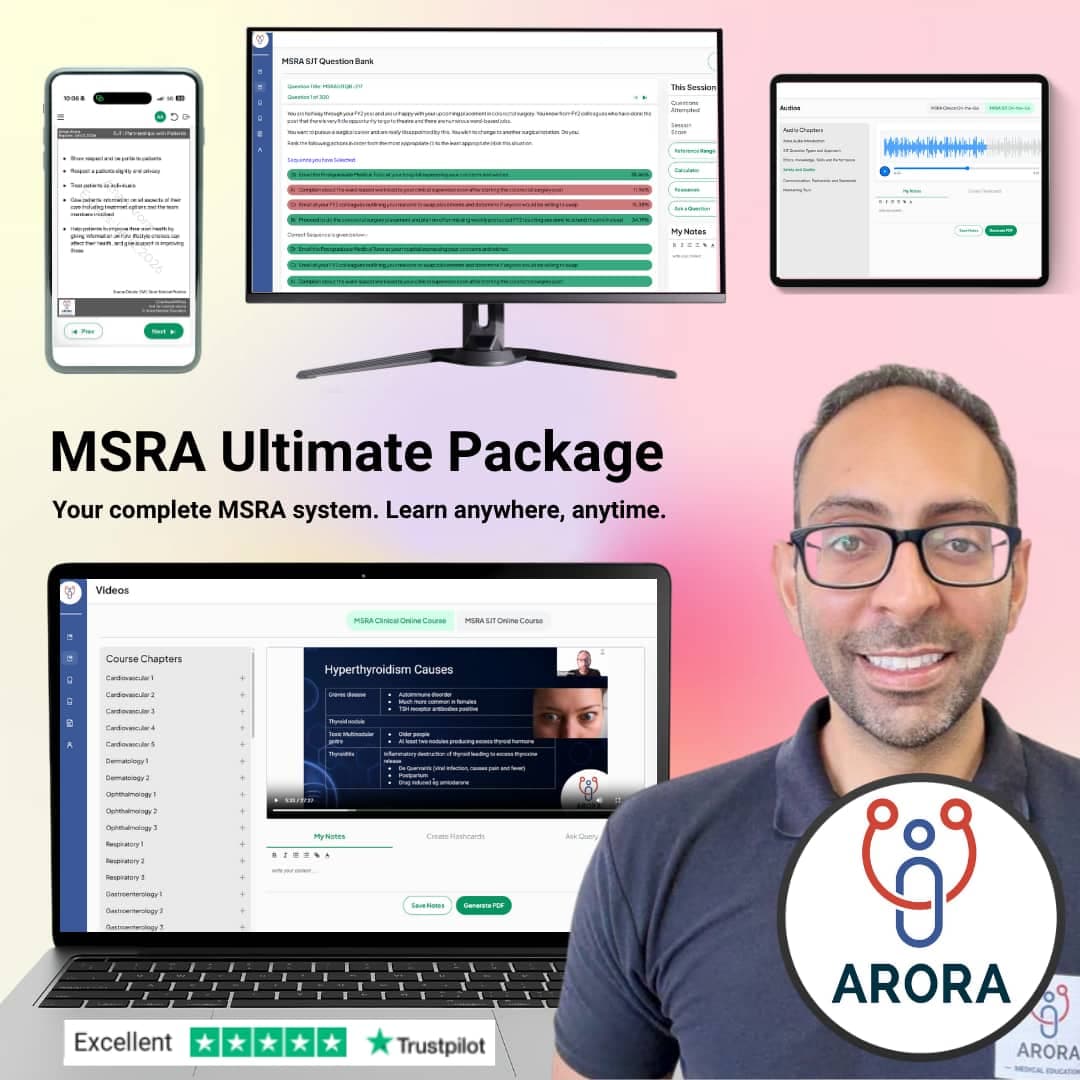
– MSRA Ultimate – a full MSRA preparation system with question banks, videos, audios, live teaching, flashcards and mock exams.
– A live MSRA Crammer course held a few weeks before each sitting.
– Individual resources such as audios, videos, question banks or mocks.
Each option follows a clear plan that helps you stay organised and focused. Explore these more here.
Also:
– Join National MSRA WhatsApp teaching group here
– Get MSRA Updates and Teaching Emails here
– Register for next Free MSRA Webinar here
On a final note
Applying for Core Surgical Training requires early planning, consistency and realistic preparation across every stage of the process.
If you are preparing for a surgical training application, we wish you the very best. With the MSRA now playing a central role in CST recruitment, structured preparation can make a meaningful difference.
We look forward to supporting you through your application journey.
Good luck.
#CanPassWillPass

Lead MSRA Tutor - Dr Aman Arora
Hi! I’m Dr. Aman Arora, a Portfolio GP with over a decade of clinical and teaching experience, dedicated to helping doctors achieve their goals with confidence. Having had the privilege of supporting more than 50,000 doctors worldwide across exams such as MRCGP AKT, SCA, MSRA, PLAB 2 and PLAB 1, I understand the challenges you face and the strategies needed to overcome them. Through personalised face-to-face sessions, engaging online courses, mocks, audio and a vibrant social media community, we’re here to guide you every step of the way.
Whether you’re looking to pass crucial exams or take the next big step in your medical career, we’re here to help you succeed. Feel free to get in touch with any thoughts, questions, or ideas — I look forward to working with you and being part of your journey.

Senior MSRA Tutor - Dr Pooja Arora
Dr Pooja Arora is a GP with a background in Medical Politics, where she passionately focuses on improving the opportunities and working conditions for junior doctors. She is proud to hold FRCGP (Fellow of Royal College of General Practitioners).
You can find out more about Pooja’s previous roles and qualifications here.
Other blogs that may interest you