


Radiology Training in the UK: What it is and How to Apply
Clinical Radiology is one of the most competitive specialty training pathways in the UK. Each year, large numbers of junior doctors apply, drawn by the breadth of clinical work, intellectual challenge, flexible working patterns and long-term career options.
If you are considering applying for Radiology ST1, this guide walks you through the process clearly and honestly. We cover what radiology training involves, who is eligible to apply, how the application works, and where most candidates succeed or fall short. We also explain the central role of the MSRA, which is now the key differentiator in the radiology selection process.
– Join National MSRA WhatsApp teaching group here
– Get MSRA Updates and Teaching Emails here
– Register for next Free MSRA Webinar here
– Pass with MSRA Ultimate Package here
What is Clinical Radiology training?
Clinical Radiology is a five-year specialty training programme (ST1–ST5) leading to a Certificate of Completion of Training (CCT) and entry onto the Specialist Register.
Radiologists are doctors who use imaging to diagnose and increasingly treat disease. This includes:
– Plain X-ray, CT and MRI
– Ultrasound
– Nuclear medicine
– Image-guided interventional procedures
Training combines reporting, procedural skills, clinical decision-making and close multidisciplinary working. During training you will rotate through a wide range of subspecialties such as neuroradiology, musculoskeletal imaging, chest imaging, gastrointestinal radiology and emergency imaging.
Most trainees sit the FRCR examinations during training, which are required for progression and completion.
Why is Radiology so competitive?
Radiology consistently attracts a high number of applicants for several reasons:
– Broad clinical exposure across all specialties
– Predictable working patterns compared with many acute specialties
– Opportunities for flexible, less than full-time and remote working
– Strong consultant demand across the UK
– A mix of diagnostic and procedural work
Because of this, shortlisting is tight, and small differences in application scores can make a big difference to outcomes.
Who can apply for Radiology ST1?
To apply for Clinical Radiology ST1, you must meet standard specialty training eligibility requirements. These include:
– Full GMC registration with a licence to practise by the time training starts
– Evidence of having met UK foundation competencies (either through completion of UK foundation year programme or through evidence of signed the latest CREST form – read about the CREST form here).
– No more than the permitted amount of prior radiology experience (beyond foundation level)
– Must have 12 months medical experience (UK or abroad) after full GMC registration – by the time training is due to start.
International medical graduates can apply provided they meet the same criteria and hold GMC registration.
Eligibility details can change slightly year to year, so it is always worth checking the official NHS England guidance before applying.
How does the Radiology application process work?
Applications for Radiology ST1 are made through Oriel and follow a structured national process.
In simple terms, the process involves:
-
Submitting an online application
-
Sitting the MSRA – a central role in determining who progresses.
-
Shortlisting based primarily on MSRA score
-
Interview
-
Ranking and offers
The MSRA for Radiology – why it matters so much
For Radiology applicants, the Multi-Specialty Recruitment Assessment (MSRA) is the single most important part of the application.
Your MSRA score is used to:
– Determine whether you are invited to interview
– Contribute significantly to your final overall ranking
Each year, a cut-off score is applied. Candidates below this score do not progress further, regardless of portfolio strength or prior experience.
This is where many applicants underestimate the process. Radiology is not a specialty where a strong CV alone can compensate for a weak MSRA performance. A few marks can be the difference between an interview offer and rejection.
The MSRA is a computer based assessment which consists of two types of question papers:
a) Clinical questions (75-minute paper)
b) Professional dilemma questions (95-minute paper)
The total duration of the assessment is just under 3 hours (175 minutes, including break). A 5-minute break occurs between papers (countdown appears on screen). The Professional Dilemma Paper usually happens first and is shortly followed by the Clinical Questions paper.
The Professional dilemma paper (SJT) consists of 50 Situational Judgement Test questions in 95 minutes – this paper occurs first. It tests judgement, professionalism and decision-making in workplace scenarios.
The Clinical problem-solving paper (CPS) consists of 97 clinical questions in 75 minutes – this paper starts 2 minutes after completion of the SJT paper. It tests applied clinical knowledge across a broad range of specialties, at the level expected of a doctor entering specialty training.
Neither paper is radiology-specific. This means applicants must prepare widely and strategically, not just focus on imaging topics.
For full details of the MSRA exam, including example questions click here.
For our comprehensive All-in-one MSRA Ultimate Package click here.
Does the portfolio matter for Radiology?
The role of the portfolio in Radiology applications has reduced over time.
While you are still expected to have a sensible, consistent CV, the portfolio is no longer the primary shortlisting tool. It cannot compensate for a low MSRA score.
This often surprises applicants who have invested years building teaching, audits and publications. Those achievements still have value, but they sit behind MSRA performance in the current system.
The Radiology interview
Candidates who score highly enough in the MSRA are invited to interview.
The interview assesses:
– Clinical reasoning
– Communication
– Professional judgement
– Insight into radiology as a career
Interview performance contributes to final ranking, but it is important to be realistic. If your MSRA score is borderline, even a strong interview may not be enough to secure a post. This is why early, structured MSRA preparation is critical.
Common mistakes Radiology applicants make
Over the years, several patterns come up repeatedly:
– Starting MSRA preparation too late
– Assuming radiology knowledge is the main focus of the exam
– Over-focusing on portfolio work at the expense of exam performance
– Underestimating the Professional Dilemmas paper
– Treating MSRA as a “screening exam” rather than a ranking exam
Radiology selection is competitive precisely because many applicants are strong. Small strategic errors matter.
How Arora Medical Education Can Support You
Clear MSRA Teaching Built for Busy Doctors
If you want a guided path for MSRA, our MSRA resources help you build confidence at each step. Everything is created by senior UK doctors with experience in the exam and in teaching.
You can choose:
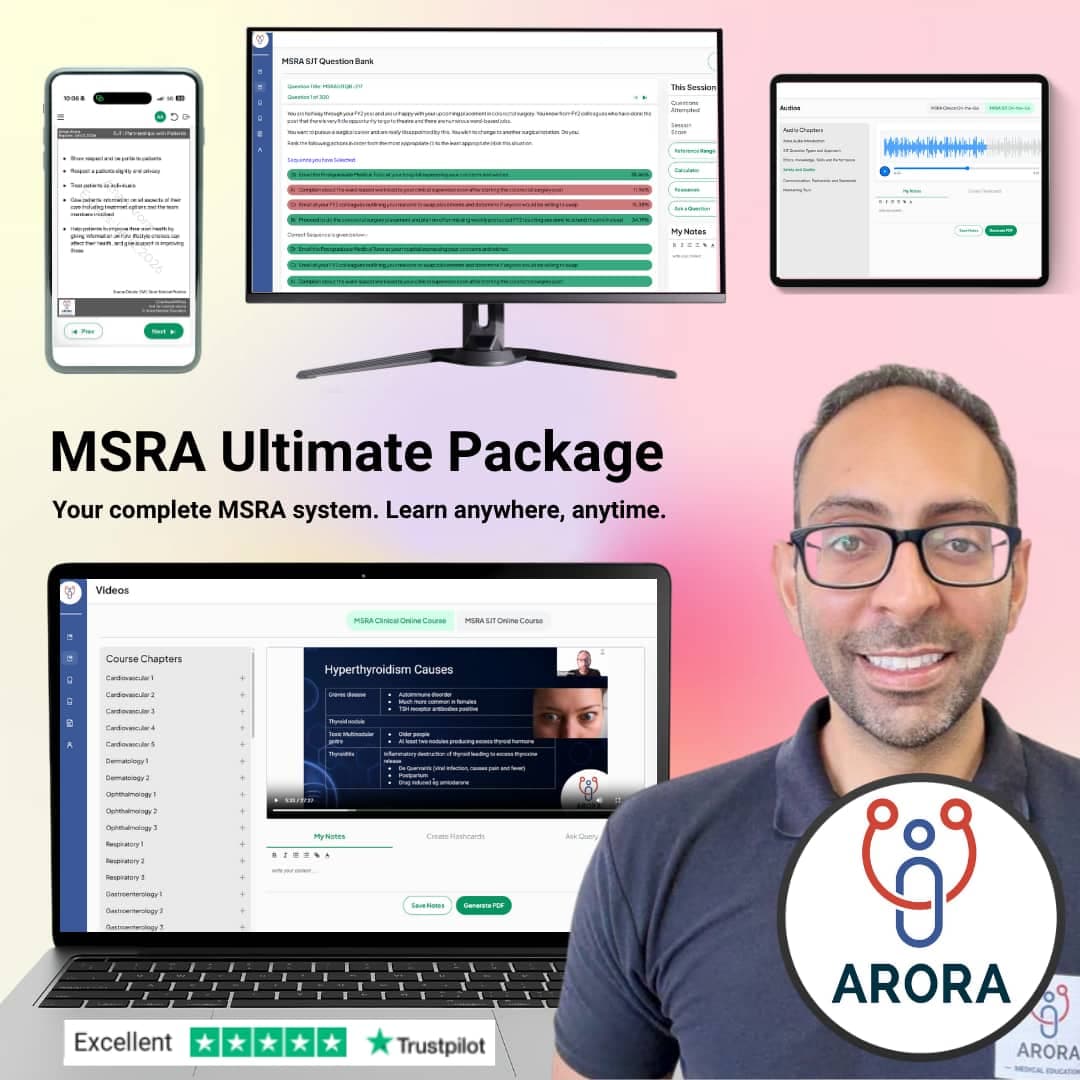
– MSRA Ultimate – a full MSRA preparation system with question banks, videos, audios, live teaching, flashcards and mock exams.
– A live MSRA Crammer course held a few weeks before each sitting.
– Individual resources such as audios, videos, question banks or mocks.
Each option follows a clear plan that helps you stay organised and focused. Explore these more here.
Also:
– Join National MSRA WhatsApp teaching group here
– Get MSRA Updates and Teaching Emails here
– Register for next Free MSRA Webinar here
Other Speciality blogs that may help
Final thoughts
Radiology is an excellent career choice, but it is not one to approach casually. The application process rewards clarity, structure and early preparation, particularly for the MSRA.
If Radiology ST1 is your goal, focus first on performing strongly in the MSRA. Everything else builds on that foundation.
For the most up-to-date eligibility rules and recruitment details, always refer to the official NHS England guidance. And if you want structured support with MSRA preparation, explore our dedicated MSRA resources.
Good luck with your application.
#CanPassWillPass

Lead MSRA Tutor - Dr Aman Arora
Hi! I’m Dr. Aman Arora, a Portfolio GP with over a decade of clinical and teaching experience, dedicated to helping doctors achieve their goals with confidence. Having had the privilege of supporting more than 50,000 doctors worldwide across exams such as MRCGP AKT, SCA, MSRA, PLAB 2 and PLAB 1, I understand the challenges you face and the strategies needed to overcome them. Through personalised face-to-face sessions, engaging online courses, mocks, audio and a vibrant social media community, we’re here to guide you every step of the way.
Whether you’re looking to pass crucial exams or take the next big step in your medical career, we’re here to help you succeed. Feel free to get in touch with any thoughts, questions, or ideas — I look forward to working with you and being part of your journey.

Senior MSRA Tutor - Dr Pooja Arora
Dr Pooja Arora is a GP with a background in Medical Politics, where she passionately focuses on improving the opportunities and working conditions for junior doctors. She is proud to hold FRCGP (Fellow of Royal College of General Practitioners).
You can find out more about Pooja’s previous roles and qualifications here.