


Finding Your First NHS Job After PLAB: A Practical Guide for IMG Doctors
If you have recently passed UKMLA PLAB 2, or you are waiting on your GMC registration to come through, the question on your mind is probably a simple one: how do I actually get my first NHS job. It is a question that comes loaded with a lot of noise. Forums full of conflicting opinions, friends who had very different experiences to one another, and right now, genuine uncertainty caused by the Medical Training (Prioritisation) Act 2026 and what it might mean for doctors like you.
This guide is written to cut through that noise. It will not tell you that getting a job is effortless, because for some doctors it is not. It will not tell you to panic either, because for the vast majority of properly registered, properly prepared doctors, a first NHS job is genuinely achievable. What it will do is walk you through what actually determines how quickly you find a post, what level of job realistically suits where you are right now, where to actually look, what the Prioritisation Act does and does not affect, and what you can do practically to strengthen your chances.
There is no single correct path here. Your situation, your registration status, your flexibility on location and specialty, and your long-term goals will all shape what the right next step looks like for you.
A quick note before we start: this guide is general information, written to help you understand your options and think through your own job search. It is not individual career, legal or immigration advice, and it is not a substitute for guidance from your GMC registration team, a qualified immigration adviser, the HR or international recruitment team at the Trust you are applying to, or a reputable recruitment agency where relevant to your situation. Employment practice, visa rules and NHS recruitment policy, including the Medical Training (Prioritisation) Act 2026, change relatively often, so always check the current position with the relevant official source before making decisions about your own career.
– Join National MSRA WhatsApp teaching group here
– Get Exam Updates and Teaching Emails here
What Determines How Quickly You Find Your First NHS Job
There is a persistent myth that getting a first NHS job is either impossible or guaranteed, depending on which corner of the internet you happen to be reading. Neither is true. What is true is that the NHS has a continuous, ongoing need for doctors at SHO and Trust Grade level, particularly outside of London and the South East, and that doctors who are realistic and flexible tend to find a post considerably faster than those who are not.
How easily you secure a job depends heavily on your own circumstances. If you are open to relocating anywhere in the UK, your pool of available jobs expands enormously compared to someone who is fixed on one city. If you are flexible on specialty in your first post, rather than holding out for one particular department, you will see far more live vacancies. Full-time availability also opens more doors than part-time, simply because more posts are advertised as full-time. And if you can be flexible on starting salary expectations, at least for this first post, you will not be filtering yourself out of large numbers of suitable roles.
None of this means you should take a job that makes you miserable. It means being honest with yourself about which of your preferences are genuinely non-negotiable, and which ones you are willing to flex on to get your career in the UK moving. Moving to a new country is stressful enough without adding unnecessary friction to your own job search.
What Level of NHS Job Should You Apply For After PLAB 2
One of the most common sources of confusion for newly registered IMG doctors is simply understanding the different job titles used across the NHS, and which ones are realistically open to you.
A Foundation Year doctor (FY1 or FY2) is a doctor within the formal two year UK Foundation Programme. FY1 doctors have just graduated from medical school with no prior independent clinical responsibility, while FY2 doctors have completed FY1 and have a year of UK clinical experience behind them. As an IMG, you would only enter this route through specific channels such as the UKFPO eligibility process and National Clinical Assessment (NCA), or through FY2 Standalone recruitment if you meet the criteria, which we cover further down.
A Trust Grade doctor, sometimes called a Locally Employed Doctor or LED, is a non-training post employed directly by an individual NHS Trust rather than through a national training programme. These posts are advertised at a specific level, commonly equivalent to FY2 or SHO level for newly registered IMGs, and the responsibilities expected of you will match that level. Trust Grade posts are one of the most realistic and common entry points for IMG doctors immediately after PLAB 2, precisely because they are recruited locally by individual Trusts rather than through a single national competitive process.
A Clinical Fellow post is broadly similar to an SHO or Trust Grade role, but typically includes an academic, teaching, audit or quality improvement element alongside clinical duties. Junior clinical fellow posts are a realistic option for newly registered doctors, while senior clinical fellow posts usually expect at least ST3-level experience.
SHO (Senior House Officer) is a general term covering any doctor from FY2 level up to ST3 or registrar level, and you will see it used loosely across job adverts. Always read the actual person specification rather than relying on the job title alone, since the expected level of responsibility can vary.
ST or CT (Specialty Trainee or Core Trainee) posts are doctors who have completed the Foundation Programme (or an equivalent recognised through the CREST form) and have entered formal specialty training through national recruitment, run via Oriel and increasingly tied to MSRA performance. This is not where most IMGs start immediately after PLAB 2, but it is very often where the journey leads next.
SpR (Specialist Registrar) and Consultant or GP sit further along the pathway, representing senior trainee and fully qualified senior doctor level respectively.
For the overwhelming majority of doctors reading this immediately after PLAB 2, the realistic and sensible starting point is a Trust Grade or junior Clinical Fellow post at FY2 or SHO level. This is not a lesser route. It is simply the entry point that matches your current UK clinical experience, and it is also the route that gives you the UK referees, UK clinical exposure and confidence that will strengthen any future application into formal specialty training.
If you completed an internship or first postgraduate year overseas that gave you competencies equivalent to Foundation Year 1, but you have not done a UK Foundation Programme, it is worth reading our separate guide on the FY2 Standalone Programme, which explains the eligibility criteria, the application process and how the situational judgement test fits in. This route is not open to everyone, and like the wider Foundation Programme it falls within the scope of the Medical Training (Prioritisation) Act 2026, which we explain fully below. But for those who do qualify, it can be a faster way into a formally recognised foundation level post.
Where to Find NHS Job Vacancies as an IMG Doctor
The official, free, national starting point is NHS Jobs. This is where the vast majority of NHS vacancies are advertised, and you can filter by specialty, location, grade and contract type. In practice, many Trusts process the actual application and shortlisting through their own recruitment system, most commonly Trac, accessed via apps.trac.jobs, so do not be surprised if a vacancy on NHS Jobs redirects you there to complete your application. There is no cost to apply through either system.
Beyond the national job board, it is worth checking individual Trust career pages directly, particularly for Trusts in areas you would consider relocating to, since not every vacancy gets equal visibility on the national site. BMJ Careers is another long established and reputable source, particularly for SHO, clinical fellow and more senior posts.
Many Trusts also operate their own staff bank, sometimes coordinated through NHS Professionals, which allows you to pick up bank or locum shifts directly with the Trust once registered, without paying any agency fee. This can be a genuinely useful way to gain UK clinical experience and build local relationships while you continue applying for substantive posts.
Do not underestimate informal networks either. There are large, active Facebook and WhatsApp groups specifically for IMG doctors, where members share live vacancies, discuss specific Trusts and hospitals, and answer practical questions about relocation, accommodation and the realities of particular departments. These communities, including the ones we run ourselves, are often where doctors first hear about vacancies before they reach the wider public job boards.
Should You Use a Recruitment Agency to Find an NHS Job
This is one of the most common questions we are asked, and the honest answer is that there is no strong evidence either way that using an agency increases your chances of securing an NHS job. Plenty of doctors find good first posts entirely on their own, applying directly through NHS Jobs and Trac. Equally, a good agency can genuinely help, particularly if you are applying from overseas and want support navigating relocation, visa sponsorship logistics, or simply someone proactively matching you to live vacancies that suit your profile.
If you do decide to use an agency, read their terms and conditions carefully before signing up, and be clear about any fees involved, since arrangements vary considerably between agencies. Ask how they assess and place candidates, since some use an initial assessment centre or interview before putting you forward for roles, while others work differently. Be upfront with any agency about the type of post, location and specialty you are aiming for, so they are not wasting your time, or theirs, on mismatched opportunities. An agency is a tool that can sit alongside your own direct applications. It should not replace them.
What the Medical Training Prioritisation Act 2026 Means for Your Job Search
A great deal of anxiety among IMG doctors right now centres on the Medical Training (Prioritisation) Act 2026, which received Royal Assent and became law in March 2026. It is worth being precise about what this Act actually covers, because the headlines have often been more alarming than the reality for doctors in your position.
The Act applies specifically to national recruitment into the UK Foundation Programme, including FY2 Standalone, and into specialty or core training posts, meaning the formal, centrally run competitions advertised through Oriel. Within those processes, UK and Irish medical graduates, along with certain other defined priority groups, were given priority at the point offers were made for the 2026 round, with this extending to shortlisting as well from the 2027 application round onwards.
What the Act does not change is GMC registration or the PLAB pathway itself. It also does not apply to non-training NHS posts such as Trust Grade, Locally Employed Doctor, Clinical Fellow or locum positions, which continue to be recruited directly by individual Trusts on merit, exactly as they were before the Act. NHS England has been explicit that international medical graduates continue to have opportunities in these locally employed roles. For the large majority of IMG doctors using this blog as their starting point, immediately after PLAB 2, this distinction matters enormously. Your realistic first step, a Trust Grade or Clinical Fellow post, sits entirely outside the scope of what this legislation changes.
Where the Act becomes more relevant is further down the line, when you come to apply for formal specialty training through national recruitment, or if FY2 Standalone is part of your plan. We have written a separate, detailed and regularly updated guide on exactly what the Medical Training (Prioritisation) Act 2026 means for IMG doctors, covering the priority groups, the 2027 changes, and what is and is not yet confirmed. It is worth reading in full once you are ready to think about that next stage, rather than relying on secondhand summaries or social media headlines. As with the rest of this guide, treat it as background understanding rather than a basis for a final decision, and check NHS England’s own published guidance for the latest position, since the detail of the 2027 rules is still being finalised through regulations.
What You Need Before You Can Start Working as a Doctor in the NHS
Before accepting and starting any NHS post, there are several checks every Trust will require, and it is worth understanding these in advance so nothing catches you by surprise.
– Full GMC registration with a licence to practise. You can apply for and accept job offers before this comes through, but your actual start date must fall after registration is confirmed, unless you are doing an unpaid clinical attachment purely to shadow and observe.
– An enhanced DBS check. Most Trusts will arrange this for you once you accept a post, though processing time can vary.
– Occupational health clearance, including evidence of relevant immunisations.
– Right to work in the UK. If you require sponsorship, this means a valid Certificate of Sponsorship from the Trust. Visa rules and salary thresholds for sponsored roles are reviewed periodically by the Home Office, so check the current position on GOV.UK or with the Trust’s HR team rather than relying on what was true even a few months ago.
– References covering recent employment history, typically the last three years, including from your current or most recent employer.
Build extra time into your planning around these steps, particularly visa sponsorship and right to work checks, since timelines can vary by Trust and are generally outside your direct control once submitted.
How to Strengthen Your NHS Job Application
A strong NHS application is built around the specific person specification attached to each post, not a generic CV sent out unchanged to every vacancy. NHS supporting statements and interview questions are typically scored against named criteria, so directly addressing each one, with a concrete example, will consistently outperform a well-written but generic application.
If you have the opportunity to complete a short clinical attachment or observership before applying, even a couple of weeks, it can be genuinely valuable. It gives you a UK clinical referee, direct familiarity with how UK wards and consultations actually run, and something specific and current to discuss at interview. It is not a requirement, and plenty of doctors secure good posts without one, but where it is feasible it tends to make a real difference to confidence and to the strength of an application.
Prepare for the interview format itself, which in the NHS commonly uses structured, scenario-based questions around clinical governance, patient safety, teamwork and professionalism, often assessed using a framework similar to the situational judgement principles tested in the MSRA. Practising clear, structured answers, rather than long unstructured narratives, tends to score better with NHS panels.
Finally, apply broadly rather than narrowly in the early stages. Submitting applications to a wider geographic spread of Trusts, rather than waiting for the perfect post in one specific city, is consistently one of the most effective ways to shorten the time it takes to secure that first offer.
What Comes After Your First NHS Job: MSRA and Specialty Training
Your first NHS job is rarely the end point. For most IMG doctors, it is the platform that builds the UK clinical experience, references and confidence needed to move into formal training.
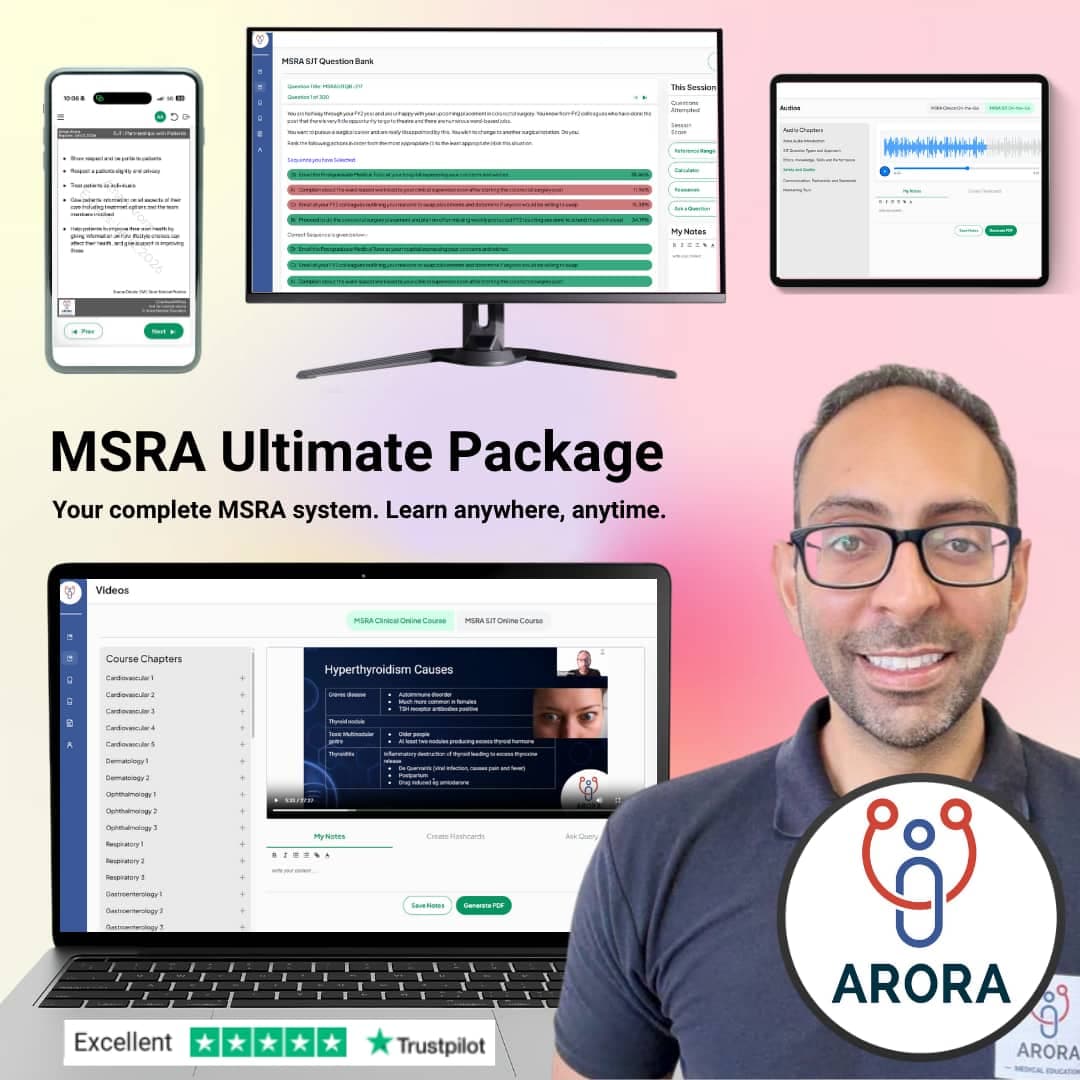
If your longer-term goal is specialty training, including routes such as Core Surgical Training, Emergency Medicine, Psychiatry or GP training, the MSRA sits at the centre of that next stage for the large majority of specialties. It is worth understanding early what the exam actually tests and how scoring works, since for some specialties, GP training in particular, your MSRA score does not just shortlist you for interview, it can directly determine which training post and location you are offered. Our guide on what the MSRA is and how to prepare covers this in detail, and our MSRA preparation course is built specifically around both papers.
If GP training is the direction you are heading in, our separate guide on how to get into UK GP training as an IMG doctor walks through that pathway in more detail.
Common Questions IMG Doctors Ask About Finding Their First NHS Job
Can I apply for jobs before my GMC registration is complete? Yes. Many IMG doctors begin applying as soon as they have passed PLAB 2, while registration is being processed. Your offer can be conditional, but your actual start date must come after full registration is confirmed, unless the role is an unpaid clinical attachment.
What is the real difference between a Trust Grade post and a Clinical Fellow post? In practice, the day to day clinical responsibilities are often very similar at the same grade. The main distinction is that Clinical Fellow posts usually include a defined academic, teaching, audit or research component built into the role, whereas Trust Grade posts are typically purely clinical. Always check the specific job description rather than assuming based on title alone.
Do I need UK clinical experience before I can get my first NHS job? No, it is not a formal requirement. A clinical attachment or observership can strengthen an application by giving you a UK referee and familiarity with UK systems, but many doctors secure their first NHS post without one.
Is locum or bank work a sensible way to start? For some doctors, yes. Picking up shifts through a Trust’s own staff bank can be a low-commitment way to gain UK experience, build local references and get a genuine feel for a department, before committing to a substantive post, whether at that Trust or elsewhere.
How long does it typically take to find a first NHS job as an IMG? This varies considerably and depends heavily on your flexibility around location, specialty and start date. Doctors who apply broadly across multiple Trusts and remain open on specialty tend to move considerably faster than those targeting one specific city or department.
Does the Prioritisation Act affect my chances of getting a Trust Grade or Clinical Fellow job? No. The Act applies to national Foundation Programme and specialty training recruitment. Trust Grade, Locally Employed Doctor, Clinical Fellow and locum posts are recruited directly by individual Trusts and are not within the scope of the Act.
Other Blogs That May Help
– Medical Training (Prioritisation) Act 2026 – What IMG Doctors Need to Know
– F2/FY2 Standalone Programme: Application Guide and How to Prepare
– What is the MSRA Assessment and How to Prepare
– How to Get Into UK GP Training as an IMG Doctor
– UKMLA PLAB 2 Exam: What It Is and How to Prepare
– What to Do After Passing UKMLA PLAB 1

Author Bio — Dr Aman Arora
Hi! I’m Dr. Aman Arora, a Portfolio GP with over a decade of clinical and teaching experience, dedicated to helping doctors achieve their goals with confidence. Having had the privilege of supporting more than 50,000 doctors worldwide across exams such as MRCGP AKT, SCA, MSRA, PLAB 2 and PLAB 1, I understand the challenges you face and the strategies needed to overcome them. Through personalised face-to-face sessions, engaging online courses, mocks, audio and a vibrant social media community, we’re here to guide you every step of the way.
Whether you’re looking to pass crucial exams or take the next big step in your medical career, we’re here to help you succeed. Feel free to get in touch with any thoughts, questions, or ideas — I look forward to working with you and being part of your journey.

Author Bio — Dr Pooja Arora
Dr Pooja Arora is a GP with a background in Medical Politics, where she passionately focuses on improving the opportunities and working conditions for junior doctors. She is proud to hold FRCGP (Fellow of Royal College of General Practitioners).
You can find out more about Pooja’s previous roles and qualifications here.